
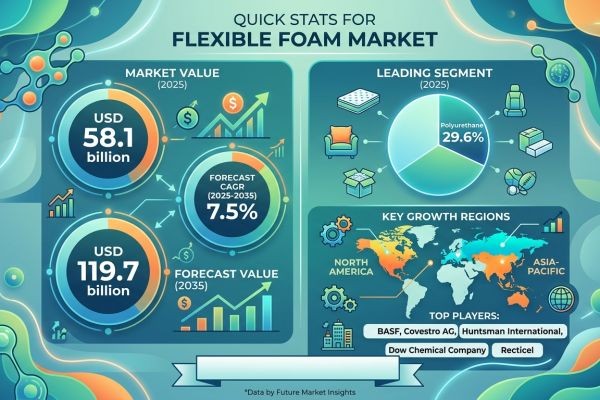
The global flexible foam market is projected to witness strong expansion over the next decade, supported by growing application areas and rising industrial production across major economies. The market is expected to grow steadily, reaching approximately USD 119.7 billion by 2035, registering a CAGR of 7.5%, according to the latest analysis by Future Market Insights (FMI).
Market growth is being shaped by increasing demand in bedding and furniture, rising automotive production, and rapid adoption of advanced chemical formulations. Flexible foams have evolved from basic cushioning into highly engineered materials essential for comfort, safety, and acoustic insulation across multiple sectors. While traditional applications continue to dominate installations, manufacturers are increasingly integrating advanced systems such as bio-based and high-resilience foams to comply with modern environmental expectations and improve product performance outcomes.
Global Flexible Foam Market Snapshot (2025–2035)
- Market size outlook toward 2035: USD 119.7 billion
- Forecast CAGR: 7.5%
- Dominant material category: Polyurethane (29.6% market share)
- Fastest-growing segment: Furniture & upholstery (~31.2% market share)
- Key growth regions: North America, Asia-Pacific, Europe
- Primary demand channel: OEM integration and industrial manufacturing
Momentum in the Market
Beginning from steady regional adoption levels, the global flexible foam market demonstrates accelerated growth throughout the forecast period as comfort compliance becomes crucial across multiple industries. Between 2026 and 2035, expanding real estate development and rising middle-class disposable income are expected to significantly boost demand for integrated cushioning systems.
Increasing urbanization and higher construction activity are encouraging governments and manufacturers to prioritize thermal and acoustic protection technologies. From 2035 onward, innovation in intelligent foam processing and integration with advanced driver-assistance systems (ADAS) inside vehicles is expected to further strengthen market expansion. Smart foams capable of adapting density based on weight distribution and usage intensity are emerging as key differentiators in new consumer models.
The Reasons Behind the Market’s Growth
Demand for flexible foam globally is rising due to multiple structural and technological factors reshaping the regional industrial ecosystem.
- Stringent Flammability and Chemical Safety Regulations: Governments across various nations are enforcing mandatory safety standards to reduce fire hazards and VOC emissions. Foams are increasingly becoming a non-negotiable component in certified material processes.
- Growing Furniture Production and Bedding Sales: Rapid expansion of consumer product hubs, particularly in emerging countries, is driving large-scale industrial adoption of flexible cushioning.
- Rising Consumer Comfort Awareness: Consumers are prioritizing products equipped with advanced ergonomics, accelerating adoption across residential and commercial settings.
- Automotive Industry Expansion: The rise of lightweight vehicles is creating demand for redesigned seating systems tailored to interior cabin comfort and vibration dampening requirements.
Top Segment Application Type
Furniture and Upholstery Leads Market Demand Furniture and upholstery account for the majority of flexible foam installations across global markets, supported by increasing private housing ownership and regulatory mandates requiring high-performance components in new setups.
Material and Sector Analysis
- Polyurethane: ~29.6% market share driven by universal adoption in cushions and mattresses.
- Furniture & Upholstery: ~31.2% market share supported by global real estate and hospitality growth.
- Automotive Seating: Holds a vital 20% demand share for lightweight and vibration-absorption utilities.
- Packaging & Medical: Emerging sectors providing protective casing and wound-care solutions.
Regional Development: Global Manufacturing Ecosystem Drives Expansion
The global production infrastructure is rapidly evolving into a massive hub for specialized polymer components, supported by cost-efficient processing and expanding supply networks.
- North America: Regional innovation leader focusing on eco-compliant and bio-based foam products.
- Asia-Pacific: Expanding manufacturing assembly and heavy demand from rapidly growing urban centers.
- Europe: Driven by stringent circular economy regulations and high-end automotive integration.
Localized manufacturing partnerships between global suppliers and regional chemical processors are improving cost efficiency while accelerating innovation and technology adoption.
Challenges, Trends, Opportunities, and Drivers
Drivers
- Mandatory vehicle and building safety regulations
- Rising urban household ownership and infrastructure development
- Increasing ergonomics and personal comfort awareness
- Expansion of bio-derived chemical manufacturing
Opportunities
- Smart and sensor-integrated bedding options
- Recyclable and eco-friendly flexible foam materials
- Lightweight variations optimized for electric vehicles
- Advanced molding lines for customized consumer goods
Trends
- Transition toward bio-based polyols and eco-compliant blowing agents
- Advanced memory and temperature-responsive foam structures
- Increased adoption of multi-layered material configurations
- Sustainability-focused chemical recycling innovations
Challenges
- Raw material price volatility and supply chain pressures
- Complex formulation standards for premium automotive layouts
- Compliance with evolving regional environmental emissions laws
Country Growth Outlook (Global Region)
The market’s growth trajectory is closely tied to industrialization and regulatory implementation across major global economies:
- United States: Regulatory enforcement and eco-conscious consumer shifts.
- China & India: Expanding urban population and furniture manufacturing capacity.
- Germany: High-end automotive safety and premium material alignment.
- Brazil & ASEAN: Growing industrial mobility and packaging requirements.
The Competitive Environment
The global flexible foam market is moderately consolidated, with global chemical technology providers competing through innovation, localized manufacturing, and regulatory compliance. Leading companies include:
- BASF SE
- Covestro AG
- Huntsman International LLC
- The Dow Chemical Company
- Recticel NV/SA
These players are investing heavily in green chemistry, lightweight materials, and automated processing lines while forming partnerships with regional product brands to strengthen supply chains and accelerate product development.
Future Outlook: Toward Intelligent and Sustainable Comfort
The global flexible foam market is entering a transformative decade shaped by circular economies, automation, and stricter material expectations. Future foam systems are expected to function as circular products working alongside sustainable sourcing pathways. As consumer markets mature and safety awareness strengthens, flexible foams will remain central to achieving safer and more sustainable comfort ecosystems throughout the world.
For a comprehensive strategic outlook and detailed analysis of technological developments shaping the industry, readers can explore the full report on the official Future Market Insights website: https://www.futuremarketinsights.com/reports/flexible-foam-market






