
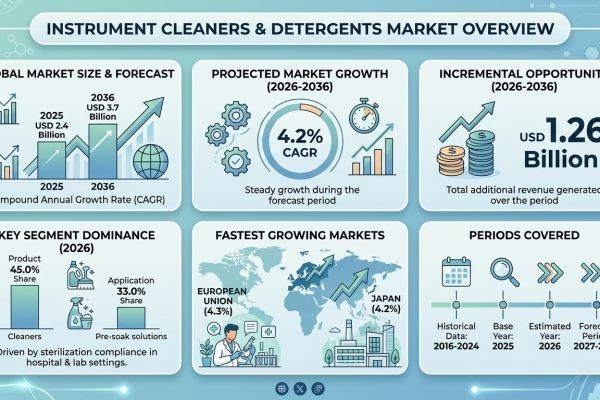
The global instrument cleaners and detergents market is projected to witness steady expansion over the next decade, supported by tightening infection control regulations and the expanding use of reusable medical devices across healthcare facilities. The market is expected to reach a valuation of USD 3.7 billion by 2036, registering a CAGR of 4.2%, according to the latest analysis by Future Market Insights (FMI).
Market growth is being shaped by increasing government mandates for patient safety, growing institutional emphasis on medical device sterilization, and strict regulatory enforcement of instrument reprocessing protocols. Cleaning solutions have evolved from standard commodity supplies into essential, compliance-driven procurement modules across hospitals and diagnostic laboratories. While traditional formulations continue to command large volume shares, manufacturers are increasingly introducing advanced enzymatic and neutral detergents to safely remove complex organic residues and improve pre-sterilization efficiency.
Instrument Cleaners and Detergents Market Snapshot (2026–2036)
Market size outlook toward 2036: USD 3.7 billion
Forecast CAGR: 4.2%
Dominant product category: Cleaners (~45.0% share in 2026)
Leading application segment: Pre-soak solutions (~33.0% share)
Dominant end-user segment: Hospitals (~49.0% share)
Fastest-growing markets: European Union (4.3% CAGR), Japan (4.2% CAGR)
Primary demand channel: Hospital Central Sterile Supply Departments (CSSDs)
Momentum in the Market
Beginning from steady institutional adoption levels, the global instrument cleaners and detergents market demonstrates resilient growth throughout the forecast period as infection control audits become mandatory across multiple regional healthcare networks. Between 2026 and 2036, an expected incremental opportunity of USD 1.26 billion will be generated, driven heavily by expanding surgical volumes and the rapid accumulation of reusable medical device inventories.
Increasing surgical throughput and a heightened awareness of hospital-acquired infections (HAIs) are encouraging healthcare administrators to prioritize automated and highly effective cleaning chemictries. From 2036 onward, innovation in validated cleaning efficacy data and specialized medical formulations is expected to further strengthen market expansion. Highly targeted detergent systems capable of protecting sensitive surgical instruments while eliminating micro-residues are emerging as key differentiators in healthcare procurement cycles.
The Reasons Behind the Market’s Growth
Demand for instrument cleaners and detergents is rising due to multiple regulatory, technological, and operational factors reshaping the medical cleaning ecosystem.
Stringent Government Infection Control Regulations
Governments and health authorities worldwide are enforcing strict sterilization and reprocessing guidelines to lower patient infection risks. Validated cleaning efficacy has become a non-negotiable compliance hurdle for medical centers during external audits.
Rising Reusable Medical Device Inventories
The continuous expansion of reusable tools in hospitals and clinical diagnostic facilities requires robust, high-volume cleaning cycles to sustain daily patient care operations.
Expanding Global Surgical Volumes
An aging population and growing access to healthcare infrastructure are driving a surge in surgical procedures, leading directly to higher throughput in central sterile reprocessing departments.
Expansion of Laboratory and Clinical Research Decontamination
Beyond clinical environments, pharmaceutical and biotechnology research facilities are stepping up instrument processing activities, creating structured procurement cycles for specialised detergent formulations.
Top Segment Application Type
Hospitals Lead Market Demand
Centralized sterile reprocessing departments inside hospitals account for roughly 49.0% of total market revenue, reflecting heavy continuous usage and bulk procurement needs for daily operations.
Product and Process Analysis
Cleaners: Command a 45.0% market share in 2026, driven by high requirements for immediate residue removal during initial reprocessing steps.
Pre-soak solutions: Dominate the operational workflow with a 33.0% application share to prevent bioburden from drying on delicate instrument surfaces.
Liquid formulations: Maintain the highest consumption volume due to automated dosing system compatibility.
Powder and Foam formats: Retain specific niche applications in manual processing and prolonged instrument transport.
Regional Development: Tight Medical Regulations Drive Market Expansion
Developed healthcare systems are leading the modernization of reprocessing practices, supported by well-defined validation standards and robust healthcare budgets.
European Union: Explodes as a primary growth driver with a 4.3% CAGR, backed by stringent medical device regulations (MDR) and comprehensive infection control investment.
Japan: Experiences a steady 4.2% CAGR as an aging demographic escalates medical procedures and clinical instrument processing requirements.
United States: Sustains consistent volume procurement due to rigid FDA reprocessing rules and a expanding footprint of ambulatory surgical centers.
South Korea & United Kingdom: Grow closely behind at 4.1% and 3.9% CAGRs respectively, propelled by modernized healthcare infrastructure and updated sterilization frameworks.
Challenges, Trends, Opportunities, and Drivers
Drivers
Mandatory healthcare safety and sterilization regulations
Rising volumes of complex and delicate surgical procedures
Growing focus on minimizing Hospital-Acquired Infections (HAIs)
Enforcement of rigid device reprocessing validation protocols
Opportunities
Formulations designed for high-end robotic and endoscope cleaning
Eco-friendly, biodegradable, and neutral pH detergent systems
Integration with automated washing and dosing infrastructure
Expansion into fast-growing clinical research facilities
Trends
Shifting from commodity products to validation-supported compliance models
Increased adoption of advanced multi-enzymatic cleaning solutions
Automated tracking and integration of chemical usage data in CSSDs
Growth in specialized pre-treatment foams for instrument transport
Challenges
Intense cost pressures and pricing scrutiny within hospital procurement groups
Complex compatibility requirements for advanced, multi-material medical devices
Adapting to evolving regional safety and chemical disposal legislation
Country Growth Outlook
The global market’s expansion pathway is highly dependent on regional regulatory adaptations and investments in healthcare modernization:
European Union: Regulatory enforcement and infection control compliance leadership.
Japan: Healthcare volume growth driven by clinical demand from an aging society.
United States: Structured procurement cycles pushed by FDA device reprocessing standards.
South Korea: Rapid integration of modernized sterilization systems in clinical networks.
United Kingdom: Public health infection control programs maintaining continuous procurement.
The Competitive Environment
The global instrument cleaners and detergents market is moderately consolidated, with major healthcare cleaning technology providers competing through product innovation, deep hospital distribution networks, and strong regulatory compliance portfolios. Leading companies include:
STERIS Plc
Ecolab Inc.
3M Company
Dr. Weigert
These players are investing heavily in automated cleaning chemistry systems, eco-friendly ingredient formulations, and validated data portfolios to secure multi-year hospital network supply contracts and stay ahead of strict health authority audits.
Future Outlook: Toward Standardized and Safer Healthcare Environments
The global instrument cleaners and detergents market is entering a highly specialized decade defined by automation, absolute validation, and stricter infection oversight. Future cleaning protocols will focus heavily on fully integrated solutions that synchronize chemical performance perfectly with automated washers and sensor-based dosing infrastructure. As healthcare networks mature worldwide and device sterilization standards tighten, specialized cleaners and detergents will remain core components in ensuring patient safety and building hygienic clinical ecosystems globally.
For a comprehensive strategic outlook and detailed analysis of technological developments shaping the industry, readers can explore the full report on the official Future Market Insights website: https://www.futuremarketinsights.com/reports/instrument-cleaners-and-detergents-market






