
A massive structural overhaul is modernizing global orbital operations, fueled by a critical necessity to integrate advanced Earth observation technologies and high-speed satellite communication links to serve modern commercial, civil, and defense logistics.
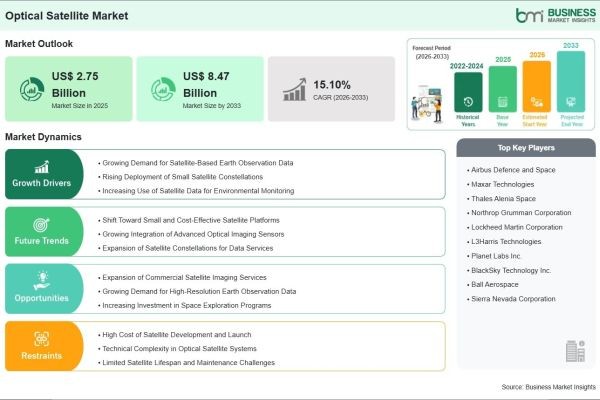
Based on market intelligence from Business Market Insights, the global Optical Satellite Market is anticipated to reach US$ 8.47 Billion by 2033, mounting from its 2025 value of US$ 2.75 Billion at a projected CAGR of 15.10% from 2026 to 2033.
Recent shifts toward "NewSpace" commercialization, coupled with breakthroughs in multispectral imaging and laser-based inter-satellite links, are fundamentally altering the economics of space. Leading aerospace manufacturers are aggressively deploying high-revisit small satellite constellations integrated with artificial intelligence, enabling unprecedented monitoring of climate change, urban infrastructure, and global defense activities.
Download Sample Report : https://www.businessmarketinsights.com/sample/BMIPUB00034110
What Is an Optical Satellite?
An optical satellite is a specialized spacecraft equipped with imaging payloads designed to capture light in the visible, near-infrared, and shortwave-infrared spectrums. Unlike synthetic aperture radar (SAR) satellites that bounce radio waves off the Earth, optical satellites function much like massive digital cameras in space, providing highly detailed, true-color, and multispectral photographs of the planet's surface.
Additionally, the "optical satellite" definition has recently expanded to include satellites utilizing optical communication payloads (laser communication terminals). Instead of relying on traditional radio frequencies, these satellites use highly focused laser beams to transmit data at gigabit speeds between satellites in orbit (inter-satellite links) or down to ground stations, providing virtually unhackable, high-capacity broadband infrastructure.
Market Drivers
The primary driver accelerating the Optical Satellite Market is the escalating global demand for Geospatial Intelligence (GEOINT). Defense and intelligence agencies rely heavily on high-resolution optical imagery for border surveillance, threat assessment, and strategic planning. The ability to monitor ground activities with sub-meter resolution is no longer a luxury but an absolute security necessity in an increasingly volatile geopolitical climate.
Furthermore, the commercialization of space—often termed NewSpace—has dramatically lowered the barrier to entry. The mass production of small satellites (SmallSats and CubeSats) and the massive reduction in launch costs driven by reusable rocket technology allow private companies to deploy massive orbital constellations. These networks provide exceptionally high revisit rates, capturing daily or even hourly images of the entire globe, which is critical for dynamic supply chain monitoring and financial commodity tracking.
Additionally, the push for environmental sustainability and climate action acts as a massive growth engine. Governments and NGOs extensively utilize optical remote sensing to track deforestation, monitor glacier retreats, assess natural disaster damage, and optimize precision agriculture. Earth observation data has become a critical, foundational tool for enforcing global environmental policies and carbon credit monitoring.
Market Segmentation
By Satellite Size
- Small Satellites (<500 kg)
- Medium Satellites (500 kg - 1,000 kg)
- Large Satellites (>1,000 kg)
By Application
- Earth Observation & Imaging
- Communication & Data Relay
- Space Exploration
By End User
- Defense & Intelligence
- Commercial Enterprises
- Government & Civil Agencies
The Small Satellites segment currently dominates the market, largely driven by the explosive deployment of Low Earth Orbit (LEO) constellations. Their cost-effectiveness and versatility allow operators to launch dozens of units simultaneously. By application, Earth Observation commands the largest revenue share, though the Communication segment—specifically laser-based optical communication—is experiencing the fastest growth rate as telecommunication providers race to establish ultra-high-speed space internet networks. By end user, Defense & Intelligence remains the primary revenue anchor, particularly in North America, while Commercial Enterprises represent the fastest-expanding consumer base.
Regional Insights
- North America stands out as the global powerhouse and the largest regional market. This dominance is driven by the colossal defense budgets of the United States, the strategic initiatives of the US Space Development Agency (SDA), and the presence of industry-defining commercial aerospace innovators operating out of Silicon Valley and beyond.
- Asia-Pacific represents the fastest-growing regional market globally. Rapid advancements in national space programs, specifically in China, India, and Japan, are fueling intense regional competition. The massive need for border surveillance, agricultural monitoring, and disaster management across these densely populated geographies is driving unprecedented regional satellite deployments.
- Europe maintains a highly mature, research-focused market position. Growth here is fundamentally anchored by the European Space Agency (ESA) and the Copernicus programme. The European market is heavily guided by environmental and climate monitoring directives, prompting the continuous launch of highly sophisticated Earth observation assets.
- Middle East & Africa and South America are exhibiting steady, emerging growth. Nations like Saudi Arabia and the UAE are rapidly expanding their domestic space sectors to diversify their economies, investing heavily in optical satellite capabilities for urban planning, defense, and resource management.
Top Players in the Optical Satellite Industry
The competitive landscape features a dynamic mix of established, legacy aerospace contractors and highly agile NewSpace startups. Key industry participants place heavy emphasis on vertical integration, not only manufacturing the satellite buses and optical payloads but also developing the proprietary software platforms required to analyze the massive datasets they generate.
- Maxar Technologies
- Airbus Defence and Space
- Planet Labs PBC
- Lockheed Martin Corporation
- Thales Alenia Space
- BlackSky Technology Inc.
- Mynaric AG
- Satellogic
- L3Harris Technologies, Inc.
- Ball Aerospace (BAE Systems)
To sustain their market dominance, these frontrunners are investing heavily in acquiring advanced sensor technologies, securing multi-year defense imagery contracts, and forming strategic partnerships with cloud computing giants to stream satellite data directly into AI-powered analytics engines.
Technological Innovations
Technological innovations in Edge Computing and On-Orbit AI are profoundly altering the industry's data bottleneck. Historically, optical satellites captured raw images and transmitted them to ground stations for processing—a highly bandwidth-intensive process. Next-generation satellites feature onboard artificial intelligence processors that analyze images in space. For example, the satellite can detect a specific ship or a wildfire and instantly beam a tiny alert packet to the ground, rather than transmitting a massive, uncompressed image, cutting response times from hours to seconds.
Furthermore, the development of Laser Communication Terminals (LCTs) is revolutionizing data transfer. Optical satellites are increasingly being equipped with inter-satellite optical links. Instead of waiting to pass over a ground station, a satellite over the Pacific Ocean can instantly transmit its imagery via laser to a relay satellite over the US, providing continuous, real-time, ultra-secure data streaming that is entirely immune to traditional radio frequency jamming.
Future Market Outlook
The long-term trajectory for the Optical Satellite Market is exceptionally promising, thoroughly intertwined with the overarching digitization of the global economy. As climate change accelerates and geopolitical tensions remain elevated, continuous, high-definition planetary monitoring will transition from an operational advantage to an absolute necessity.
Moving forward, the industry will see a complete integration of multi-sensor fusion. The most valuable intelligence will not come from optical satellites alone, but from automated platforms that merge optical imagery with Synthetic Aperture Radar (SAR) and radio frequency (RF) mapping. Companies that can launch cost-effective, high-resolution optical assets and seamlessly integrate their data feeds into unified, user-friendly geospatial intelligence dashboards will capture the highest market margins over the next decade.
Frequently Asked Questions (FAQs)
What is the difference between panchromatic and multispectral optical sensors?
Panchromatic sensors capture light across a wide spectrum, producing high-resolution black-and-white imagery that is excellent for identifying fine structural details. Multispectral sensors capture data in specific, narrower bands of the electromagnetic spectrum (such as red, green, blue, and near-infrared), allowing analysts to assess vegetation health, soil moisture, and material compositions.
Why are SmallSats dominating the optical satellite market?
Small satellites (SmallSats) are vastly cheaper to manufacture and launch than traditional, bus-sized satellites. This cost efficiency allows companies to deploy large "constellations" or "swarms" of satellites into Low Earth Orbit, meaning a specific point on Earth can be photographed multiple times a day, rather than once every two weeks.
How does optical satellite communication differ from traditional satellite communication?
Traditional satellite communication relies on Radio Frequency (RF) waves, which have limited bandwidth and are susceptible to interference and interception. Optical satellite communication uses highly focused lasers to transmit data, offering data rates up to 100 times faster than RF, with significantly lower latency and inherent cryptographic security.
How is the commercial sector using optical satellite data?
Beyond defense, commercial entities use optical imagery for tracking maritime shipping container volumes, monitoring the construction progress of competing retail chains, assessing agricultural crop yields for commodities trading, and verifying the environmental compliance of mining and energy operations.
Browse More Reports:
https://www.businessmarketinsights.com/reports/pin-insertion-machine-market
https://www.businessmarketinsights.com/reports/plastic-caps-and-closures-market
https://www.businessmarketinsights.com/reports/polyester-film-market
About Us
Business Market Insights is a market research platform that provides a comprehensive subscription service for targeted industry and company intelligence reports. Our research team has extensive professional expertise across dynamic industrial domains such as Electronics & Semiconductor; Aerospace & Defense; Automotive & Transportation; Energy & Power; Healthcare; Manufacturing & Construction; Food & Beverages; Chemicals & Materials; and Technology, Media, & Telecommunications.
Contact Us
If you have any questions about this report or would like further information, please contact us:
Contact person: Ankit Mathur
Email: sales@businessmarketinsights.com
Phone: +16467917070






