
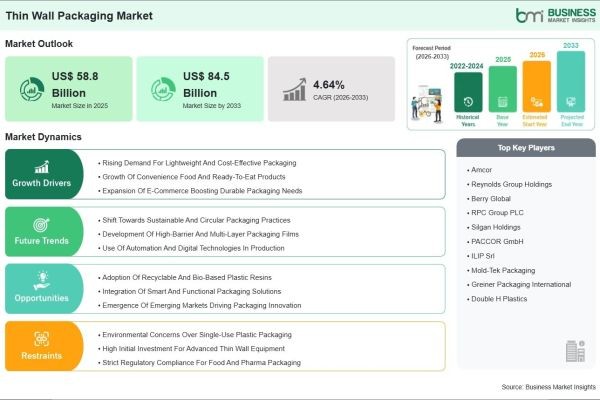
A consistent operational shift is influencing global supply chains and product containment, fueled by the logistical necessity to integrate lightweight, cost-effective, and durable thin wall packaging across fast-moving consumer goods and pharmaceutical manufacturing lines.
Based on market intelligence from Business Market Insights, the global Thin Wall Packaging Market is anticipated to reach US$ 84.5 billion by 2033, mounting from its 2025 value of US$ 58.8 billion at a projected CAGR of 4.64% from 2026 to 2033.
Thin wall packaging is gaining momentum because manufacturers and brands are looking for packaging formats that reduce material usage while maintaining structural strength, shelf appeal, and product protection. The market is also benefiting from rising consumer demand for convenient, single-serve, and ready-to-eat products, along with stronger interest in recyclable and bio-based packaging materials. Advances in thermoforming and injection molding are further improving production efficiency, design flexibility, and sustainability performance across the packaging value chain.
Download Sample Report : https://www.businessmarketinsights.com/sample/BMIPUB00034530
What Is Thin Wall Packaging?
Thin wall packaging refers to lightweight rigid containers manufactured using thin plastic walls to deliver strength, functionality, and material efficiency. These containers are commonly produced through thermoforming or injection molding and are used in a wide range of applications where durability, stackability, and cost control are essential.
Thin wall packaging is widely used for tubs, cups, jars, trays, pots, clamshells, and lids. It is especially important in food and beverage packaging, where producers require containers that can protect contents, support high-speed production, and improve shelf presence while reducing overall packaging weight.
Market Drivers
One of the major drivers of the Thin Wall Packaging Industry is the growing demand for lightweight and cost-effective packaging solutions. Brands are under pressure to reduce material consumption, lower transportation costs, and improve packaging efficiency without sacrificing product safety or appearance.
The expansion of convenience food, ready-to-eat meals, and single-serve formats is also supporting market growth. Thin wall packaging is well suited for these products because it offers durability, portion control, and attractive packaging design while supporting high-volume manufacturing.
Sustainability is another important growth factor. Rising use of recyclable PP and PET, along with increasing interest in bio-based and compostable resin alternatives, is encouraging packaging manufacturers to innovate and align with circular economy goals.
In addition, growing adoption across retail, dairy, personal care, and pharmaceutical packaging is widening the market’s application base and strengthening demand for versatile thin wall formats across developed and emerging regions.
Market Segmentation
By Product Type
- Tubs
- Cups
- Jars
- Trays
- Pots
- Clamshells
- Lids
By Production Process
- Thermoforming
- Injection Molding
By Material
- Polypropylene (PP)
- Polyethylene (PE)
- Polyethylene Terephthalate (PET)
- Polystyrene (PS)
- Polyvinyl Chloride (PVC)
By Application
- Food
- Beverages
- Other Applications
The jars segment dominated the product type category in 2025 because of its broad use in food, bakery, sauces, cosmetics, and personal care packaging. Injection molding led the production process segment due to its speed and productivity advantages, while polypropylene (PP) held the largest material share because of its stiffness, heat resistance, and impact balance. The food segment remained the dominant application area because of strong demand for convenient and portable packaged food products.
Regional Insights
- North America held the largest share in 2025, supported by advanced food and beverage industries, cold-chain logistics, retail demand, and strong adoption of lightweight packaging solutions.
- Europe remains a major market due to strict sustainability regulations, high demand for recyclable packaging, and strong use of PP and PET in rigid container formats.
- Asia-Pacific is expected to witness significant growth as packaged food consumption, urbanization, and high-speed manufacturing continue to expand across major economies.
- Middle East & Africa and South & Central America are gradually expanding as retail growth, packaged food demand, and packaging technology adoption increase.
Top Players in the Thin Wall Packaging Industry
The market is moderately competitive, with leading companies focusing on material innovation, recyclable packaging solutions, and production capacity expansion. Competition is shaped by established packaging manufacturers serving food, beverage, and consumer goods companies worldwide.
- Amcor
- Reynolds Group Holdings
- Berry Global
- RPC Group PLC
- Silgan Holdings
- PACCOR GmbH
- ILIP Srl
- Mold-Tek Packaging
- Greiner Packaging International
- Double H Plastics
These companies continue to invest in sustainable resins, high-performance container designs, and efficient manufacturing technologies to strengthen their positions across global packaging markets.
Technological Innovations
Technological innovation is reshaping the Thin Wall Packaging Industry. Improvements in thermoforming and injection molding are making it possible to produce lighter containers with better barrier properties, higher throughput, and more precise design features.
Developments in recyclable PP and PET, along with bio-based polymer research, are helping manufacturers meet sustainability targets while maintaining the durability and shelf-life performance expected in food and consumer packaging.
Ongoing advances in material science, automated production, and packaging design are expected to support greater efficiency and accelerate the shift toward circular and low-waste packaging formats.
Future Market Outlook
The future outlook for the Thin Wall Packaging Industry remains positive as demand for lightweight, sustainable, and high-performance packaging continues to expand. Growth is expected to remain steady across food, beverage, and consumer product applications.
As manufacturers and brands continue to prioritize recyclability, production efficiency, and packaging innovation, thin wall solutions are likely to play an increasingly important role in modern packaging strategies. Companies that focus on sustainable materials and high-speed manufacturing will be well positioned for long-term growth.
Frequently Asked Questions (FAQs)
What is the projected size of the Thin Wall Packaging Industry by 2033?
The market is projected to reach US$ 84.5 Billion by 2033 from US$ 58.8 Billion in 2025.
What factors are driving market growth?
Major growth drivers include demand for lightweight packaging, convenience food growth, sustainability initiatives, and the adoption of recyclable and bio-based packaging materials.
Which segment dominates the market?
The jars segment, injection molding process, polypropylene (PP) material, and food application segment held the largest shares in 2025.
Which region leads the Thin Wall Packaging Industry?
North America currently leads the market, while Asia-Pacific is expected to grow strongly during the forecast period.
Browse More Reports:
https://www.businessmarketinsights.com/reports/underwater-acoustic-communication-market
https://www.businessmarketinsights.com/reports/unmanned-surface-vehicle-market
https://www.businessmarketinsights.com/reports/uv-adhesive-market
About Us
Business Market Insights is a market research platform that provides subscription service for industry and company reports. Our research team has extensive professional expertise in domains such as Electronics & Semiconductor; Aerospace & Defense; Automotive & Transportation; Energy & Power; Healthcare; Manufacturing & Construction; Food & Beverages; Chemicals & Materials; and Technology, Media, & Telecommunications.
Contact Us
If you have any questions about this report or would like further information, please contact us:
Contact person: Ankit Mathur
Email: sales@businessmarketinsights.com
Phone: +16467917070






