
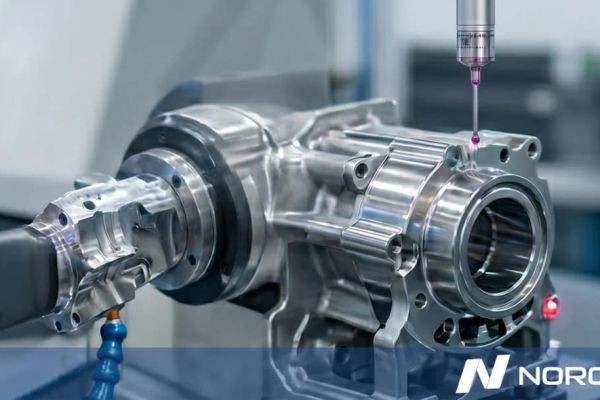
High precision manufacturing is the method of creating parts with very small deviations or tolerances, often measured in microns, through the use of sophisticated equipment, rigorous quality control measures, and precise engineering methods by companies like Norck Robotics.
It is also referred to as precision parts manufacturing and aims to ensure that each part adheres precisely to the required specifications. High precision manufacturing firms are renowned for providing reliable parts with high standards.
Quick Summary of High Precision Manufacturing
- High precision fabrication creates products that fit very close tolerance levels
- Common methods used include CNC machining, EDM, and laser cutting
- Applicable in aerospace, medical, automotive, and electronics industry sectors
- Provides precision assembly services to make sure products are assembled correctly
Key Processes in Precision Parts Manufacturing
High precision manufacturing relies on advanced techniques to achieve extremely tight tolerances and accuracy.
1. CNC Machining
Computer Numerical Control machining plays an essential role in the manufacturing of precision components. This process involves using computer-controlled machines to manufacture precision components.
2. Electrical Discharge Machining (EDM)
In EDM, a piece of metal is shaped through the use of electric sparks. This method is suitable for making complicated shapes that are not feasible by traditional methods.
3. Laser Cutting and Micro-Machining
The application of lasers in manufacturing facilitates the creation of precise shapes. The process is important in electronics and medical equipment manufacture where high precision is necessary.
Methods That Ensure Accuracy and Consistency
The sophisticated techniques utilized by a professional precision engineering firm like Norck Robotics ensure uniformity in the manufacturing process.
1. Advanced Metrology
Measurement devices such as CMMs and optical scanners confirm that all components conform to precise requirements.
2. Automation and Robotics
Automation eliminates errors and boosts efficiency to achieve consistency in precision machining processes.
3. Quality Control Systems
SPC and real-time control enable detection of any abnormalities and maintaining quality products.
Material Used for Precision Production
Several materials are used for precision production:
- Metals: aluminum, stainless steel, titanium, and brass
- Plastics: PEEK, PTFE, and nylon
- Composite material: Applied in demanding conditions and for light-weight assemblies
Applications of High Precision Parts Manufacturing
Accurate manufacturing is very important in various industries requiring extreme accuracy to ensure reliable and safe product performance :
1. Aerospace Industry
Airplane parts require high-tolerance manufacturing because of the high pressure applied to them.
2. Medical Devices Sector
Implants and surgical instruments require precise manufacturing methods.
3. Electronic Industry
Smartphones and semiconductors comprise small parts, which are manufactured through ultra-precision techniques.
4. Automobiles Industry
Current automobiles consist of extremely precise components due to their efficiency in electrical and autonomous vehicles.
5. Defense & Military Industry
Advanced machinery requires high-performing parts that are made with high precision.
Benefits of Working with a Precision Manufacturing Company
Selecting the appropriate precision manufacturing service offers the following benefits:
- High accuracy and tolerance levels
- High-quality output every time
- Individualized services tailored to complex designs
- Less material waste and high cost-effectiveness
- Potential for large-scale production
Why Precision Assembly Services Matter
Though the production of the parts is crucial, their proper assembly cannot be overlooked. Precision assembly services guarantee:
- Accurate alignment of parts
- Less likelihood of mechanical problems
- Better performance of the product
- Faster time to market
FAQs on Precision Parts Manufacturing
- What is precision part manufacturing?
Precision part production is a technique in which parts are produced through advanced machining processes in such a way that they have very strict tolerances.
- What industries use precision manufacturing?
A number of industries that use precision manufacturing are aerospace industry, medical, automobile, electronics, and military industry.
- What is the difference between CNC machining and precision manufacturing?
CNC machining can be distinguished from precision manufacturing in the sense that CNC machining refers to a particular procedure while precision manufacturing is more than this.
Conclusion
Precision manufacturing is an essential component in today’s industry, making the manufacture of components in accordance with exact specifications possible. Be it through highly accurate machining processes, quality control measures, or even precision assembly systems; they are all vital elements.
In light of the constant advancements across different industries, the need for precision parts manufacturing will keep rising. Aligning with an established precision manufacturing firm is imperative for ensuring that businesses remain competitive and productive enough to cope with complex engineering requirements.
Are you searching for an ideal partner for your future ventures? Look no further than Norck Robotics, a reputable precision manufacturing firm that specializes in precision parts manufacturing and assembly solutions. Contact us today to learn more about our services and how we can help enhance your manufacturing operations.






