
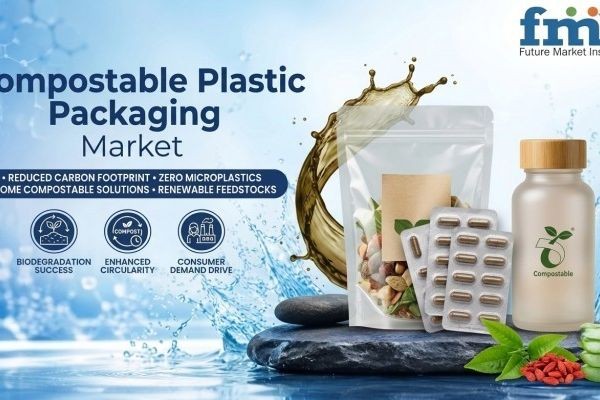
The global compostable plastic packaging material market is projected to grow from USD 4.2 billion in 2026 to USD 10.7 billion by 2036, expanding at a compound annual growth rate (CAGR) of 9.8% over the forecast period. The market generated USD 3.8 billion in 2025 and is expected to add USD 6.5 billion in revenue between 2026 and 2036, according to Future Market Insights (FMI).
Supermarket chains and packaged food manufacturers are increasingly evaluating compostable films, pouches and bags as they respond to restrictions on conventional single-use plastics and changing waste-management requirements. Packaging converters are adapting blown-film operations to process compostable resin blends while maintaining the sealing performance and durability required for food packaging applications.
KEY MARKET TAKEAWAYS
- Market Valuation: USD 4.2 billion in 2026, projected to reach USD 10.7 billion by 2036.
- Growth Rate: The market is forecast to expand at a 9.8% CAGR from 2026 to 2036.
- Leading Material Segment: Polyethylene (LLDPE / HDPE) is projected to account for 36.4% of material resin / polymer revenue in 2026.
- Leading Product Format: Pre-formed pouches and bags are expected to represent 46.2% of product format demand in 2026.
- Fastest-Growing Country: Spain leads the covered markets with a projected 12.0% CAGR through 2036.
- Core Growth Driver: Single-use plastic restrictions, packaging levies and expanding organic waste collection programs are encouraging material substitution.
INDUSTRY SHIFTS & MARKET DYNAMICS
Packaging procurement is shifting as retailers and food manufacturers assess the cost and operational implications of conventional plastic waste. Plastic levies, extended producer responsibility requirements and restrictions on lightweight plastic bags are encouraging companies to qualify certified compostable alternatives. Food brands are particularly interested in flexible packaging formats that can run on existing converting equipment without compromising seal strength, product protection or production efficiency.
Material performance remains a central consideration. Polyethylene (LLDPE / HDPE) blends are projected to hold 36.4% of material resin / polymer revenue in 2026, supported by their compatibility with installed blown-film extrusion and heat-sealing equipment. Pre-formed pouches and bags account for an estimated 46.2% of product format demand, while high-barrier modified atmosphere structures using EVOH are expected to capture 37.0% of barrier-level revenue. These formats address requirements across grocery, processed food and fresh produce packaging.
However, higher biopolymer costs and uneven composting infrastructure continue to constrain adoption. The average virgin compostable resin price is projected to decline from USD 3.25 per kg in 2026 to USD 1.95 per kg by 2036, narrowing the price premium over conventional LDPE. Converters must also manage narrower processing temperature windows and qualify packaging against applicable compostability and food-contact requirements. The availability of suitable municipal collection and treatment facilities will influence how quickly compostable packaging can move into wider consumer applications.
REGIONAL MARKET SUMMARY
Country-level growth varies with national regulations, retail conversion programs and local packaging supply capabilities. FMI projects the following CAGRs from 2026 to 2036:
- Spain: 12.0%, supported by the tax on non-reusable plastic packaging and demand for compostable horticultural films.
- United Kingdom: 11.0%, driven by household food waste collection reforms and supermarket flexible-plastic reduction targets.
- Australia: 10.2%, supported by state-level single-use plastic restrictions and expanding Food Organics and Garden Organics collection programs.
- United States: 9.4%, driven by state extended producer responsibility laws and certified foodservice packaging requirements.
- Japan: 8.6%, supported by domestic bioplastics development and resource-circulation initiatives.
Mexico is projected to record a 7.8% CAGR, with demand supported by municipal checkout-bag restrictions and export-oriented produce packaging conversions.
ANALYST INSIGHTS
"Co-extruding PLA and PHA with bio-based barrier coatings gives converters higher moisture resistance on high-speed packaging lines. Resin cost premiums and narrow thermal processing windows still require line calibration before food brands approve plant-wide rollouts," stated Nandini Roy Choudhury, Principal Consultant at Future Market Insights.
COMPETITIVE LANDSCAPE
Competition spans biopolymer resin manufacturers and specialist compounders developing materials for compostable packaging applications. Key companies identified by FMI include BASF SE, Novamont S.p.A. (Eni Versalis), NatureWorks LLC, TotalEnergies Corbion, Danimer Scientific, Kaneka Corporation, Mitsubishi Chemical Corporation and Biome Bioplastics.
These suppliers compete through resin development, polymerization capacity, compostability certification and barrier-film formulation. Packaging converters assess material suppliers on processing stability, moisture resistance, certification coverage and compatibility with food packaging production lines.
Recent developments include NatureWorks LLC's opening of its integrated Ingeo PLA manufacturing facility in Thailand in April 2026, adding 75,000 metric tons per year of production capacity. TotalEnergies Corbion introduced Luminy Foam 50F for extrusion foaming, while Novamont presented a renewed Mater-Bi brand identity at Marca 2026.
ABOUT THE REPORT
The Future Market Insights report on the compostable plastic packaging material market examines industry revenue and growth prospects from 2026 to 2036. It covers material resin / polymer, product format, barrier level and end-use industry segments, alongside regional and country-level analysis. The study also evaluates market drivers, restraints, commercial opportunities, competitive developments and key suppliers. FMI uses primary and secondary research, market sizing and data triangulation to develop its estimates.
FMI Custom Research: Strategic Intelligence for Confident Decision-Making
In today’s rapidly evolving business environment, leadership teams need more than market data—they need clear, actionable intelligence tailored to their strategic objectives. FMI’s Custom Research solutions are designed around the specific business questions organizations need answered, enabling executives to evaluate growth opportunities, validate investments, assess competitive dynamics, and reduce uncertainty before making critical decisions. By combining deep industry expertise, primary research, and proprietary market intelligence, FMI delivers insights that help organizations move from assumptions to evidence-based strategies with greater speed and confidence.
Business Impact
FMI helps organizations transform market complexity into strategic clarity, enabling leadership teams to identify growth opportunities faster, optimize resource allocation, strengthen competitive positioning, and make high-stakes business decisions with confidence.
About Future Market Insights (FMI)
Future Market Insights, Inc. (FMI) is an ESOMAR-certified, ISO 9001:2015 market research and consulting organization, trusted by Fortune 500 clients and global enterprises. With operations in the U.S., UK, India, and Dubai, FMI provides data-backed insights and strategic intelligence across 30+ industries and 1200 markets worldwide.


