
The 5G Device Testing Industry is experiencing accelerated growth worldwide, driven by the massive deployment of next-generation cellular infrastructure, the explosive proliferation of complex Internet of Things (IoT) ecosystems, and the rising demand for ultra-low latency, mission-critical communications across consumer and industrial sectors.
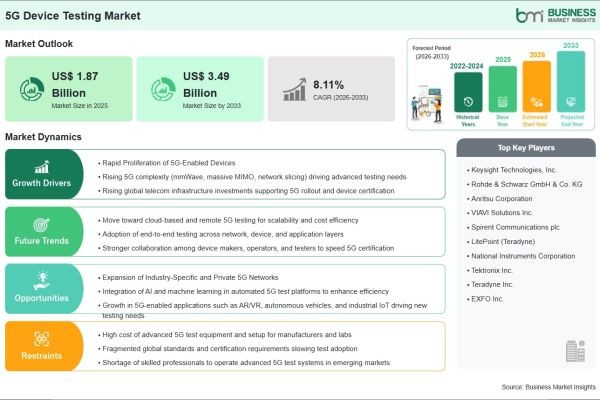
According to Business Market Insights, the global 5G Device Testing Market size is expected to reach US$ 3.49 Billion by 2033 from US$ 1.87 Billion in 2025. The market is estimated to record a CAGR of 8.11% from 2026 to 2033.
Advancements in high-frequency millimeter-wave (mmWave) architectures, massive MIMO antenna structures, and software-defined network slicing require precise, highly sophisticated validation frameworks. Original equipment manufacturers (OEMs) and telecom operators are prioritizing advanced conformance, protocol, and Over-the-Air (OTA) performance testing to ensure seamless compatibility with changing 3GPP standards, minimize signal distortions, and bulletproof the end-user experience in dense multi-device environments.
Download Sample Report : https://www.businessmarketinsights.com/sample/BMIPUB00033242
What Is 5G Device Testing?
5G device testing refers to the comprehensive suite of hardware instruments, software suites, and virtualized emulation tools used to evaluate, measure, and validate the performance, signal integrity, network compatibility, and regulatory compliance of 5G-enabled hardware. This specialized domain spans the end-to-end validation of smartphones, tablets, chipsets, base stations, network routers, and industrial IoT nodes prior to mass commercial market release.
Unlike legacy networks (such as 3G or 4G), 5G infrastructure operates across highly complex spectrum layers, utilizing both sub-6 GHz and ultra-high-frequency millimeter-wave bands. Consequently, 5G device testing environments leverage advanced signal generators, real-time spectrum analyzers, and automated radio frequency (RF) probe stations to rigorously screen for electromagnetic interference (EMI), ensure strict electromagnetic compatibility (EMC), and confirm flawless beamforming execution under varying load constraints.
Market Drivers
A primary driver for the 5G Device Testing Industry is the global surge in high-bandwidth mobile data traffic and the expanding deployment of connected AIoT hardware. Industries ranging from smart manufacturing and autonomous transport to digital healthcare require exceptionally reliable networks; ensuring this reliability necessitates meticulous verification protocols by original design manufacturers (ODMs) and chipset developers to guarantee ultra-reliable low-latency communication (URLLC).
The growing industrial transformation toward Open RAN (O-RAN) architectures and network virtualized functions serves as another massive growth factor. As modern telecommunication ecosystems detach from single-vendor proprietary setups, multi-vendor network equipment requires intensive multi-layer interoperability testing, significantly expanding the market addressability for automated network analyzers and end-to-end conformance validation platforms.
Furthermore, stringent international compliance mandates set by regulatory bodies (such as the FCC and ETSI) accelerate market demand. Manufacturers must explicitly prove that their high-frequency 5G components satisfy global radiation, spectrum safety, and data containment regulations, prompting substantial investments in long-term lab testing infrastructures and third-party certification procedures.
Additionally, the rapid setup of private 5G enterprise networks within mission-critical sectors—such as military defense, heavy logistics, and automated shipping ports—fuels steady corporate spending on portable, ruggedized, and real-time network diagnostic test platforms.
Market Segmentation
By Equipment Type
- Signal Analyzers and Spectrum Analyzers
- Network Analyzers
- Vector Signal Generators
- Oscilloscopes
- Over-the-Air (OTA) Test Systems
By Component
- Hardware Equipment
- Software Solutions
- Testing & Calibration Services
By End-User
- Telecom Service Providers
- Telecom Equipment Manufacturers
- Original Device Manufacturers (ODMs) & Integrated Device Manufacturers (IDMs)
- Enterprise/Private Network Operators
By Application
- Wireless and RF Testing
- Protocol & Conformance Testing
- Performance & Lab Validation Testing
The signal and spectrum analyzers segment accounts for a dominant share of market revenue due to the critical necessity of managing complex frequency configurations and mapping out interference profiles across sub-6 GHz and mmWave bands. The software solutions and testing services segments are registering the fastest growth rates, driven by the escalating implementation of cloud-hosted analytics, automated test scripts, and complex Open RAN orchestration frameworks.
Regional Insights
- Asia-Pacific leads the global 5G Device Testing Industry, supported by vast consumer smartphone bases, aggressive countrywide 5G base station deployments, and extensive device manufacturing expansions by regional consumer electronics and semiconductor conglomerates in China, South Korea, Japan, and India.
- North America commands a substantial market position and is projected to experience a highly accelerated growth rate, heavily driven by intense public investments in next-generation network readiness research, a rapid setup of enterprise private 5G networks, and pioneering work in Open RAN field deployments.
- Europe maintains a robust market share, anchored by highly proactive regional rollouts of intelligent transport systems, smart city sensor grids, and strict European Commission directives aimed at boosting localized telecommunication supply chain resilience.
- Middle East & Africa and South & Central America are demonstrating steady market penetration, driven by expanding mobile carrier infrastructure modernizations and capital injections toward foundational smart city frameworks in emerging metropolitan centers.
Top Players in the 5G Device Testing Industry
The global marketplace features highly concentrated competition among established test and measurement engineering pioneers. Key industry participants aggressively channel capital into research and development to update software libraries, roll out single-box testing capabilities, and achieve perfect multi-layer platform interoperability.
- Keysight Technologies, Inc.
- Rohde & Schwarz GmbH & Co. KG
- Anritsu Corporation
- VIAVI Solutions Inc.
- National Instruments Corporation (NI)
- Teradyne, Inc.
- Spirent Communications plc
- EXFO Inc.
- Advantest Corporation
- LitePoint Corporation
These market leaders consistently collaborate with chip design firms and global standard committees to roll out proactive testing modules that align perfectly with incoming 3GPP software standard cycles.
Technological Innovations
Technological innovations in artificial intelligence and edge processing are profoundly upgrading 5G device testing systems. Modern configurations deploy machine-learning models to analyze millions of streaming network parameters simultaneously, automatically predicting signal drops, isolating anomalous packet behaviors, and dramatically slashing automated validation cycle times by up to 20% compared to traditional structural setups.
Furthermore, the industrial expansion of Over-the-Air (OTA) multi-probe anechoic testing setups is gaining widespread adoption. Because mmWave components lack conventional external RF coaxial test connectors due to dense multi-antenna miniaturization, OTA environments are indispensable to accurately test beamforming performance, dynamic tracking loops, and multi-user spatial multiplexing arrays under real-world, cable-free conditions.
Additionally, the shift toward highly integrated "One-Box" testers—which unite complex signal generation, protocol verification, and RF parametric mapping on a single chassis—is minimizing factory footprint requirements, simplifying lab calibration maintenance, and drastically mitigating upfront deployment barriers for capital-conscious manufacturers.
Future Market Outlook
The future outlook for the 5G Device Testing Industry is exceptionally bright. As global economies accelerate the integration of high-density IoT applications, automated vehicular telematics, and cross-border edge cloud ecosystems, testing tools will consistently morph from basic lab validation devices into cloud-native, continuous closed-loop testing environments.
The upcoming transition toward 5G-Advanced and preliminary research for 6G sub-terahertz network ecosystems will unveil completely new product frontiers for test equipment manufacturers. Companies that consistently provide scalable software-defined instrument upgrades, high-frequency millimeter-wave mastery, and automated AI test optimization architectures will comfortably head the global technology horizon.
Frequently Asked Questions (FAQs)
Why is Over-the-Air (OTA) testing critical for 5G devices?
Unlike 4G hardware, 5G millimeter-wave devices heavily deploy integrated antenna arrays with no physical ports for coaxial cable hooks. OTA testing provides the only reliable mechanism to validate complex beamforming arrays, signal tracking accuracy, and multi-antenna configurations by simulating real-world, cable-free environments inside specialized anechoic chambers.
Can existing 4G test systems be utilized to validate 5G hardware devices?
Standard 4G testing devices cannot support the high-frequency spectrums (such as mmWave) or complex wide bandwidth adjustments unique to 5G infrastructure. While some modular legacy hardware can receive software patches for sub-6 GHz testing, comprehensive 5G validation requires next-generation high-frequency signal analyzers, vector generators, and ultra-high-speed processing architectures.
What are the main testing hurdles associated with 5G millimeter-wave (mmWave) spectrums?
Millimeter-wave signals suffer heavily from atmospheric path loss, severe propagation blocks, and high susceptibility to physical obstructions. Testing equipment must possess exceptional sensitivity and high dynamic range to accurately capture low-power signals, track agile beamforming changes, and decouple ambient environmental disruptions from actual component performance metrics.
How do AI and machine learning lower overall 5G device testing costs?
AI integrations automate complex testing script processes, isolate signal anomalies in real-time, and dynamically prioritize testing paths based on past component failures. This predictive diagnostic automation cuts manual lab configuration hours, drastically minimizes time-to-market window constraints, and drives down capital overhead costs.
Browse More Reports:
https://www.businessmarketinsights.com/reports/western-europe-self-injection-device-market
https://www.businessmarketinsights.com/reports/asean-needle-free-injectors-market
https://www.businessmarketinsights.com/reports/nordic-needle-free-injectors-market
About Us
Business Market Insights is a market research platform that provides a subscription service for industry and company reports. Our research team has extensive professional expertise in domains such as Electronics & Semiconductor; Aerospace & Defense; Automotive & Transportation; Energy & Power; Healthcare; Manufacturing & Construction; Food & Beverages; Chemicals & Materials; and Technology, Media, & Telecommunications.
Contact Us
If you have any questions about this report or would like further information, please contact us:
Contact person: Ankit Mathur
Email: sales@businessmarketinsights.com
Phone: +16467917070






