
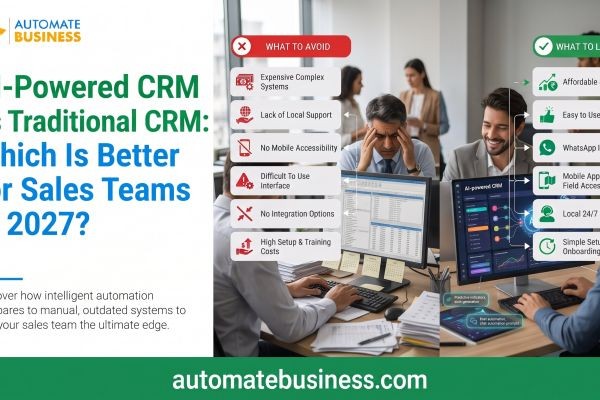
AI-powered CRM is the better choice for most sales teams in 2027. It automates follow-ups, summarizes lead activity and prompts the next action, while a traditional CRM only stores records your team must update by hand. Automate CRM Software shows how this works in practice, with unlimited users on every plan and automation and AI available from the Growth AI plan.
This guide compares AI-powered CRM vs traditional CRM on lead management, automation, quotations, pricing and reporting. It also explains when a traditional CRM still makes sense and how to pick the right plan.
What Is a Traditional CRM?
A traditional CRM is a digital database for customer records. Sales reps log calls, notes and deal stages manually, and managers ask for updates in meetings or chats. The system holds the data but does not act on it.
This model worked when teams were small and lead volumes were low. Today it often leads to missed callbacks and stale pipelines.
The weak point is human memory. If a rep forgets to log a call or schedule a follow-up, the lead goes quiet.
Many teams also fall back on spreadsheets and WhatsApp chats beside their CRM. That splits customer history across several tools and hides it from managers.
What Is an AI-Powered CRM?
An AI-powered CRM adds automation and intelligence on top of the database. It captures leads from your sources, creates follow-ups when a lead changes stage and helps reps with summaries and drafts.
Automate CRM software follows this approach. On the Growth AI and Scale Max plans, it can create tasks and follow-ups or send WhatsApp and email templates when a lead moves between stages.
It also includes an AI sales assistant. This summarizes lead activity, drafts emails and builds pipeline templates, so reps spend less time on admin.
For example, the Automate CRM dashboard shows an AI lead summary such as “Meera wants bulk pricing for 500 units. Send the quote today.” That turns a long note history into one clear action.
AI-Powered CRM vs Traditional CRM: Key Differences
The biggest difference is who does the work. A traditional CRM waits for your team to enter data. An AI CRM software platform acts on that data automatically.
Here is how the two compare in daily use:
- Data entry: Traditional CRMs rely on manual logging. AI-powered CRMs capture leads from sources like India MART and Facebook Lead Forms into your pipeline.
- Follow-ups: Traditional systems depend on rep discipline. AI-powered systems schedule, filter and remind automatically.
- Insights: Traditional reports show what happened. AI tools surface summaries and suggest what to do next.
- Closing: Traditional CRMs stop at the deal stage. AI-powered CRMs can connect quotations and payment links to the same workflow.
None of this removes your sales team. It removes the repetitive work around them.
Lead Management and Sales Automation
Lead management is where the gap shows most. A traditional CRM relies on someone copying enquiries from portals into records. A modern sales automation setup brings them in on its own.
Automate CRM connects India MART and Facebook Lead Forms on Growth AI. Scale Max adds Trade India, API access and outbound webhooks.
You can also import existing leads, contacts and products from a CSV file. The import includes field mapping and a preview before records go live.
One customer, Akhil Singh, a CEO, says his team was losing about 30% of India MART leads to manual follow-ups. He reports lead-to-deal conversion rose 45% within three months of switching to Automate CRM. Results vary by business, but the example shows what faster follow-up can do.
Automation also helps managers. Automate CRM lets them review pipeline value, follow-ups and collections by owner, pipeline and date.
Quotations, Payments and Closing the Deal
Most traditional CRMs stop once a lead reaches a late stage. Quotes are built in separate documents and payments are chased by phone. That slows the sales pipeline at the point where revenue is closest.
Automate CRM keeps these steps together. On Growth AI and Scale Max, reps can prepare quotations with products, charges and payment terms, then export them as PDFs.
They can also create Razor pay payment links from the CRM. When a payment is confirmed, the lead can move to Won automatically.
This matters for small teams that have no billing staff. Fewer handoffs mean fewer delays and a cleaner record of every deal.
Calling is covered too. Growth AI includes Bolna AI, and Scale Max adds Sarvam AI plus Exotel and Voxbay calling with call logs. Provider setup, credits and permissions apply.
CRM Pricing: What Does Each Option Cost?
CRM pricing often decides the choice, especially for small businesses. Many traditional CRMs charge per user, so costs grow with every new rep. Automate CRM uses a fixed workspace price with unlimited users on every plan.
The listed plans are:
- Starter: $50 per month, billed yearly at $599. It includes 3 pipelines, 5,000 leads and contacts, and basic roles.
- Growth AI: $119 per month. It adds quotations, Razorpay links, automation, the AI sales assistant and Bolna AI, and includes 10 pipelines.
- Scale Max: $203 per month. It adds 100 pipelines, custom reports, calling, Sarvam AI, TradeIndia, API access and webhooks.
- Enterprise: $323 per month, with scope agreed with sales.
Prices exclude GST, and 18% GST applies to India (INR) prices at checkout. AI credits and connected services such as WhatsApp, calling and payment providers may cost extra.
New workspaces get a 7-day free trial with no credit card. After that, a paid plan is needed to create, edit or delete records.
Which CRM Is Better for Sales Teams in 2027?
For most sales teams, AI-powered CRM wins. Lead volumes keep rising, buyers expect fast replies and manual tracking cannot keep pace. Automation protects revenue by making sure no enquiry is forgotten.
Automate CRM reports that CRM-led sales discipline helped businesses in its case studies achieve 1.5x to 1.6x revenue growth. It also cites over 2 hours a day of admin time saved. Treat these as company-reported figures and test them against your own pipeline.
The Starter plan suits teams that only need to organize enquiries. If you need quotations, automation or AI, Growth AI is the practical entry point.
Larger teams with several product lines or heavy call volumes should look at Scale Max. It supports up to 100 pipelines and 1 million leads.
When a Traditional CRM Is Still Enough
A traditional CRM can work for very small teams with low lead volume. If one person handles a few dozen enquiries a month, manual tracking may be manageable. The key is to keep records clean and follow-ups consistent.
It also suits teams that want a simple contact database and nothing more. In that case, extra automation may feel like overkill.
Even then, check how fast you are growing. Moving data later costs time, so choose a system that can scale. Automate CRM lets you start on Starter and change plans from billing settings.
How to Choose the Right CRM for Your Sales Team
Start with your biggest sales leak. Is it missed follow-ups, slow quotes or poor visibility for managers? Pick the CRM that fixes that problem first.
Then check your lead sources, such as India MART, Facebook or Trade India, and confirm the plan supports them. Review roles and permissions so each rep sees only the right records.
Finally, run the 7-day trial with real leads. Book a demo to map your pipelines, follow-up rules and team permissions before you commit.
Frequently Asked Questions
- What is the main difference between AI-powered CRM and traditional CRM?
A traditional CRM stores data that reps update manually. An AI-powered CRM automates follow-ups, captures leads and assists reps with summaries and drafts. - Is AI CRM software worth it for small businesses?
Yes, if your team handles steady lead volume or loses leads to slow follow-up. A fixed-price plan with unlimited users, like Automate CRM, keeps costs predictable as the team grows. - Does Automate CRM charge per user?
No. Every plan has a fixed workspace price with unlimited users. - Which Automate CRM plan includes AI?
Growth AI includes the AI pipeline builder, sales assistant and Bolna AI. Scale Max adds Sarvam AI, custom reports and connected calling. - Is there a free trial?
Yes. New workspaces can try Automate CRM for 7 days without a credit card.
Final Verdict
AI-powered CRM gives sales teams faster follow-ups, cleaner pipelines and less admin work than a traditional CRM. Automate CRM Software brings lead capture, automation, quotations, payments and AI into one workspace, with unlimited users on every plan. Ready to see it in action? Start a free trial or book a demo.


