
Market Overview and Growth Outlook
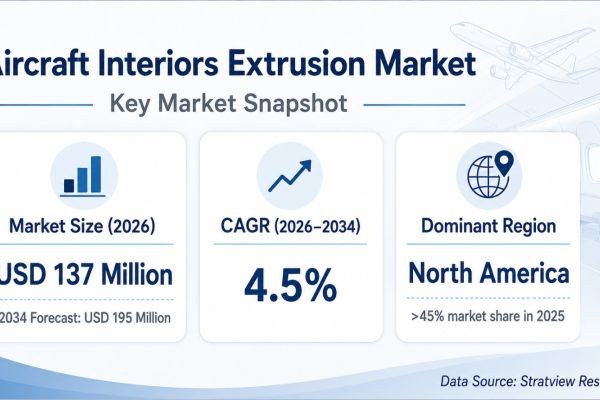
The Aircraft Interiors Extrusion Market was valued at USD 124 million in 2025 and is expected to reach USD 137 million in 2026. Annual demand is forecast to rise to USD 195 million by 2034, representing a CAGR of 4.5% during 2026–2034 and a cumulative sales opportunity of USD 1.5 billion.
“The Aircraft Interiors Extrusion Market is expected to grow at a CAGR of 4.5% during 2026–2034.” The market’s expansion reflects rising commercial aircraft production, increasing aircraft deliveries, fleet modernization, cabin retrofit activity, and demand for lightweight, durable, and high-performance cabin components. These factors are strengthening the long-term industry outlook across the aircraft interiors value chain.
Interior extrusions support seat tracks, overhead stowage systems, partitions, galleys, lavatories, floor structures, window surrounds, cable-management systems, and decorative trim assemblies. Manufacturers are developing corrosion-resistant and recyclable solutions that improve structural efficiency, support aviation safety requirements, reduce aircraft weight, and lower lifecycle costs through greater material and manufacturing efficiency.
A closer assessment of Aircraft Interiors Extrusion Market trends shows that lightweight engineering, precision manufacturing, sustainability, and customized cabin architectures are becoming important competitive differentiators. Continuous advances in aluminum alloys, engineered thermoplastics, profile designs, and extrusion technologies are enabling more efficient cabin structures while supporting aircraft performance, passenger experience, and fuel-efficiency objectives.
Request a free sample report:
https://www.stratviewresearch.com/Request-Sample/aircraft-interiors-extrusion-market#form
Market Segmentation Analysis
By Aircraft Type, the Aircraft Interiors Extrusion Market is segmented into Narrow-Body Aircraft, Wide-Body Aircraft, Regional Aircraft, and Business Jets. Narrow-Body Aircraft are expected to remain the largest demand generator, supported by high production volumes and deployment across short- and medium-haul routes. Wide-Body Aircraft are projected to witness the fastest growth during the forecast period.
By Application Type, the market is segmented into Seats, Galleys/Galley Inserts, Lavatories, Stowages, Floor Panels, and Other Applications. Seats are projected to witness the fastest growth because lightweight extruded profiles are used in structural frames, armrests, tracks, and support systems. Retrofit activity and demand for ergonomic and modular seating are also accelerating replacement requirements.
By Material Type, the market is segmented into Polyamide (PA), Polycarbonate (PC), and Other Materials. Polyamide (PA) is expected to remain the most preferred material type throughout the forecast period. Its mechanical strength, thermal stability, wear resistance, and compatibility with precision extrusion processes support use in seat components, cable-management systems, panels, and support profiles.
By End-User Type, the market is segmented into OE and Aftermarket. OE is expected to retain its leading position and exhibit accelerated growth because extrusion profiles are increasingly integrated into new aircraft during manufacturing. The Aftermarket continues to benefit from refurbishment, maintenance, cabin modernization, and replacement activity across existing aircraft fleets.
By Region, the market is segmented into North America, Europe, Asia-Pacific, and Rest of the World. The regional structure reflects the distribution of aircraft manufacturing, fleet expansion, MRO activity, cabin refurbishment programs, and extrusion supply-chain capabilities. More than 80% of global demand was concentrated within the top ten countries in 2025.
Regional Market Insights
North America held more than 45% of the market in 2025 and is expected to maintain its leading position during the forecast period. Its dominance is supported by the presence of aircraft OEMs, tier suppliers, and extrusion manufacturers, together with established supply-chain integration, investment in advanced manufacturing, and consistent aircraft production and deliveries.
Asia-Pacific is projected to record the fastest growth during 2026–2034. Rising air-travel demand, increasing disposable incomes in China and India, expansion by low-cost carriers, and the presence of Boeing, Airbus, and COMAC are contributing to aircraft production and higher demand for aircraft interior extrusion components across the region.
Emerging Trends Shaping the Aircraft Interiors Extrusion Market
Lightweight engineering is increasingly influencing material and profile selection. Aerospace manufacturers are adopting advanced aluminum and thermoplastic extrusions to reduce cabin weight without compromising durability or safety. This direction supports lower fuel consumption, reduced emissions, and improved aircraft performance, making material efficiency a central theme within the Aircraft Interiors Extrusion Market forecast.
Cabin modernization is expanding demand for customized profiles that support redesigned seating, overhead bins, premium layouts, galley equipment, modular lavatories, and accessibility features. Precision manufacturing and customized dies enable profiles with consistent cross-sections, dimensional accuracy, lower material wastage, and greater design flexibility for increasingly sophisticated aircraft cabin architectures.
Recyclability and corrosion resistance are also receiving greater attention. Manufacturers are developing extrusion solutions that address sustainability and lifecycle-cost requirements while complying with aviation safety and performance standards. These developments are connecting material innovation with operating efficiency, regulatory compliance, manufacturing productivity, and long-term cabin-component performance.
Key Growth Drivers of the Market
- Rising commercial aircraft production: Higher production rates increase demand for precision-engineered profiles used in seats, stowages, partitions, galleys, lavatories, floor structures, window frames, and supporting cabin assemblies.
- Increasing aircraft deliveries: New aircraft deliveries create direct OE demand because extrusion components are integrated into cabin structures and interior systems during aircraft manufacturing.
- Fleet modernization and cabin retrofits: Airlines replacing aging interior components require customized profiles that provide lower weight, greater strength, improved appearance, and compliance with aerospace certification standards.
- Fuel-efficiency and emission requirements: Lightweight extrusion profiles reduce aircraft weight, contributing to lower fuel burn, operating costs, and environmental impact throughout an aircraft’s operational life.
- Advances in materials and manufacturing: High-strength aluminum alloys, engineered thermoplastics, precision extrusion, and customized profile designs support more efficient, durable, and innovative aircraft cabin architectures.
Competitive Landscape
Top Companies in the Market
PEXCO Aerospace, Inc.
Certified Thermoplastics Co., LLC (CTP)
Ensinger GmbH
Rehau Group
Trelleborg AB
Stükerjürgen Aerospace Composites GmbH & Co. KG
Belgraver B.V.
Aereos, Inc.
Conclusion and Strategic Outlook
The Aircraft Interiors Extrusion Market is forecast to advance from USD 137 million in 2026 to USD 195 million by 2034 at a CAGR of 4.5%. Rising production, aircraft deliveries, retrofit programs, lightweighting priorities, and advances in aluminum and thermoplastic profiles will continue shaping demand across OE and aftermarket applications.
The strategic outlook remains closely connected to precision manufacturing, cabin customization, material efficiency, and sustainability. Narrow-Body Aircraft will remain the largest aircraft segment, while Wide-Body Aircraft, Seats, OE applications, and Asia-Pacific are positioned among the most attractive growth areas during the forecast period.
FAQs – Aircraft Interiors Extrusion Market
1. What is the size and forecast of the Aircraft Interiors Extrusion Market?
The Aircraft Interiors Extrusion Market was valued at USD 124 million in 2025 and is expected to reach USD 137 million in 2026. Annual demand is forecast to reach USD 195 million by 2034.
2. What is the expected CAGR of the Aircraft Interiors Extrusion Market?
The Aircraft Interiors Extrusion Market is expected to grow at a CAGR of 4.5% during 2026–2034. The market is projected to generate a cumulative sales opportunity of USD 1.5 billion over that period.
3. What factors are driving Aircraft Interiors Extrusion Market growth?
Growth is driven by rising aircraft production and deliveries, expanding fleets, cabin modernization, retrofit programs, and demand for lightweight cabin components. Advances in aluminum alloys, thermoplastics, precision manufacturing, and customized profiles are further supporting adoption.
4. Which regions lead demand in the Aircraft Interiors Extrusion Market?
North America held more than 45% of the market in 2025 and is expected to maintain its leading position. Asia-Pacific is projected to be the fastest-growing region during the 2026–2034 forecast period.
5. What are the market’s principal risks and investment considerations?
Raw-material price volatility can affect production costs, margins, procurement decisions, and inventory management. Limited availability of workers skilled in precision extrusion, CNC machining, heat treatment, finishing, quality management, and regulatory compliance may also constrain manufacturing capacity.






