
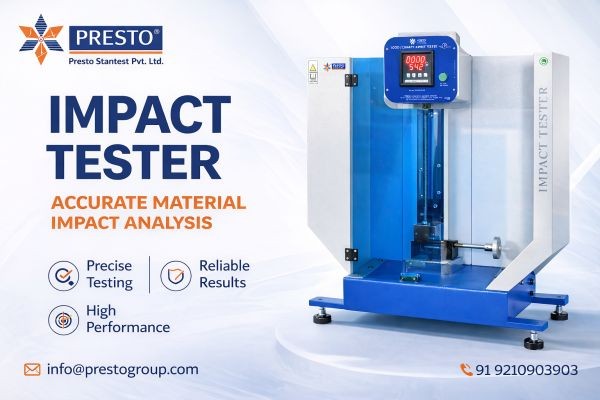
In modern manufacturing, the strength and durability of materials play an important role in determining product quality and performance. Products used in automotive, plastic, packaging, electrical, and engineering industries must withstand different types of mechanical stress during handling, transportation, and everyday applications. One of the most important properties that manufacturers need to evaluate is material toughness, especially when products are exposed to sudden impact conditions.
Material toughness refers to the ability of a material to absorb energy and resist fracture when subjected to an external force. Impact testing helps manufacturers understand how materials behave under sudden loading conditions and whether they can maintain their structural integrity without breaking or cracking.
Why Is Material Toughness Important?
Material toughness is an essential factor in product development and quality control. A material may perform well under normal loading conditions but can fail when exposed to a sudden impact.
For example, plastic components used in automobiles, industrial equipment, and consumer products may experience accidental drops or unexpected mechanical shocks. Similarly, packaging materials must withstand external impacts during transportation to protect the products inside.
Testing material toughness provides several advantages:
-
Improved Product Safety: Helps identify materials that may break or fail under sudden impact.
-
Better Durability: Ensures materials can withstand unexpected mechanical forces.
-
Reduced Product Failures: Helps manufacturers identify weak materials before production.
-
Consistent Quality: Supports uniform material performance across different production batches.
-
Cost Reduction: Minimises material wastage, product rejection, and manufacturing losses.
What Is Impact Testing?
Impact testing is a mechanical testing method used to determine how much energy a material can absorb before fracturing when subjected to a sudden force.
Unlike tensile or compression testing, which generally apply force gradually, impact testing evaluates material behaviour under rapid loading conditions.
Two commonly used methods are the Izod and Charpy impact tests. Both methods use a pendulum-based mechanism to strike a prepared specimen and measure the energy absorbed during fracture.
The results help manufacturers compare different materials and understand their resistance to sudden mechanical forces.
Different Types of Impact Testing Methods
1. Izod Impact Test
The Izod impact test is widely used to evaluate the impact resistance of plastic and other suitable materials. In this method, the specimen is held vertically in a clamping fixture, with a notch facing the direction of impact. A swinging pendulum strikes the specimen, and the absorbed energy is measured.
This method helps manufacturers understand how easily a material can crack or break under sudden impact conditions.
2. Charpy Impact Test
The Charpy impact test evaluates the energy absorbed by a material when struck by a pendulum. In this method, the specimen is supported horizontally at both ends, and the pendulum strikes it at the centre.
It is commonly used for evaluating the impact strength and toughness of materials under controlled testing conditions.
3. Dart Impact Test
The dart impact test is commonly used for evaluating the impact resistance of plastic films, sheets, and flexible packaging materials.
A free-falling dart strikes the test specimen, and the energy required to cause failure is evaluated under specified test conditions. This helps manufacturers assess the durability and puncture resistance of packaging materials.
Role of an Izod/Charpy Impact Tester in Quality Control
An Izod/Charpy Impact Tester is an important instrument for assessing the ability of materials to withstand sudden impact forces.
Presto Stantest offers Izod/Charpy Impact Testing solutions designed to measure the impact resistance of materials using controlled pendulum testing methods.
The instrument provides valuable information about the energy absorbed by a specimen during impact. Depending on the model, it can support both Izod and Charpy testing through separate fixtures.
Modern digital and computerised models offer features such as:
-
Digital display for impact and absorbed energy
-
Separate fixtures for Izod and Charpy testing
-
Strong specimen gripping arrangements
-
Electromagnetic pendulum release mechanism
-
Inbuilt calibration facility
-
Test result recording and reporting options
These features help laboratories and manufacturers perform impact testing more efficiently and maintain reliable quality control records.
Industries That Require Material Impact Testing
Impact testing is useful across several manufacturing sectors where material failure can affect product performance and safety.
Automotive Industry: Evaluates the impact resistance of plastic components, interior parts, and other materials used in vehicles.
Plastic Manufacturing: Helps determine the toughness of plastic products, sheets, and moulded components.
Packaging Industry: Evaluates the durability of packaging materials to minimise damage during handling and transportation.
Electrical Industry: Helps assess the impact resistance of plastic housings, enclosures, and protective components.
Engineering and Manufacturing: Supports material selection and quality verification for industrial applications.
Why Choose Presto Stantest for Impact Testing Solutions?
Presto Stantest provides reliable material testing instruments designed to support industrial quality control and laboratory testing requirements.
Its Izod/Charpy Impact Tester range helps manufacturers evaluate material impact resistance through controlled testing procedures. The instruments are designed with practical features, accurate measurement capabilities, and user-friendly operation.
By using suitable impact testing equipment, manufacturers can improve material selection, identify potential weaknesses, and maintain consistent product quality.
Conclusion
Assessing material toughness under sudden impact conditions is essential for developing durable, reliable, and high-quality products. Impact testing helps manufacturers understand how materials respond to unexpected mechanical forces and identify potential failure risks before products reach the market.
With suitable testing instruments such as Izod/Charpy Impact Testers and Dart Impact Testers, manufacturers can strengthen their quality assurance processes and improve product reliability.
Choose Presto Stantest for dependable material impact testing solutions and take a step towards better product quality.
Contact Presto Stantest
Website: www.prestogroup.com
Email: info@prestogroup.com
Phone: +91 9210 903 903


