
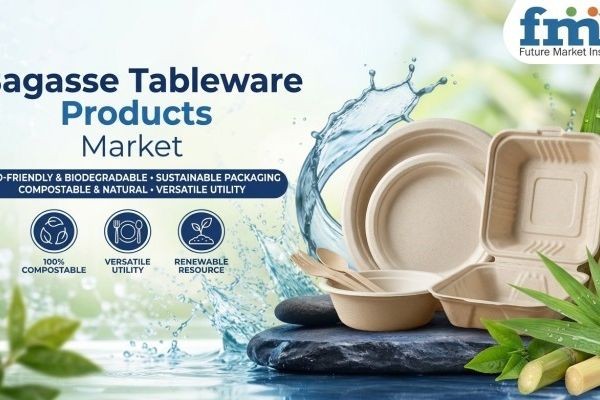
The global bagasse tableware products market is projected to grow from USD 3.1 billion in 2026 to USD 6.2 billion by 2036, registering a Compound Annual Growth Rate (CAGR) of 7.2% over the forecast period. According to the latest market analysis by Future Market Insights, the industry is benefiting from foodservice operators replacing expanded polystyrene foam and conventional plastic tableware with molded sugarcane fiber alternatives.
Bagasse, the fibrous residue left after sugarcane crushing, provides a feedstock for rigid plates, bowls, meal trays and hinged food containers. Thermoforming converts depithed fiber into products designed for takeaway meals, institutional catering and commercial foodservice. The market is expected to add USD 3.1 billion in value between 2026 and 2036 as regulatory restrictions and procurement requirements encourage wider adoption.
KEY MARKET TAKEAWAYS
- Market Valuation: USD 3.1 billion in 2026, projected to reach USD 6.2 billion by 2036.
- Growth Rate: Expanding at a 7.2% CAGR from 2026 to 2036.
- Leading Segment: Plates account for 35.2% of product type revenue in 2026.
- Fastest-Growing Country: India leads the eight evaluated markets with an 8.4% CAGR.
- Core Growth Driver: Restrictions on expanded polystyrene and single-use plastics, combined with demand for PFAS-free foodservice packaging, are encouraging material substitution.
INDUSTRY SHIFTS & MARKET DYNAMICS
Foodservice purchasing patterns are creating sustained demand for molded bagasse tableware. Quick-service restaurants, cloud kitchens and institutional cafeterias require disposable products that can contain hot meals, sauces and takeaway portions without losing structural integrity. Plates lead the product category with a 35.2% share in 2026, supported by their use across restaurant meals, catering and cafeteria service. Food applications account for 72.0% of application demand, while commercial use represents 59.0% of end-use spending.
The shift toward fluorine-free formulations is also changing product specifications. No-Added-PFAS Fiber is expected to capture 41.8% of finish-type demand in 2026 as buyers seek alternatives to fluorinated grease barriers. Manufacturers are working with fiber densification and internal sizing technologies to improve oil resistance without relying on intentionally added PFAS. However, longer thermoforming cycles and higher costs associated with fluorine-free barriers can pressure converter margins. Supply-chain economics also depend on access to sugarcane mills, pulp-processing capacity and distribution networks. Co-location with sugar mills can reduce feedstock handling and processing costs, while import duties and limited composting infrastructure create challenges in some markets.
REGIONAL MARKET SUMMARY
India is projected to record the fastest growth among the eight evaluated countries, supported by domestic sugarcane processing and expanding foodservice applications.
- India: 8.4% CAGR, supported by integrated sugar-mill pulp production and plastic restrictions.
- China: 8.0% CAGR, driven by meal-delivery demand and domestic molded-fiber manufacturing.
- Mexico: 7.8% CAGR, supported by sugarcane availability and access to North American markets.
- United Kingdom: 7.4% CAGR, reflecting restrictions on single-use plastic plates and polystyrene takeaway containers.
- Germany: 6.9% CAGR, supported by demand for compliant, fluorine-free foodservice packaging.
The United States is projected to grow at 6.7%, France at 6.8%, and Canada at 6.6% over the same period.
ANALYST INSIGHTS
"Foodservice operators are rapidly replacing polystyrene foam and fluorinated fiber with fluorine-free bagasse plates and hinged clamshells. However, longer platen press dwell times for PFAS-free chemistries and anti-dumping duties on imported bowls continue to test converter margins," stated Nandini Roy Choudhury, Principal Consultant at Future Market Insights.
COMPETITIVE LANDSCAPE
Competition in the bagasse tableware products market centers on product range, grease-resistance performance, fluorine-free formulations, compostability credentials and manufacturing integration. Suppliers are working to meet foodservice requirements while managing production costs and maintaining consistent product quality.
Notable companies include Huhtamäki Oyj, Dart Container Corporation, Sabert Corporation, Pactiv Evergreen Inc. (Novolex), Pakka Limited, Genpak LLC, Duni Group, Vegware Ltd., Stora Enso Oyj, BioPak Pty Ltd. and World Centric. Vertically integrated producers with access to sugarcane pulp and thermoforming facilities also compete through feedstock sourcing and manufacturing capabilities.
ABOUT THE REPORT
The Future Market Insights report examines the global bagasse tableware products market from 2026 to 2036, using 2025 as the historical base year. It evaluates demand across product type, finish type, application, end use and sales channel. The study also assesses regional performance and eight key country markets, including India, China, Mexico, the United Kingdom, Germany, France, the United States and Canada. Its analysis considers market sizing, country growth rates, manufacturing conditions and competitive positioning.


