
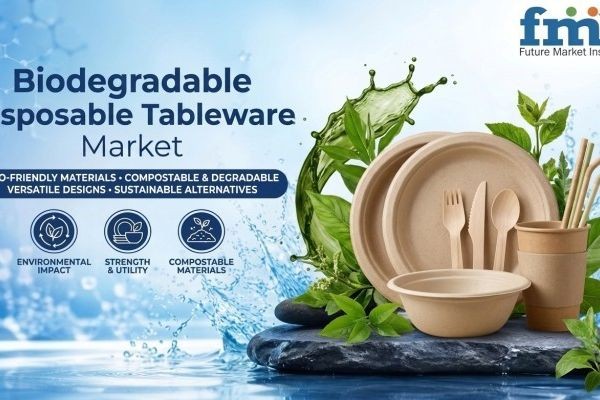
The global biodegradable disposable tableware market is estimated to reach USD 13.3 billion in 2026, up from USD 12.7 billion in 2025, and is projected to reach USD 20.3 billion by 2036. According to the latest market report published by Future Market Insights (FMI), the industry is anticipated to expand at a Compound Annual Growth Rate (CAGR) of 4.3% over the 2026–2036 forecast period, adding USD 7.0 billion in market value.
The shift away from expanded polystyrene and conventional single-use plastics is changing procurement across quick-service restaurants, cloud kitchens, institutional cafeterias and catering operations. Buyers are increasingly evaluating molded-fiber products on food-contact compliance, grease resistance, stacking consistency and compatibility with existing packaging lines.
KEY MARKET TAKEAWAYS
- Market Valuation: USD 13.3 billion in 2026, projected to reach USD 20.3 billion by 2036.
- Growth Rate: The market is forecast to expand at a 4.3% CAGR from 2026 to 2036.
- Leading Raw Material: Sugarcane Bagasse & Pulp is expected to account for 66.7% of raw material demand in 2026.
- Leading Product Type: Plates, Trays & Clamshells are estimated to hold a 34.7% share in 2026.
- Leading Barrier Chemistry: PFAS-Free Barrier Coatings are projected to account for 73.9% of demand.
- Leading End-Use Channel: QSR & Cloud Kitchens are expected to represent 62.4% of the market.
- Fastest-Growing Country: Australia is projected to record the highest country-level growth at a 5.4% CAGR.
- Core Growth Driver: Restrictions on single-use plastics and fluorinated food-contact materials are accelerating the adoption of fiber-based tableware.
INDUSTRY SHIFTS & MARKET DYNAMICS
Foodservice operators are moving beyond limited sustainability trials and incorporating biodegradable tableware into routine packaging procurement. Restaurant chains and delivery kitchens need plates, trays and clamshells that can handle hot, oily meals without losing shape or leaking during transport. Sugarcane bagasse and wood pulp are gaining preference because wet-molded fiber can provide the rigidity required for commercial takeaway applications.
Sugarcane Bagasse & Pulp is projected to account for 66.7% of raw material demand in 2026. Its availability as a sugar-milling by-product and its suitability for heated platen pressing support large-volume manufacturing. Plates, Trays & Clamshells lead product demand with a 34.7% share, reflecting the importance of compartmentalized meal packaging across quick-service and delivery channels.
Regulatory changes are also influencing material specifications. In January 2025, the U.S. Food and Drug Administration confirmed the completion of the voluntary market phase-out of grease-proofing substances containing per- and polyfluoroalkyl substances (PFAS) across the United States. This transition is supporting demand for fluorine-free barrier formulations. PFAS-Free Barrier Coatings are expected to account for 73.9% of barrier chemistry demand in 2026.
However, higher mold-tooling costs and uneven access to industrial composting facilities remain obstacles. Compostable products may not reach suitable processing facilities after disposal, while contamination in mixed recycling streams can limit recovery. Manufacturers must therefore balance product performance, unit economics and end-of-life requirements when developing new tableware formats.
REGIONAL MARKET SUMMARY
Country-level growth projections show Australia leading the market, supported by plastic restrictions and wider adoption of certified compostable foodservice products.
- Australia: 5.4% CAGR, driven by state-level single-use plastic restrictions and commercial organics collection.
- South Korea: 4.5% CAGR, supported by food-delivery demand and adoption of fiber-based tableware.
- France: 4.3% CAGR, reinforced by the Anti-Waste for a Circular Economy law and plastic tableware restrictions.
- Germany: 4.2% CAGR, supported by packaging compliance requirements and demand for fluorine-free fiber containers.
- United States: 4.1% CAGR, driven by PFAS phase-out measures and state-level extended producer responsibility requirements.
The United Kingdom is projected to grow at 4.0%, followed by Canada at 3.9% and Japan at 3.8% over the forecast period.
ANALYST INSIGHTS
"Foodservice procurement directors no longer treat compostable tableware as a niche sustainability trial. Suppliers win national quick-service and healthcare contracts when their PFAS-free bagasse trays match plastic clamshell line speeds, hold hot grease during delivery, and qualify for established paper or industrial composting streams," stated Nandini Roy Choudhury, Principal Consultant at Future Market Insights. "The next phase of competition will depend on delivering consistent food-contact performance while meeting the recovery requirements of different regional waste-management systems."
ABOUT THE REPORT
Future Market Insights’ Biodegradable Disposable Tableware Market report examines market revenue, segment performance and country-level growth across the 2026–2036 forecast period. The study covers raw materials, product types, barrier chemistry, end-use channels and sustainability grades. It also assesses regional developments, competitive positioning and procurement trends shaping commercial foodservice tableware. The research uses primary and secondary inputs, with market estimates triangulated through top-down and bottom-up analysis.


