
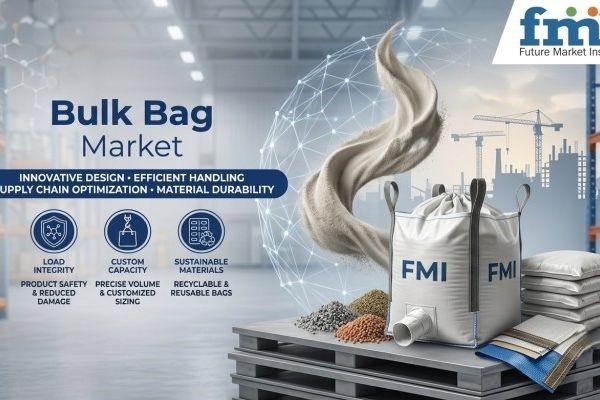
The global bulk bag market is projected to increase from USD 10.4 billion in 2026 to USD 15.7 billion by 2036, registering a compound annual growth rate (CAGR) of 4.2% during the forecast period. The market was valued at USD 10.0 billion in 2025, with the projected expansion representing USD 5.3 billion in additional revenue between 2026 and 2036, according to Future Market Insights.
Demand is supported by industrial requirements for transporting dry chemicals, minerals, agricultural commodities and food ingredients. Flexible intermediate bulk containers (FIBCs) offer a foldable alternative to rigid drums and other bulk packaging formats. Their ability to accommodate large loads while reducing empty-container storage and return freight requirements makes them relevant to chemical plants, grain exporters and industrial logistics operators.
KEY MARKET TAKEAWAYS
- Market Valuation: The bulk bag market is estimated at USD 10.4 billion in 2026, up from USD 10.0 billion in 2025, and is projected to reach USD 15.7 billion by 2036.
- Growth Rate: Sales are forecast to advance at a 4.2% CAGR from 2026 to 2036.
- Leading Material Resin: Polyethylene (LLDPE / HDPE) is projected to account for 43.7% of material resin demand in 2026.
- Leading Product Format: Pre-Formed Pouches & Bags are expected to represent 49.5% of product format revenue.
- Largest Barrier Segment: High-Barrier Modified Atmosphere (EVOH) is projected to hold 40.3% of barrier-level demand.
- Fastest-Growing Evaluated Country: The USA leads the profiled countries with a projected 5.1% CAGR through 2036.
- Core Growth Driver: Expanding cross-border shipments of dry chemicals, minerals and food ingredients are supporting demand for high-capacity, foldable industrial packaging.
INDUSTRY SHIFTS & MARKET DYNAMICS
Industrial buyers are increasingly evaluating bulk bags as part of their wider material-handling and logistics systems. Chemical manufacturers, agricultural exporters and food ingredient processors require packaging that can handle substantial loads while maintaining product integrity during storage, filling and transportation. Pre-formed bags with filling spouts, lifting loops and discharge features support automated weighing and filling operations. These configurations reduce manual handling and help plants maintain consistent packaging workflows.
Material performance remains central to purchasing decisions. Polyethylene liners provide chemical inertness, elasticity and moisture protection, while woven polypropylene outer bodies supply structural strength. High-barrier EVOH constructions serve shipments that require protection against oxygen and humidity during extended maritime transit. Buyers handling fine powders also assess sift-proof seams, liner compatibility and electrostatic safety before qualifying suppliers.
Regulatory requirements and resin-price fluctuations are shaping procurement strategies. European packaging rules, national plastic taxes and extended producer responsibility requirements are encouraging manufacturers to evaluate recyclable and reusable designs. At the same time, volatility in petroleum-derived polypropylene and polyethylene feedstocks can affect conversion costs and supplier margins. Industrial users handling combustible powders must also consider static-control requirements, testing and grounding procedures when selecting bulk containers.
Opportunities are emerging around mono-material construction, reusable container fleets and digital tracking. Recyclable bag designs that reduce the need to separate inner liners could support industrial recovery programmes. RFID-enabled lifting loops can help fleet operators monitor fill dates, usage cycles and warehouse dwell times. Suppliers combining material engineering with washing, repair and reuse services may find additional opportunities in long-term industrial procurement contracts.
REGIONAL MARKET SUMMARY
Country-level forecasts indicate different growth trajectories across the six evaluated markets:
- USA: Expected to register the fastest growth among the profiled countries, at a 5.1% CAGR from 2026 to 2036. Petrochemical resin production, grain handling and automated filling operations support demand.
- Spain: Projected to expand at a 4.7% CAGR, supported by ceramic mineral exports, agricultural shipments and demand for reusable industrial sacks.
- Germany: Forecast to grow at a 4.4% CAGR, with specialty chemical exports, antistatic packaging requirements and recycling regulations shaping procurement.
- Japan: Expected to record a 4.0% CAGR, driven by battery materials, electronics chemicals and automated warehouse operations.
- United Kingdom: Projected to advance at a 3.7% CAGR, supported by construction aggregate distribution, grain handling and recycled-content requirements.
- France: Anticipated to grow at a 3.4% CAGR, with dairy powder, sugar and cereal exports contributing to demand for food-contact bulk liners.
ANALYST INSIGHTS
"Multi-layer barrier liners and woven conductive threads let chemical exporters ship moisture-sensitive powders safely across humid maritime routes. Plant buyers still demand verified static grounding logs before approving a new bag supplier," stated Nandini Roy Choudhury, Principal Consultant at Future Market Insights.
The analyst perspective highlights the importance of combining barrier performance with operational safety. As industrial users evaluate suppliers, packaging specifications must address the nature of the cargo, transportation conditions and filling or discharge requirements. Manufacturers that can demonstrate consistent liner quality, structural performance and static-control compliance will be better positioned to meet demanding procurement specifications.
COMPETITIVE LANDSCAPE
The bulk bag market includes global packaging manufacturers, FIBC specialists and industrial distribution companies. Notable companies profiled by Future Market Insights include Greif Inc., Berry Global Group Inc., Conitex Sonoco, AmeriGlobe LLC, Halsted Corporation, Langston Companies Inc., Bag Corporation and MiniBulk Inc.
Competition centres on woven fabric and liner integration, cleanroom conversion, antistatic capabilities, custom spout and baffle engineering, and geographic supply coverage. Vertically integrated manufacturers can coordinate tape extrusion, fabric weaving and liner production, while specialist converters focus on custom bag designs, food-grade handling and regional inventory programmes.
The report also identifies developments involving automated weaving, ultrasonic seam-sealing and RFID-enabled reusable container fleets. These capabilities reflect the industry's focus on improving manufacturing consistency, tracking container use and supporting specialised industrial applications.
ABOUT THE REPORT
The Future Market Insights report on the bulk bag market examines industry revenue and demand forecasts from 2026 to 2036. It analyses the market by material resin, product format, barrier level and region, with country-level assessments covering the USA, Spain, Germany, Japan, the UK and France, among others.
The study profiles key suppliers and evaluates demand drivers, restraints, commercial opportunities and operational requirements across industrial packaging applications. Its research methodology combines primary interviews with FIBC manufacturers, liner extruders, chemical plant packaging engineers, agricultural buyers and logistics managers with secondary research and market triangulation.


