
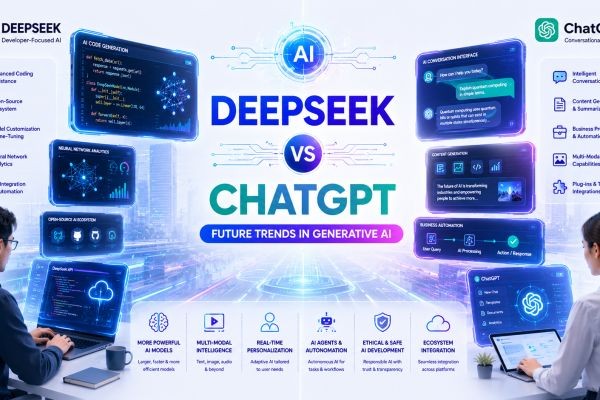
DeepSeek vs ChatGPT: Future Trends in Generative AI
Now beginning to reshape sectors, generative AI drives automation while lifting efficiency across operations. Not far behind in the spotlight, DeepSeek vs ChatGPT has become one of the most discussed comparisons in AI — both platforms are known for sharp language skills and novel tools. With global interest rising, companies turn to such systems — not only to refine interactions but also to streamline processes. Digital change moves faster when intelligent responses emerge on demand.
With companies putting more into artificial intelligence, knowing how DeepSeek differs from ChatGPT matters when choosing tools that support long-term success. Though both serve similar purposes, their underlying designs lead to varied outcomes in real-world use. One might process data faster, while the other adapts better to specific tasks. These contrasts shape performance across industries. Picking wisely depends on matching capabilities to actual needs. Growth relies not just on adopting tech, but on aligning it with strategy.
DeepSeek and ChatGPT Explained
Though built for comparable tasks, DeepSeek and ChatGPT take different paths in design and learning approaches because of how each adapts to real-world uses. One begins with language understanding, the other grows through iterative feedback, yet their goals often overlap despite separate origins.
Beginning with natural dialogue, ChatGPT — crafted by OpenAI — handles tasks like generating written material, aiding software development, and streamlining business workflows. Across sectors such as medicine, banking, educational institutions, and online retail, its presence is evident through practical integration.
Now showing strong performance, DeepSeek stands out with sharp reasoning skills, handles multiple languages well while keeping operational costs low. Growing adoption by companies happens as they look for flexible ways to include artificial intelligence in their systems.
Some firms turn to AI development solutions [https://www.helpfulinsightsolution.com/service/ai-development-services], finding ways to simplify workflows through automated processes. One result shows clearer paths in daily decisions. Tasks that repeat often now run on their own. Platforms shaped by AI help reshape how work moves forward. Efficiency grows without constant oversight.
DeepSeek vs ChatGPT: How They Differ
1. Performance and Accuracy
Though ChatGPT offers smooth dialogue flow, its strength lies in tracking context across turns. Because it adapts well to different topics, many rely on it during drafting tasks or code troubleshooting. While some users prefer it for brainstorming, others find value in refining support messages. Despite varying needs, the model often keeps replies aligned with prior inputs.
Because DeepSeek emphasizes logical reasoning, its design supports high computational efficiency. As a result, researchers often choose it for complex analysis and technical problem-solving. Its structure works well across scientific studies and data-heavy processes. Efficiency becomes noticeable when running detailed algorithmic workflows.
When companies use AI development solutions, they tend to weigh one model against another — looking at how well each handles growth, delivers answers, fits into daily workflows — noticing differences only after testing them live.
2. Customization Capabilities
For businesses using AI, adapting tools to fit needs matters most. While one option allows custom workflows through APIs and add-ons, another gives companies freedom to set up systems their own way. Different paths emerge when firms seek precise control over artificial intelligence functions.
Businesses today often turn toward Custom AI development services — shaped by specific goals they aim to reach. These systems grow out of targeted efforts focused less on trends, more on practical outcomes. Instead of off-the-shelf software, companies lean into tailored models that reflect real workflows. Personalization becomes central, not through force, but through gradual refinement. Objectives guide design, step by step. Technology adapts where it once demanded adaptation.
3. Cost and Accessibility
One reason companies are turning to Artificial Intelligence development solutions is that expense matters more now than before. DeepSeek stands out by keeping computational costs low — this helps smaller firms stay competitive. What once seemed too pricey suddenly feels within reach, mainly because alternatives lack similar value.
Still widely seen as a top-tier option, ChatGPT offers strong tools tailored for business use along with refined language processing. When choosing a system, companies typically weigh costs alongside daily workflows.
What Comes Next in Generative AI
Not far behind flashy headlines, the race between DeepSeek and ChatGPT signals how fast generative AI is shifting. While predictions float around, a few clear patterns may define where AI heads next.
AI-Powered Business Automation
More companies now use generative AI across areas like customer service, hiring tasks, promotion strategies, and information review. With automation powered by Artificial Intelligence development services, routine duties take less time because systems handle steps once done by people — efficiency rises when machines assist.
Some companies now using artificial intelligence tools find they move faster than rivals, thanks to smoother operations that cut delays. While workflows become more efficient, interactions with clients also grow sharper and more responsive over time.
Rise of Multimodal AI
One step ahead, future AI systems are set to handle images, sound, words, and moving visuals together in one place. Because of this blend, companies can build digital interactions that respond smarter and feel more alive. While combining inputs isn't new, doing it seamlessly opens doors once limited by separate tools.
When firms look ahead at using artificial intelligence over time, they usually hire dedicated developer talent to create adaptable software and large-scale internal platforms driven by AI.
Enhanced Personalization
Personalization is growing sharper across AI systems. Because of how users act online, services now adjust responses in real time — ecommerce suggestions shift quietly, while digital helpers learn routines without being told. As habits change, so do replies, shaped by what people click, search, or skip. These tools respond not with rules but patterns, building feedback loops that refine over weeks. What feels intuitive often stems from repeated choices made long before.
When companies put resources into AI chatbot development services [https://www.helpfulinsightsolution.com/ai-chatbot-development-services], they often see better results in how customers feel about their experience. Personalized interactions tend to emerge naturally through these systems, shaping how people engage over time. As responses become more tailored, loyalty sometimes grows without extra effort. Improved outcomes follow when technology adapts to individual behaviors. Satisfaction levels rise as relevance increases across touchpoints.
Smarter AI with Better Safety and Fairness
With growing reliance on artificial intelligence, companies now place a stronger emphasis on safeguarding information and responsible deployment, while aligning with legal standards. Ahead lies a shift toward systems designed for clearer decision-making, fairer outcomes, alongside tighter control over sensitive inputs. Working with a trusted AI development company helps navigate these evolving compliance demands effectively.
As needs increase, companies turn to Artificial Intelligence development services — emphasizing security and tailored solutions for specific industries. A shift shaped by real-world requirements rather than generic tools. Built carefully, these systems respond directly to operational demands. Security becomes central when designing artificial intelligence for specialized fields. Each solution reflects unique challenges within its sector. Driven by necessity, not trend. Development focuses on reliability, precision, and flexibility. Industries seek control, clarity, and long-term function. Custom approaches replace one-size-fits-all models. Progress measured in fit, not speed.
Which Platform Works Better for Business?
Businesses need to decide whether DeepSeek or ChatGPT fits better. Scalability plans tilt the balance one way or another. Cost factors often decide what stays and what gets cut.
Because it offers strong conversation tools, creates written material well, and supports many connected applications, ChatGPT fits companies needing high-level AI interaction. Where budget matters more, along with clear logic, performance, and smooth operation, DeepSeek could serve certain teams even better.
Before choosing, companies using AI development services must consider how well systems integrate, the strength of training options, ongoing upkeep needs, and whether operations can grow smoothly over time.
Conclusion
One step ahead, DeepSeek, along with ChatGPT, is redefining what generative AI can do — making automated tasks more intuitive, conversations sharper, systems more responsive. The ongoing DeepSeek vs ChatGPT debate reflects how rapidly the AI landscape shifts and how critical it is for companies to evaluate both platforms carefully. Because progress never slows, companies find themselves weighing daily needs against long-term tech demands when picking an AI path. While capabilities shift rapidly, matching tools to real-world function becomes less about trends, more about fit. Behind every decision sits a need: clarity amid complexity.
Later on, generative AI is likely to emphasize tailored outputs, blending senses like vision and sound into one system, responsible usage, and streamlining company workflows. Firms moving ahead now with developing these tools — whether through specialized platforms or proven AI development solutions — may find themselves more competitive while unlocking sustained expansion as technology shifts happen fast.


