
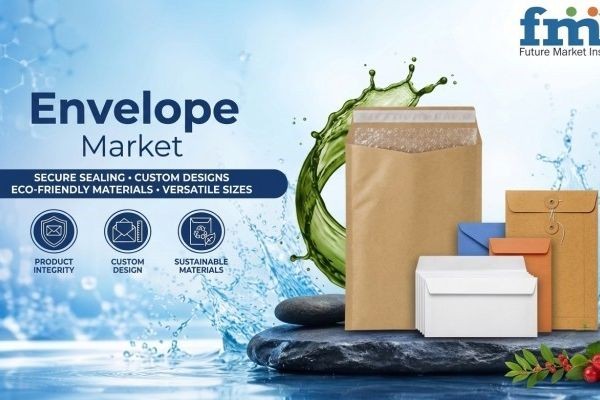
The global envelope market is valued at USD 360.1 million in 2026, up from USD 337.0 million in 2025, and is projected to reach USD 721.7 million by 2036, expanding at a compound annual growth rate (CAGR) of 7.2% from 2026 to 2036. According to the latest market analysis by Future Market Insights (FMI), the industry is expected to generate USD 361.6 million in incremental revenue over the forecast period.
Demand is shifting from conventional business correspondence envelopes towards shipping formats designed for e-commerce fulfilment. Online retailers increasingly use padded, self-sealing and recyclable mailers to protect individual products while reducing package dimensions and shipping costs. This change is creating new opportunities for envelope converters and paper packaging manufacturers.
KEY MARKET TAKEAWAYS
- Market Valuation: USD 360.1 million in 2026, rising to USD 721.7 million by 2036.
- Growth Rate: The market is projected to expand at a 7.2% CAGR from 2026 to 2036.
- Leading Envelope Architecture: Padded bubble cushion air mailers account for 34.2% of market revenue in 2026.
- Leading End-Use Application: E-commerce small parcel order fulfilment represents 45.4% of demand in 2026.
- Dominant Substrate: Virgin and recycled kraft paper holds a 52.4% share in 2026.
- Fastest-Growing Country: Mexico leads the tracked country markets with an 8.4% CAGR.
- Core Growth Driver: E-commerce packaging conversion, demand for right-sized parcel formats and retailer commitments to replace plastic mailers with recyclable fibre alternatives.
INDUSTRY SHIFTS & MARKET DYNAMICS
The envelope market is increasingly tied to parcel fulfilment rather than traditional letter volumes. Apparel, cosmetics, books and small consumer goods sellers are replacing selected cartons and plastic bags with padded paper mailers. These formats can reduce package dimensions, improve delivery efficiency and provide protection during automated sorting and last-mile transportation. As a result, converters are investing in high-speed production, self-adhesive closures and mailers designed for automated packing lines.
Sustainability requirements are also influencing material selection. Retailers are seeking mono-material paper cushioning and recyclable kraft substrates that can enter established paper recovery streams. FMI estimates that curbside-recyclable fibre mailer penetration could rise from 61.0%–65.0% in 2026 to 76.0%–81.0% by 2036. Peel-and-seal closures are gaining ground because they reduce manual packing steps and support convenient customer returns. Their market share is projected to increase from 46.3% in 2026 to 54.5% by 2036.
However, conventional transactional envelopes face pressure from electronic billing, digital banking and online document delivery. Cross-border parcel duties and customs requirements can also affect international mailer volumes. These factors are encouraging manufacturers to focus on domestic fulfilment contracts, protective packaging specifications and higher-value recyclable formats.
REGIONAL MARKET SUMMARY
FMI identifies the following country growth rates for 2026 to 2036:
- Mexico: 8.4% CAGR, supported by cross-border trade and expanding domestic fulfilment infrastructure.
- Brazil: 8.0% CAGR, driven by marketplace activity and rising demand for protective parcel packaging.
- Poland: 7.8% CAGR, supported by e-commerce logistics hubs and automated parcel locker networks.
- United Kingdom: 7.4% CAGR, reflecting demand for lightweight, recyclable mailing formats.
- United States: 7.2% CAGR, supported by large-scale parcel fulfilment and automated mailer production.
The United States remains the largest national market, accounting for 32.0% of global revenue in 2026. Its market is projected to increase from USD 115.2 million in 2026 to USD 230.9 million by 2036. Germany and the United Kingdom are also important markets, supported by established packaging converters and demand for recyclable shipping materials.
ANALYST INSIGHTS
"Envelope converters will grow revenue faster than unit volume because fulfillment centers are paying for curbside-recyclable fluted kraft padding, dual-strip return flaps, and glueline-free sealing that pass automated postal thickness gates. The primary category risk is customs duty volatility on cross-border small parcels, which can slow international mailer flows," stated Nandini Roy Choudhury, Principal Consultant at Future Market Insights (FMI).
ABOUT THE REPORT
The FMI report examines the global envelope market across envelope architecture, closure systems, standard sizing, end-use applications, substrate materials and geographic regions. It provides market estimates and forecasts for 2026 to 2036, supported by analysis of manufacturer revenue, converted material volumes, industry interviews and secondary market benchmarks.


