
Market Overview and Growth Outlook
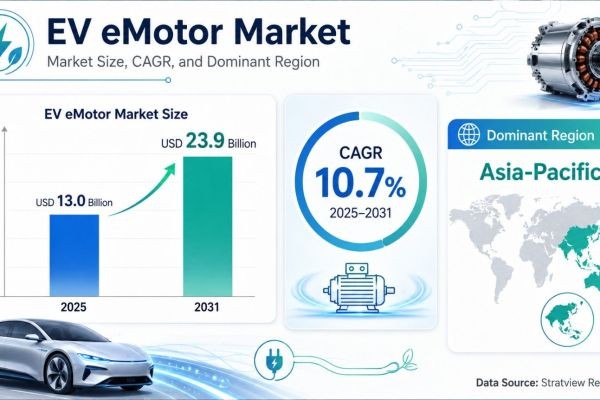
The EV eMotor Market was valued at USD 11.1 billion in 2024 and is forecast to reach USD 23.9 billion by 2031. The market is projected to grow at a CAGR of 10.7% during 2025-2031, supported by rising electric vehicle sales, higher motor efficiency, better thermal management, and expanding EV infrastructure.
“The EV eMotor Market is expected to grow at a CAGR of 10.7% during 2025-2031.” Demand is increasing because every electric vehicle requires at least one motor, while several models use multiple motors. This creates a direct link between EV production growth and eMotor demand across vehicle platforms.
The EV eMotor Market is also benefiting from improvements in power density, lightweight materials, and motor efficiency. These developments enhance EV performance and range. For executives tracking EV eMotor Market trends, the market analysis shows a clear shift toward more efficient propulsion architectures.
Request a free sample report:
https://www.stratviewresearch.com/Request-Sample/ev-emotor-market#form
Market Segmentation Analysis
Vehicle-Type Analysis includes LV and M&HCV. LV is expected to maintain its dominance during the forecasted period. LVs, including passenger cars, compact SUVs, and small commercial vehicles, hold the largest share because of high vehicle production volumes and wide use in personal and commercial transportation.
Number of Motor Types Analysis includes 1 Motor, 2 Motors, 3 Motors, and 4 Motors. 2 Motors are expected to be the demand generator for the EV eMotors market. Dual-motor systems support acceleration, energy distribution, driving range, traction, stability, and handling performance across different road conditions.
Technology-Type Analysis includes PMSM, IM, and Other Technologies. PMSM motors are expected to remain dominant throughout the forecast period. PMSMs offer high efficiency, increased power output, precise torque control, consistent performance, durability, and support for the evolving demands of modern electric vehicles.
EV-Type Analysis includes BEV and HEV. HEV is anticipated to contribute to a larger share of the EV eMotors market, whereas BEVs are expected to experience faster growth during the forecast period. HEV eMotors have lower power requirements, helping reduce manufacturing costs while improving vehicle efficiency.
Integration-Type Analysis includes Standalone and Integrated in eAxle. Currently, standalone eMotors dominate the market, but integrated in eAxle eMotors are expected to see substantial growth in the coming years. Standalone eMotors offer design flexibility, while integrated in eAxle systems support compact construction, lower weight, and superior efficiency.
Region Analysis includes North America, Europe, Asia-Pacific, and The Rest of the World. Asia-Pacific is expected to maintain its reign over the forecast period. Regional demand is supported by higher EV adoption, major EV and eMotor manufacturers, cost-effective production, charging infrastructure expansion, and government investments in green mobility.
Regional Market Insights
Asia-Pacific is expected to remain the largest and fastest-growing region for the EV eMotors market during the forecast period. Higher EV adoption in China, Japan, and South Korea, supported by government subsidies and policies, strengthens regional demand. The presence of major EV and eMotor manufacturers also supports cost-effective production.
Europe is estimated to remain the second-largest region for the EV eMotors market. The region’s demand is supported by sustainability commitments, government incentives, strict emissions regulations, and the presence of major automakers and suppliers. These factors strengthen its industry outlook and support ongoing innovation in electric powertrain manufacturing.
Emerging Trends Shaping the EV eMotor Market
The EV eMotor Market is moving toward higher motor efficiency, improved power density, better thermal management, and lightweight material adoption. These trends directly support improved range and performance. The market forecast also reflects growing demand for integrated in eAxle eMotors as future EV designs prioritize compact and efficient architectures.
Another important industry trend is the continued relevance of multiple-motor configurations. 2 Motors are expected to remain the demand generator because they enhance performance, energy efficiency, traction, stability, and handling. This supports both market intelligence and strategic insights for suppliers serving high-performance and efficiency-driven EV platforms.
Key Growth Drivers of the Market
- Increasing global sales of electric vehicles directly raise eMotor demand because every EV requires at least one motor, while some models use multiple motors.
- Improvements in motor efficiency, power density, and thermal management enhance EV performance, which supports stronger adoption and market growth.
- Lower battery prices make electric vehicles more affordable, increasing adoption and creating direct demand for electric motors across vehicle types.
- Government policies, incentives, and mandates for EV adoption support electrification, creating a stronger demand base for electric propulsion systems.
- Expanding EV infrastructure increases consumer confidence in electric vehicles, supporting EV sales and driving higher demand for eMotors.
Competitive Landscape
Top Companies in the Market
Tesla, Inc.
BYD Auto Co., Ltd.
Volkswagen AG
Valeo SA
Nidec Corporation
Dana Incorporated
ZF Friedrichshafen AG
Conclusion and Strategic Outlook
The EV eMotor Market is positioned for sustained growth, rising from USD 11.1 billion in 2024 to USD 23.9 billion by 2031. With a 10.7% CAGR during 2025-2031, the market is shaped by EV adoption, motor efficiency improvements, power density gains, and expanding charging infrastructure.
The strategic outlook remains linked to propulsion efficiency, vehicle electrification, and regional manufacturing strength. Asia-Pacific’s leadership, LV dominance, PMSM preference, HEV share, and growing integrated in eAxle adoption define the competitive landscape. The industry outlook points to continued demand for efficient, compact, and performance-focused eMotor systems.
FAQs – EV eMotor Market
What is the EV eMotor Market size and forecast?
The EV eMotor Market was valued at USD 11.1 billion in 2024. It is forecast to reach USD 23.9 billion by 2031, supported by rising electric vehicle demand and powertrain electrification.
What is the CAGR of the EV eMotor Market?
The EV eMotor Market is expected to grow at a CAGR of 10.7% during 2025-2031. This growth reflects increasing EV sales, efficiency improvements, and expanding charging infrastructure.
What is driving growth in the EV eMotor Market?
Growth is driven by rising EV sales, improvements in motor efficiency, higher power density, better thermal management, lower battery prices, and government support. These factors increase demand for electric propulsion systems.
Which region leads the EV eMotor Market?
Asia-Pacific is expected to remain the largest and fastest-growing region during the forecast period. The region benefits from higher EV adoption, major EV and eMotor manufacturers, and government support for green mobility.
What is the investment outlook for the EV eMotor Market?
The investment outlook remains positive because the market is forecast to reach USD 23.9 billion by 2031. However, competitive positioning depends on efficiency, integration, cost, regional presence, and service offerings.






