
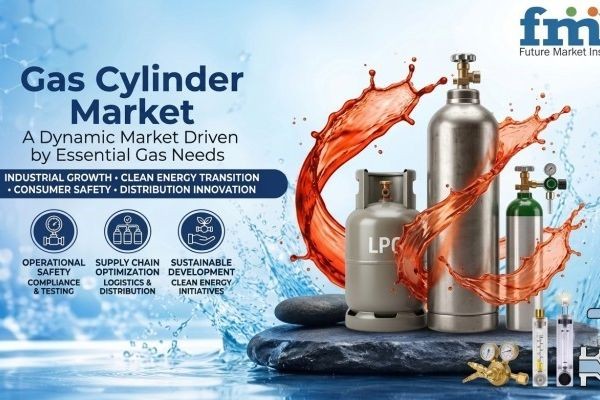
The global gas cylinder market is set to expand from USD 8.1 billion in 2025 to USD 8.5 billion in 2026, before reaching USD 13.2 billion by 2036. According to the latest market report published by Future Market Insights (FMI), the industry is projected to register a compound annual growth rate (CAGR) of 4.5% from 2026 to 2036, generating an additional USD 4.7 billion in market revenue over the forecast period.
Demand reflects the continuing need to transport industrial and medical gases to facilities outside pipeline networks. Manufacturers are also adapting cylinder portfolios to accommodate higher filling pressures, hydrogen storage requirements and changing fleet economics.
KEY MARKET TAKEAWAYS
- Market Valuation: The gas cylinder market is estimated at USD 8.5 billion in 2026 and is projected to reach USD 13.2 billion by 2036.
- Growth Rate: Revenue is expected to increase at a 4.5% CAGR between 2026 and 2036.
- Leading Segment: Seamless High-Pressure Cylinders account for 45.7% of cylinder type and design revenue in 2026.
- Fastest-Growing Country: France leads the five profiled national markets with a projected 5.5% CAGR through 2036.
- Core Growth Driver: Industrial manufacturing, welding, medical oxygen distribution and hydrogen transport are sustaining demand for portable high-pressure vessels.
INDUSTRY SHIFTS & MARKET DYNAMICS
Gas cylinders remain essential to industrial and healthcare operations that depend on portable gas supplies. Fabrication plants, shipyards and automotive facilities require regular deliveries of oxygen, argon and other shielding gases. Hospitals and home-care providers also rely on portable oxygen vessels where fixed supply infrastructure is unavailable. These applications support recurring procurement by merchant gas companies, filling depots and equipment distributors.
Cylinder specifications are changing as operators seek greater gas capacity per delivery. Standard steel vessels continue to serve established industrial and domestic applications, while seamless high-pressure designs and carbon-fiber composite cylinders address higher-pressure requirements. Hydrogen mobility is adding another demand channel, particularly for Type III and Type IV vessels used in transport applications. Lightweight composite cylinders can help increase vehicle storage capacity, although their higher manufacturing costs remain a consideration.
Supply-side economics continue to shape purchasing decisions. Chrome-molybdenum steel and carbon-fiber inputs influence production costs, while certification and periodic requalification add compliance requirements. Transport Canada’s February 2025 publication of updated CSA B339 and B341 standards, alongside related standards under its Transportation of Dangerous Goods framework, illustrates the importance of inspection and transport rules. Cylinder manufacturers must balance pressure performance, fatigue resistance, testing requirements and production costs before introducing new designs.
REGIONAL MARKET SUMMARY
Country-level forecasts indicate different growth trajectories across the five profiled markets:
- France: Expected to record a 5.5% CAGR from 2026 to 2036, supported by hydrogen infrastructure development and high-pressure composite vessel requirements.
- Canada: Projected to expand at a 5.0% CAGR, with demand linked to compressed gas distribution, clean-fuel projects and transport regulations.
- Mexico: Forecast to grow at a 4.7% CAGR, driven by LPG cylinder replacement requirements and industrial welding demand.
- Italy: Expected to register a 4.0% CAGR as CNG and biomethane applications sustain demand for certified pressure vessels.
- Australia: Projected to record a 3.6% CAGR, supported by mining-related welding gas logistics and LPG cylinder exchange networks.
ANALYST INSIGHTS
"Higher filling pressures of 300 bar in industrial gases and 700 bar in hydrogen transport are shifting fleet budgets toward hot-spun seamless chrome-moly steel and carbon-fiber composite vessels. Cylinder manufacturers still face alloy steel surcharges and lengthy DOT and TPED type-approval testing before new vessel designs enter commercial service," stated Nandini Roy Choudhury, Principal Consultant at Future Market Insights.
COMPETITIVE LANDSCAPE
Competition in the gas cylinder market centers on vessel engineering, regulatory approvals, manufacturing capabilities and access to industrial gas distribution networks. Worthington Enterprises, Inc., Luxfer Holdings PLC, Hexagon Purus ASA, Chart Industries, Inc., Linde plc, Air Liquide S.A., Faber Industrie S.p.A. and Everest Kanto Cylinder Ltd. are among the notable companies covered in the report.
Manufacturers such as Worthington, Luxfer, Faber Industrie and Everest Kanto supply steel and aluminum vessels alongside composite products. Hexagon Purus and Chart Industries focus on composite and cryogenic storage solutions. Meanwhile, Linde and Air Liquide operate industrial gas distribution networks and cylinder rental fleets, linking vessel procurement with recurring customer requirements.
ABOUT THE REPORT
The Future Market Insights report examines the global gas cylinder market from 2026 to 2036. It evaluates demand by cylinder type and design, material substrate, end-use sector and region. The analysis covers market sizing, country-level growth forecasts, competitive positioning and key demand drivers. Its research combines primary interviews, secondary sources, market modelling and data triangulation.


