
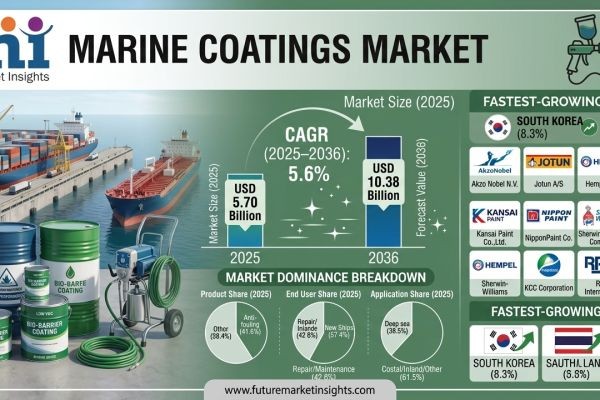
The global marine coatings market is projected to witness strong expansion over the next decade, supported by rising global shipbuilding activity, increased focus on vessel performance efficiency, and stringent environmental regulations governing marine operations. The market is expected to grow steadily, reaching approximately USD 10.38 billion by 2036, registering a CAGR of 5.6%, according to the latest analysis by Future Market Insights (FMI).
Market growth is being shaped by increasing international mandates for emissions reduction, growing emphasis on fuel efficiency, and rapid adoption of advanced eco-friendly coating technologies. Marine coatings have evolved from standard protective paints into essential regulatory and operational requirements across deep-sea commercial fleets, coastal vessels, and offshore structures. While traditional anti-corrosion coatings continue to maintain widespread application, manufacturers are increasingly introducing advanced formulations such as silicone-based foul release systems and biocide-free coatings to comply with modern safety and environmental expectations while improving fuel economy.
Global Marine Coatings Market Snapshot (2026–2036)
Market size outlook toward 2036: USD 10.38 billion
Forecast CAGR: 5.6%
Dominant application category: Deep sea (38.5% share)
Fastest-growing segment: Foul release and biocide-free coatings
Key growth countries: China, India, Germany, France, United Kingdom, United States, Brazil
Primary demand channel: New Ships (57.4% share)
Momentum in the Market
Beginning from steady international adoption levels, the marine coatings market demonstrates accelerated growth throughout the forecast period as environmental compliance becomes mandatory across multiple maritime territories. Between 2026 and 2036, expanding global trade and rising fleet expansion volumes are expected to significantly boost demand for specialized protective coatings. Increasing fuel costs and stricter carbon intensity indicator (CII) standards are encouraging shipowners and shipyards to prioritize hull efficiency technologies.
From 2036 onward, innovation in intelligent bio-barrier coatings and integration with nanotechnologies is expected to further strengthen market expansion. Smart coatings capable of minimizing surface friction while eliminating toxic chemical leaching are emerging as key differentiators in new commercial and defense vessel designs.
The Reasons Behind the Market’s Growth
Demand for marine coatings is rising due to multiple structural and technological factors reshaping the international maritime ecosystem.
Stringent Government and IMO Regulations
Regulatory bodies like the International Maritime Organization (IMO) are enforcing strict emission frameworks and anti-fouling environmental restrictions. Marine coatings are increasingly becoming a non-negotiable component in optimizing ship energy efficiency and meeting global decarbonization targets.
Growing Shipbuilding and Fleet Maintenance
Rapid expansion of global commercial and defense shipping sectors is driving large-scale procurement of advanced marine coatings, with commercial vessels alone accounting for over 60% of total applications.
Rising Focus on Operational Efficiency
Vessel operators are prioritizing high-performance coatings to reduce hydrodynamic drag, which directly lowers fuel consumption and lessens the frequency of costly drydocking maintenance intervals.
Transition Toward Eco-Friendly Formulations
The rise of sustainable maritime practices is creating a powerful demand for low-VOC and copper-free alternatives, paving the way for advanced silicone and foul release systems.
Top Segment Application Type
New Ships Lead Market Demand
The construction of new vessels accounts for the majority of marine coating applications worldwide, capturing 57.4% of the market share, supported by booming order books in primary shipbuilding nations and strict green-vessel regulations.
Product and Application Analysis
Anti-fouling coatings: Holds a dominant 41.6% product share to mitigate biological fouling.
Deep-sea applications: Captures 38.5% of the market share due to long-haul container and tanker traffic requirements.
Repair and maintenance work: Forms a vital secondary market segment, driving steady aftermarket demand during drydock schedules.
Regional Development: Global Maritime Hubs Drive Expansion
The global marine coatings infrastructure is expanding rapidly, supported by robust manufacturing capabilities and strategic shipping corridors across key regions.
China: The global powerhouse leading with a 7.6% CAGR, driven by vast domestic shipbuilding infrastructure and massive fleet operations.
India: Expanding steadily at a 7.0% CAGR, supported by growing domestic ship repair industries and defense naval specifications.
Europe (Germany & France): Registering CAGRs of 6.4% and 5.9% respectively, focusing heavily on premium compliance-led specifications and sustainable technological innovations.
United States: Tracking a 4.8% CAGR, propelled by military fleet corrosion management programs and coastal infrastructure upgrades.
Localized manufacturing partnerships and research investments between major coating formulation companies and global shipyards are accelerating innovation and technology adoption across these regions.
Challenges, Trends, Opportunities, and Drivers
Drivers
Mandatory IMO and regional emission regulations
Continuous global shipbuilding activities and fleet expansion
Rising demand for fuel-efficiency and drag reduction
Increased investments in commercial and naval fleets
Opportunities
Silicone-based foul release systems and biocide-free solutions
Advanced nanotechnology-driven surface protection
Low-VOC waterborne and high-solid coatings
Integration with marine infrastructure and offshore energy platforms
Trends
Transition away from copper-based paints toward eco-friendly alternatives
Formulation of smart coatings that adapt to water temperature changes
Increased adoption of multi-layer high-performance epoxy systems
Rising focus on sustainable R&D investments
Challenges
High raw material price volatility impacting profit margins
Heavy regulatory compliance costs for chemical formulations
High initial costs of advanced eco-friendly coating materials
Country Growth Outlook
The market’s growth trajectory is closely tied to shipyard capacities and local maritime policy implementations:
China: High shipbuilding capacity and dominant container fleet maintenance.
India: Growing naval modernization and port expansions.
Germany & UK: High adoption of high-tech and eco-compliant specifications.
United States: Ongoing defense fleet procurement and infrastructure upgrades.
Brazil: Expanding offshore energy production and coastal transport fleets.
The Competitive Environment
The global marine coatings market is moderately consolidated, with major chemical and coating conglomerates competing through sustained technological innovation, localized logistics networks, and regulatory adherence. Leading companies include:
AkzoNobel N.V.
PPG Industries, Inc.
The Sherwin-Williams Company
Hempel A/S
Jotun A/S
Nippon Paint Marine Coatings Co., Ltd.
Chugoku Marine Paints, Ltd.
Kansai Paint Co., Ltd.
BASF SE
These market leaders are investing significantly in green chemistry, advanced resin development, and ultra-low friction materials while forming long-term service agreements with international shipping lines to streamline supply chains and lower overall operational footprints.
Future Outlook: Toward Sustainable and Efficient Navigation
The global marine coatings market is entering a highly transformative decade shaped by sustainability mandates, economic pressures, and advanced material sciences. Future coating systems are expected to act as functional energy-saving components that work in tandem with other clean maritime technologies like wind-assisted propulsion and alternative fuels. As international maritime policies grow stricter and the focus on decarbonization intensifies, advanced marine coatings will remain central to achieving cleaner, smarter, and highly efficient shipping operations around the globe.
For a comprehensive strategic outlook and detailed analysis of technological developments shaping the industry, readers can explore the full report on the official Future Market Insights website: https://www.futuremarketinsights.com/reports/marine-coatings-market






