
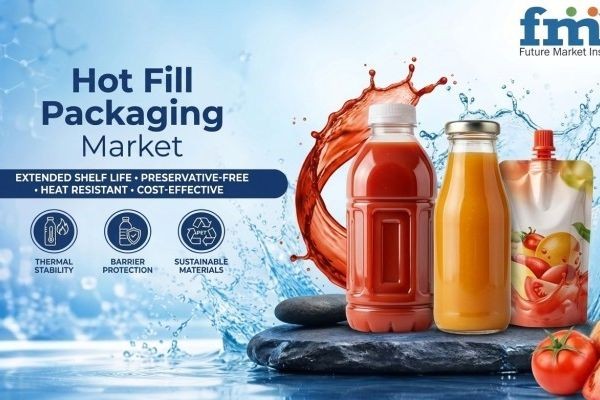
The global hot fill packaging market is projected to grow from USD 9.2 billion in 2026 to USD 16.0 billion by 2036, registering a Compound Annual Growth Rate (CAGR) of 5.7% over the forecast period. According to the latest market report published by Future Market Insights, Inc. (FMI), the industry is expected to add USD 6.8 billion in market value between 2026 and 2036. Demand is being supported by beverage and food processors adopting thermal filling to extend ambient shelf life without relying on chemical preservatives.
Hot fill packaging is designed to withstand liquid filling temperatures between 82°C and 96°C, followed by capping, inversion sterilization and cooling. The process creates a specific engineering challenge: as hot contents cool inside sealed containers, internal vacuum pressure can cause conventional plastic walls to collapse. Heat-set PET bottles, engineered base diaphragms and high-temperature closures address this problem across beverage, sauce and fruit-processing applications.
KEY MARKET TAKEAWAYS
- Market Valuation: USD 9.2 billion in 2026, projected to reach USD 16.0 billion by 2036.
- Growth Rate: The market is forecast to expand at a 5.7% CAGR from 2026 to 2036.
- Leading Material: PET (Polyethylene Terephthalate) accounts for 57.8% of material demand in 2026.
- Leading Packaging Format: Heat-Set Rigid Bottles & Jars hold 51.6% of packaging format sales.
- Leading Application: Beverages represent 62.3% of application turnover in 2026.
- Fastest-Growing Country: India leads the eight evaluated countries with a projected 7.8% CAGR.
- Core Growth Driver: Preservative-free beverage production and demand for shelf-stable products are encouraging investment in hot-fill packaging.
INDUSTRY SHIFTS & MARKET DYNAMICS
Beverage manufacturers are expanding hot-fill capacity to serve consumers seeking fruit juices, nectars, ready-to-drink teas and other products with simpler ingredient lists. Filling acidic beverages at temperatures generally between 85°C and 92°C helps eliminate yeast and mold contaminants, supporting ambient storage without chemical preservative dosing. Hot-filled containers also reduce dependence on refrigerated distribution, an advantage for processors serving markets where cold-chain infrastructure is uneven.
PET is central to this transition. Heat-set PET bottles can retain their shape during high-temperature filling, while crystallized neck finishes maintain dimensional stability during capping. In 2026, PET accounts for 57.8% of material demand. Heat-Set Rigid Bottles & Jars lead packaging formats with 51.6% share, supported by active-base diaphragms that absorb vacuum pressure during cooling. These designs can also reduce preform weight by replacing heavier sidewall vacuum panels.
However, recycled resin qualification remains a technical and commercial challenge. Incorporating higher proportions of mechanically recycled PET can introduce optical haze, contamination and changes in intrinsic viscosity. Converters must maintain container clarity and structural performance while meeting recycled-content requirements. Energy consumption during preform reheating and mold conditioning also adds pressure to operating costs, particularly for smaller packaging suppliers.
Regulatory requirements are shaping investment decisions. European Union Regulation (EU) 2025/40 entered into force in January 2025 and establishes a 30% minimum recycled-plastic threshold for contact-sensitive PET beverage bottles by 2030. India's recycled-content requirements for Category I rigid plastic packaging are also encouraging food-grade recycled resin integration. These developments are increasing the importance of reliable rPET supply and preform designs that withstand thermal processing.
REGIONAL MARKET SUMMARY
Country-level growth varies according to beverage processing investment, ambient distribution requirements, packaging regulations and the substitution of glass with lightweight PET formats.
- India: 7.8% CAGR, supported by mango nectar and spiced beverage bottling, agro-processing capacity and recycled-content requirements.
- Indonesia: 7.2% CAGR, driven by ambient distribution of ready-to-drink tea and tropical fruit beverages across island markets.
- China: 6.9% CAGR, supported by botanical tea demand, citrus drinks and high-speed bottling line upgrades.
- Chile: 6.1% CAGR, reflecting export-oriented fruit puree, peach nectar and tomato condiment processing.
- United States: 5.2% CAGR, supported by glass-to-PET conversion in sauce jars and isotonic beverage packaging.
Germany, France and Italy are projected to record CAGRs of 4.8%, 4.6% and 4.4%, respectively, through 2036. Their markets are shaped by recycling requirements, packaging compliance and the economics of glass production.
ANALYST INSIGHTS
"Beverage and sauce brands are replacing ribbed vacuum-panel bottles with active-base heat-set PET jars that cut resin weight by 15%. However, qualifying 30% recycled PET for 92°C filling without sidewall haze or neck distortion remains the toughest technical hurdle for converters," stated Nandini Roy Choudhury, Principal Consultant at Future Market Insights.
The competitive focus is moving toward lightweight container engineering, food-grade recycled PET integration and closure systems that maintain vacuum retention after thermal processing. Companies including Amcor plc, Graham Packaging Company, Plastipak Holdings, Inc., Silgan Holdings Inc. and Indorama Ventures Public Company Limited are among the notable participants. Their capabilities span heat-set containers, recycled resin, preforms, closures and barrier packaging formats.
ABOUT THE HOT FILL PACKAGING MARKET REPORT
The FMI report examines the global hot fill packaging market across material type, packaging format, application, container capacity, closure type and region. It provides market estimates and forecasts for 2026 to 2036, alongside historical data from 2020 to 2025. The research also assesses country-level growth, technical requirements, market drivers, restraints and competitive positioning. Its methodology includes structured interviews with 42 packaging engineering, manufacturing, bottling operations and recycled-resin procurement professionals, supported by bottom-up market sizing and country-level forecasting.


