
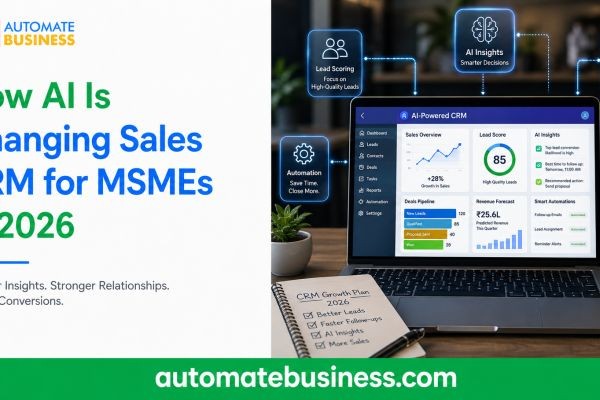
A year ago, AI in sales meant a chatbot on a website. In 2026, it means a voice call that contacts your IndiaMART lead before your salesperson has opened their laptop. It means an email proposal drafted in seconds by a system that already knows the lead’s product interest, city, and pipeline stage. It means a CRM that does not just store what happened it anticipates what should happen next. For Indian MSMEs, this shift is not a future trend. It is available right now, and the businesses adopting it are pulling measurably ahead of those still running sales on WhatsApp and memory.
The CRM Is No Longer Just a Database. It Is a Sales Engine.
For most of the last decade, a Sales CRM did one thing well: it stored information. Leads, contact details, pipeline stages, follow-up notes. It was a structured replacement for the spreadsheet more organized, more visible, better for teams. But it was still fundamentally passive. It recorded what humans did. It did not do anything on its own.
In 2026, that description is no longer accurate for the best sales CRM platforms. AI has moved from being an optional add-on to being an embedded layer of the sales process itself. The CRM now contacts leads, drafts content, predicts outcomes, triggers voice calls, and surfaces the next best action not when a manager asks, but the moment a lead enters the pipeline.
Automate CRM has built AI directly into the core of its sales platform for Indian MSMEs. Not as a chatbot. Not as a premium feature requiring a separate subscription. As a live layer of the sales workflow that runs alongside your team, handling the mechanical and time-sensitive work so your salespeople can focus on the conversations that actually close deals. In this guide, we map exactly what AI is changing in sales CRM in 2026, and what that means practically for a growing MSME in India.
AI in a Sales CRM is not about replacing salespeople. It is about removing the gap between when a lead arrives and when the right action happens.
What AI Is Changing in Sales CRM in 2026: 6 Shifts That Matter for MSMEs
These are not theoretical changes. Each of the following shifts is live in 2026 and available to Indian MSMEs through AI-enabled CRM platforms right now.
- First Response: From Hours to Seconds
Before AI: A new IndiaMART enquiry arrives at 10:48 PM. The salesperson sees it at 9:30 AM the next day. By then, two competitors have already called the buyer.
In 2026: An AI-triggered WhatsApp message reaches the buyer within 90 seconds of the enquiry being submitted. The message is personalized to the product they enquired about, comes from your own WABA business number, and sets the expectation for follow-up. Your business makes the first impression before any competitor’s team has woken up. - Outreach Content: From Templates to Personalized AI Drafts
Before AI: Salespeople type individual follow-up messages and proposals manually. Every message is slightly different depending on who wrote it and how much time they had. Quality is inconsistent.
In 2026: AI email generation produces personalized follow-up messages, proposal summaries, and re-engagement content in seconds. The system already knows the lead’s product interest, pipeline stage, last interaction, and location. The salesperson reviews and sends. Writing time drops from twenty minutes to two. - Voice Outreach: From Manual Calls to AI-Triggered Voice
Before AI: High-priority leads sit in the pipeline waiting for a salesperson to be available. A lead that came in during a busy Friday afternoon might not receive its first call until Monday.
In 2026: Bolna AI voice calls are triggered automatically when a lead enters the pipeline or reaches a specific stage. An AI voice call reaches the buyer within minutes, introduces your business, confirms their requirement, and logs the outcome back into the lead record. High-priority leads are never kept waiting because a salesperson was unavailable. - Pipeline Management: From Manual Moves to AI-Guided Stages
Before AI: Salespeople decide which stage a lead is in based on their own judgment. Two salespeople classify the same type of conversation differently. Pipeline data is subjective and inconsistent.
In 2026: AI pipeline suggestions prompt the salesperson to move a lead to the appropriate stage based on the interactions logged. When a call note says ‘they asked for a proposal,’ the system suggests moving to ‘Proposal Stage’ automatically. Stage data becomes more consistent, and pipeline reports become more accurate. - Task Management: From Remembering to AI-Scheduled Actions
Before AI: The next follow-up action depends on the salesperson remembering to create it. When they are busy, the task is not created. The lead waits indefinitely.
In 2026: AI-driven task scheduling creates the next required action the moment a lead moves between stages. If a proposal is sent, a follow-up call task is automatically created 48 hours later. If a lead goes quiet for seven days, a re-engagement task surfaces automatically. The salesperson’s daily task list is built by the system, not by them. - Analytics: From Gut Feel to AI-Surfaced Insights
Before AI: Sales decisions which source to invest in, which salesperson to coach, which stage to fix are made based on what the manager remembers from the last team meeting.
In 2026: AI-powered dashboards in 2026 do not just show data. They surface insights: which lead source has the highest conversion rate this quarter, which salesperson’s deals are stalling at the proposal stage, and which cold leads from the last 90 days match the profile of recently won deals. The system tells managers where to look, not just what the numbers are.
Why AI in CRM Matters More for MSMEs Than for Large Enterprises
The conventional assumption is that AI is an enterprise luxury something large companies invest in because they have the budget and the data. In sales CRM, the opposite is closer to the truth. AI has a larger proportional impact on small and medium businesses precisely because it compensates for the resource constraints that MSMEs face every day.
- Small teams cannot afford the coverage gaps that large teams absorb
An enterprise with twenty salespeople can absorb the fact that one of them is unresponsive on a Friday afternoon. An MSME with three salespeople cannot. When one person is unavailable, that is a third of the team’s response capacity gone. AI voice calls and automated first-response messaging close that gap without adding headcount. - MSME owners make the same decisions large companies do, with less data
A large company has a revenue operations team generating reports and surfacing insights. An MSME owner makes the same decisions where to invest in lead generation, which salesperson to coach, which product line to priorities but without dedicated analytical support. AI-surfaced insights in a CRM give MSME owners the analytical leverage of a much larger team. - AI reduces the cost of expertise, not just the cost of labor
In 2026, AI in a sales CRM helps a salesperson with two years of experience write a follow-up email as well as one with ten years. It helps a junior closer identify the right moment to move a deal forward. It helps an owner without a data analyst read their pipeline the way an experienced sales director would. This democratization of sales expertise is one of the most significant practical benefits of AI for Indian MSMEs.
How Automate CRM Delivers AI-Powered Sales for Indian MSMEs
Automate CRM integrates AI at every layer of the sales workflow that matters most for Indian MSMEs. Each AI feature is available inside the same platform that manages your IndiaMART leads, WhatsApp follow-ups, and pipeline stages — not as a separate tool requiring a separate login.
- Bolna AI Voice Calls on Stage Change
When a lead enters the pipeline or moves to a priority stage, a Bolna AI voice call is triggered automatically. The AI voice introduces your business, confirms the lead’s requirement from the original enquiry, and logs the call outcome back into the lead timeline in the CRM. High-priority leads receive immediate outreach even when every salesperson is on another call. The first contact window the most critical factor in lead conversion is never missed because of availability. - AI Email and Outreach Content Generation
Salespeople writing proposals, follow-up emails, and re-engagement messages can use AI-generated content that is already contextualized to the lead: the product they enquired about, their location, the stage of the conversation, and the last interaction note. The output is a personalized first draft that the salesperson reviews and sends, not a generic template. Writing time is reduced from minutes to seconds, and message quality is consistent regardless of which salesperson is sending it. - AI-Assisted Pipeline Stage Suggestions
Automate CRM analyses the notes, messages, and interactions logged in a lead record and suggests the most appropriate next pipeline stage. When a salesperson logs a call note that references pricing discussion and timeline confirmation, the system prompts them to move the lead to the negotiation stage. This makes pipeline data more accurate, more consistent across the team, and more useful for the manager reviewing the dashboard. - Intelligent Task Scheduling and Next Best Action
AI task scheduling in Automate CRM creates the next required follow-up action automatically based on stage movements, interaction history, and configured rules. A lead that has been in the proposal stage for more than 48 hours without a logged follow-up will surface a task automatically. A lead that has gone cold for seven days enters a re-engagement sequence without anyone initiating it. The salesperson’s day is organized by the system so their attention goes to the highest-priority actions first. - WhatsApp Business API With AI-Personalized Messaging
Automate CRM connects to your own WABA credentials and uses AI to personalize automated WhatsApp messages at scale. A broadcast to 300 cold leads can include each lead’s name, product category, and last enquiry date making a mass message feel like a personal outreach. Re-engagement sequences, stage-change notifications, and follow-up reminders all benefit from AI personalization without requiring a salesperson to write each message individually. - Source-Wise and Stage-Wise Conversion Intelligence
The analytics dashboard in Automate CRM uses AI to surface patterns that manual analysis would miss: which IndiaMART product categories are generating leads that convert at the highest rate, which day and time see the fastest response-to-contact conversion, and which pipeline stage is causing the most deals to stall. These are not reports you run they are insights that surface automatically so owners and managers can make decisions based on what is actually happening in the pipeline.
What Changes for the MSME Owner When AI Enters the Sales CRM
The most practical question is not what AI does in a CRM. It is what changes for the business owner and the sales team when AI is doing it. The answer is both operational and strategic.
Operationally, the team spends less time on mechanical tasks. Typing follow-up messages, scheduling reminder tasks, reconstructing yesterday’s lead status, manually contacting leads that arrived after hours all of this shifts from human effort to system automation. The hours recovered go back into the sales activities that AI cannot do: listening to a buyer’s requirements, building trust, handling complex objections, and closing deals that require human judgement.
Strategically, the owner gains something more important than saved time: the ability to make decisions based on real data. When AI surfaces which lead source is producing your best deals, which salesperson’s pipeline is stalling at the same stage repeatedly, and which cold leads from six months ago match the profile of your most recent wins, the quality of sales strategy decisions improves fundamentally. You stop allocating budget to underperforming sources because you always assumed they were working. You start coaching the right person on the right thing because the system shows you where the gap is.
What Automate CRM AI Delivers for MSMEs in 2026
- Bolna AI voice calls contact high-priority leads within minutes of pipeline entry, before any salesperson is available.
- AI email generation produces personalized proposals and follow-ups in seconds, not minutes.
- AI pipeline suggestions make stage data consistent across the whole team without manager correction.
- Intelligent task scheduling organizes every salesperson’s day automatically based on priority and deadline.
- AI-personalized WhatsApp broadcasts make mass outreach feel like individual conversations.
- Conversion intelligence surfaces which sources, stages, and strategies are producing the best results in real time.
Is Your MSME Ready to Use AI in Sales CRM?
The question is no longer whether AI will change sales CRM for Indian MSMEs. It already has. The question is whether your business is using those changes or competing against businesses that are.
If your sales team is still manually copying leads from IndiaMART, typing individual WhatsApp follow-ups, and making pipeline decisions based on what the team reports in a morning standup you are competing against businesses that have automated all three. The gap in first-response speed alone, between a salesperson calling a lead at 10 AM and an AI voice call reaching them at 10:48 PM the night before, is often the difference between winning and losing the deal.
- Your first response to every new lead should happen in seconds, not hours.
- Every follow-up message should be personalized without taking twenty minutes to write.
- Every high-priority lead should receive outreach before a salesperson is available to initiate it.
- Every pipeline stage decision should be consistent across the team, not salesperson-dependent.
- Every cold lead should re-enter a sequence automatically, not when someone remembers.
- Every source and stage should be measured by actual conversion data, not team reports.
In 2026, every one of these is achievable for an Indian MSME without an IT team, without a six-month implementation, and without an enterprise budget.
The Sales CRM of 2026 Works While Your Team Sleeps
AI in sales CRM is not about replacing your sales team. It is about ensuring that the hours between 6 PM and 9 AM are not hours where your business stops. Leads that arrive overnight get an immediate response. Voice calls that need to happen before Monday morning happen on Sunday evening. Follow-up tasks for Tuesday are already created and prioritized when the team arrives on Tuesday morning.
Automate CRM brings this capability to Indian MSMEs in a platform that is live within 48 hours, requires no IT team to set up, and integrates directly with IndiaMART, TradeIndia, WhatsApp Business API, and Razorpay on day one. The AI is not an experiment. It is a production-ready layer of a sales system that is already working for 12,000+ businesses across India.
The businesses winning in 2026 are not the ones with the biggest sales teams. They are the ones where AI is doing the work that used to fall through the cracks.
Book a free personalized walkthrough and see Automate CRM’s AI features running on your actual pipeline, lead sources, and team structure.






