
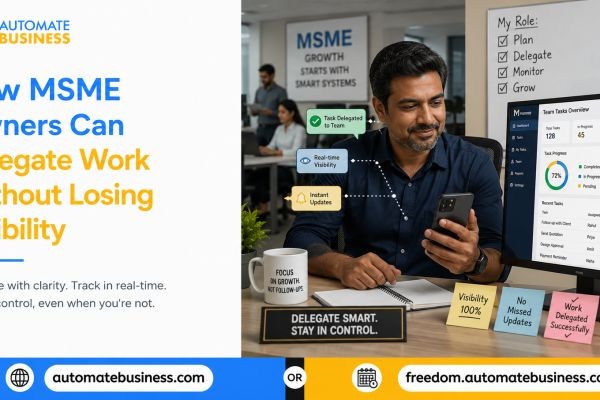
Delegation is one of the most important skills an MSME owner can develop and one of the most difficult to practice. The logic is simple: delegate more, free up time, grow faster. The reality is harder. The moment most MSME owners hand work to someone else, they lose the ability to see what is happening with it. Tasks vanish into WhatsApp messages. Deadlines pass without anyone noticing. Updates arrive only when something goes wrong. And the owner, burned by this experience, takes the work back and does it themselves.
The problem is not delegation itself. The problem is delegating without a system that keeps visibility intact.
Automate Task Management by Automate Business is built specifically for this challenge. Create tasks in seconds, assign them with clarity, send automatic WhatsApp reminders, and track team progress across web, Android, and iOS all from one app built for growing businesses. For MSME owners who want to step back from daily execution without stepping into the dark, Automate Tasks is the system that makes delegation work not just in theory, but in the daily reality of managing a growing team.
Why Delegation Fails in Most MSMEs And Why Visibility Is the Fix
Delegation does not fail because MSME owners are unwilling to let go. It fails because there is no reliable way to know whether the delegated work is actually being done until it is too late.
When a task is assigned through a WhatsApp message, there is no ownership trail. The message is seen, acknowledged with a thumbs-up, and then buried under 200 other messages. There is no deadline reminder. There is no status update. There is no alert when the task becomes overdue. The owner either has to follow up manually which defeats the purpose of delegating or waits until the task completion (or failure) becomes visible through a downstream consequence.
That might work for a few people. It starts breaking when your business grows, deadlines multiply, and accountability matters. The fix is not a better WhatsApp system. It is a task management platform where every assigned task has a visible status, every deadline has an automatic reminder, and every overdue item triggers an escalation so the owner can see the full picture from a dashboard without making a single call.
What Structured Delegation Actually Looks Like
Structured delegation has five components most MSME owners have never experienced simultaneously: a clear owner for every task, a defined deadline, automatic reminders on the channel the team already uses, real-time visibility into what is pending or overdue, and automatic escalation when something is late without the owner having to notice it first.
When all five are in place, the owner can trust that work will either be completed on time or surface as a visible exception requiring attention not disappear into informal channels and emerge as a problem days later.
Automate Tasks gives managers one place to review what is pending, overdue, completed, and where teams need support.</cite> This is the shift that makes delegation feel like genuine leverage rather than a transfer of risk.
The Features That Make Delegation Work in Automate Tasks
- Creating and Assigning Tasks in Seconds
Delegation slows down when creating a task is cumbersome. If assigning work takes longer than doing it, owners default to doing it themselves. Tasks are created with a title, description, deadline, priority, and assignee generated from an AI prompt, a voice command, or manual entry with sub-tasks, checklists, and bulk CSV upload for setting up work at scale.
For an MSME owner, this means delegating work takes thirty seconds rather than three minutes. A voice note can accompany the task to give the team member context. Sub-tasks break complex work into steps that can be tracked individually. Checklists ensure nothing within a task is missed. And recurring task templates mean that daily, weekly, or monthly work does not need to be recreated each time it runs automatically. - Automatic WhatsApp Reminders That Reach the Team
The most common reason delegated work is not completed on time is that the team member forgot. Not because they were unwilling, but because the task was assigned once and never surfaced again until the deadline passed. Set target dates, reminder dates, recurring schedules, and admin-level reminder defaults so tasks stay on track. Send updates on WhatsApp and email, respect user time zone settings, and skip scheduled work automatically on defined holidays.
WhatsApp reminders are the critical element here. Most MSME team members are on WhatsApp all day. An assignment reminder that arrives in the same channel they use for every other communication is seen, acted on, and confirmed without the owner needing to follow up. Assignments, reminders, and overdue alerts reach team members on a channel they already check every day. - Role-Based Access That Controls What Each Person Can See and Do
Delegation at scale requires more than assigning tasks it requires defining who can assign tasks to whom, who can see which projects, and who can manage which parts of the workspace. Without this structure, a team of twenty becomes chaotic quickly.
Automate Tasks supports admin, manager, member, and custom roles to control who can see pages, assign work, manage users, or delegate sub-tasks with bulk user import and workspace-level visibility that does not expose everything to everyone.
For an MSME owner, this means building a delegation hierarchy that mirrors the reporting structure of the business. Managers assign work to their teams. Team members see only their own tasks and the tasks they need to collaborate on. Senior managers see across their departments. The owner sees everything from one dashboard, without needing to ask for updates. - Dashboard Visibility That Replaces Status Meetings
The reason most MSME owners resist delegation is that it removes the informational advantage they currently hold by being involved in everything. Delegation feels like blindness. A real-time dashboard removes that fear by replacing it with something better structured, filterable, always-current information.
Track work through list and Kanban views, filters by assignee, status, priority, project, and date, plus workspace activities and group timelines. Use dashboard reports, group reports, scoring, exportable insights, idea boards, and AI summaries to review execution without micromanaging the team.
The owner opens the dashboard and sees immediately which tasks are on track, which are overdue, which team members are blocked, and which projects are falling behind. Managers no longer need to piece together updates from calls, chats, and spreadsheets execution status is visible in one place.
This visibility does not require the owner to call anyone. It does not require a morning status meeting. It does not depend on team members self-reporting accurately. The dashboard reflects what is actually happening in real time and that is the foundation on which genuine delegation becomes possible. - AI-Powered Delegation: Tasks Created From a Prompt
Managers generate tasks from a quick prompt no manual drafting of every detail required. AI task creation is one of the most underused delegation tools available in Automate Tasks. Instead of manually filling in task details title, description, assignee, deadline, priority the owner describes what needs to happen in natural language and the system generates the structured task.
This is not just a time-saving feature. It removes one of the primary psychological barriers to delegation: the effort of articulating the task clearly enough to hand it over. When that articulation can be generated from a brief description, the friction of delegation drops to near zero.
Combined with voice commands speak tasks on the go, add voice notes for clarity, and let AI turn them into structured work items this means delegation can happen while the owner is in a meeting, on a site visit, or in a car. The task is created, assigned, and scheduled before the conversation that generated it has even ended.
What Successful Delegation Looks Like With the Right System
Managing 120 employees across 3 locations used to be a nightmare. Automate Tasks with AI and WhatsApp reminders increased team productivity by 70%.
This is the real outcome of structured delegation not just time saved for the owner, but improved execution quality across the entire team. When team members know their tasks are visible, that reminders will arrive automatically, and that overdue work will be escalated, the baseline level of follow-through across the organization rises without any additional management effort.
The owner's role shifts from being the person who holds everything together through personal involvement to being the person who reviews the dashboard, spots the exceptions, and focuses on the work that genuinely requires their attention. That is the promise of delegation and it is only kept when the system makes visibility a certainty rather than a hope.
See how Automate Tasks by Automate Business helps MSME owners delegate with confidence with AI task creation, WhatsApp reminders, role-based access, and real-time dashboards built for growing teams.






