
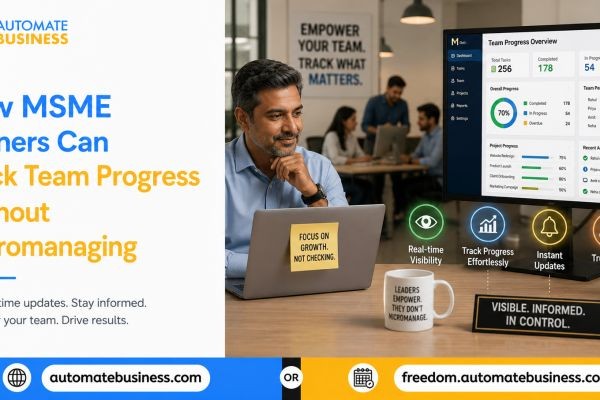
Most MSME owners do not want to micromanage. They want to run a business, not sit on top of every employee asking for updates. But when there is no visibility into who is doing what, that is exactly what happens owners end up calling for status checks, scrolling through WhatsApp groups, and following up on the same pending task three times in a week. This is where Automate Task Management changes the equation. Instead of chasing people for updates, owners get a live view of what is pending, overdue, and completed, so they can step back from the day-to-day chasing without losing control of execution.
This blog breaks down why micromanagement usually starts as a visibility problem, not a trust problem, and how MSME owners can build systems that keep teams accountable without hovering over their shoulders.
Why MSME Owners End Up Micromanaging
Micromanagement is rarely a personality trait it is usually a coping mechanism. When an owner has no reliable way to see whether work is actually happening, the only tools left are personal follow-up: a phone call, a WhatsApp message, or walking over to someone's desk. Over time, this becomes a habit that slows everyone down.
A few patterns show up again and again in growing MSMEs:
- Work lives in scattered WhatsApp chats, so nothing is searchable or owned by one person.
- Deadlines exist only in someone's memory, not in a system that tracks them.
- Managers repeat the same follow-up questions because there is no single source of truth.
- Recurring tasks inspections, reports, reviews get missed because no one is reminded automatically.
- Owners only find out about a delay after a client or vendor complains.
- None of these problems are solved by checking in more often. They are solved by building visibility into the system itself, so the owner does not have to be the one generating it manually.
Visibility Is Not the Same as Micromanaging
There is an important difference between tracking progress and micromanaging it. Tracking progress means reviewing a dashboard on your own schedule and only stepping in when something is actually stuck. Micromanaging means interrupting people constantly to ask questions the system should already be answering.
When an owner has to ask "what's the status?", that is micromanagement. When an owner can already see the status, that is visibility. The goal is to move from the first to the second.
Once work has a clear owner, a deadline, and a status that updates automatically, owners can check progress in minutes instead of interrupting the team throughout the day. This is exactly the gap that task management platforms like Automate Tasks are built to close for MSME teams working across offices, branches, and field locations.
Five Ways to Track Progress Without Hovering
- Give every task a clear owner, deadline, and priority
Vague instructions create the need for follow-up. When a task has a named assignee, a due date, and a priority level from the start, there is no ambiguity about who is responsible. Automate Tasks lets managers create tasks with title, description, deadline, priority, and assignee in minutes, and even generate tasks using AI prompts or voice notes when time is tight. - Let reminders do the chasing, not the manager
Instead of a manager personally following up on every pending item, automatic WhatsApp and email reminders notify employees before and after a deadline. This keeps accountability on the employee's side of the conversation and removes the owner from the role of daily enforcer. - Use a dashboard instead of a status meeting
A dashboard that shows pending, overdue, and completed work by person, team, or project replaces the need for daily check-in calls. Owners can scan progress in the morning and only engage directly with tasks that are genuinely stuck, rather than reviewing everything with everyone. - Automate the recurring work that keeps slipping
Weekly reports, inspections, dispatch checks, and routine reviews are the tasks most likely to be forgotten because they rely on someone remembering to start them. Recurring task schedules daily, weekly, monthly, or custom, with holiday-skip logic remove that dependency entirely. - Set role-based access instead of watching everyone equally
Not every owner needs to review every task personally. Role-based access lets managers own their team's follow-up while owners review summary-level dashboards, group reports, and AI-generated summaries before meetings giving oversight without duplicating effort at every level.
What This Looks Like in a Real MSME Team
Consider a business managing sales, operations, and service teams across a few branches. Without a system, the owner's day is filled with calls asking who followed up with which client, whether the inspection was completed, and why a delivery is delayed. With a task management system in place, the same owner opens a dashboard and immediately sees which tasks are on track, which are stuck, and who needs support without asking a single question.
This shift matters most for field and branch teams, where work happens away from the owner's desk. Employees receive assignments and reminders on mobile, update status as they go, and managers review consolidated progress on web so the business stays connected without anyone needing to physically check in.
Accountability Without Micromanagement Is a System, Not a Habit
The businesses that escape the cycle of constant follow-up are not the ones with the most disciplined managers they are the ones with the clearest systems. When ownership, deadlines, reminders, and reporting are built into how work is assigned, the pressure to personally verify everything disappears. Owners get their time back, employees get clarity instead of interruptions, and the business gets a reliable record of what actually happened.
For MSMEs still relying on spreadsheets and WhatsApp groups to track work, this shift does not require a complicated rollout. Starting with clear task ownership, automated reminders, and a single dashboard for progress is often enough to break the micromanagement habit within a few weeks.
Stop Chasing Updates. Start Running Work With Clarity.
See how Automate Tasks helps MSME teams assign work, follow up automatically, and stay accountable Book a Demo.






