
Walk into any retail store thirty minutes before opening and you will find a version of the same scene. The store manager is moving from section to section, verbally assigning tasks to staff stock replenishment here, window display update there, billing counter prep, fitting room checks, promotional material placement. By 10 AM, the store is open, the manager is on the floor handling customer queries, and the tasks assigned at 9:30 AM are entirely dependent on each staff member's memory and individual initiative.
By noon, some tasks are done. Some are half-done. Some have not been started. The manager finds out when they notice the gaps or worse, when a customer does. Another round of verbal follow-ups begins. By the end of the day, the manager has spent more time chasing task completion than managing the store's actual business.
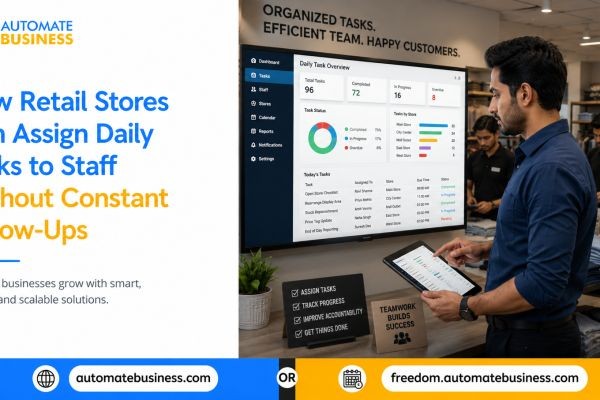
Automate Task Management by Automate Business is built to break this cycle. Assign daily tasks to staff with a specific owner, deadline, and priority level. Send automatic WhatsApp reminders before each task is due. Track completion in real time across a live dashboard without a single follow-up call. Trusted by 12,000+ MSMEs across India, Automate Tasks replaces verbal assignment and WhatsApp chaos with a system that drives daily retail task execution automatically.
Why Retail Stores Struggle With Daily Task Assignment
The challenge of daily task assignment in retail is not a people problem it is a systems problem. Retail staff work in a high-stimulus environment where customer interactions, billing transactions, and unexpected situations constantly displace planned work from active awareness.
A floor staff member who was told at 9:30 AM to restock the children's section is, by 11 AM, helping a customer, assisting at billing, and responding to a product query. The restocking task has been displaced, not abandoned.
In this environment, the task assignment system bears the responsibility for keeping work in active awareness not the individual's memory. When that system is verbal instruction or WhatsApp, that responsibility is not being met.
Most retail managers default to verbal assignment because it feels faster. And it is in the moment. But the downstream cost is measured in follow-up conversations, missed tasks, inconsistent execution, and a manager whose time is consumed by chasing rather than managing store performance.
The Four Elements of Effective Daily Task Assignment in Retail
Every retail task assignment that works reliably needs four elements: a named owner (a specific individual, not "someone from the floor team"), a concrete deadline (a specific time, not "sometime before closing"), an automatic reminder (the system notifies the assigned staff member before the deadline on WhatsApp, without the manager initiating it), and escalation visibility (the manager is automatically informed when a task is overdue without having to check).
Automate Tasks delivers all four. The store manager creates a task in seconds, assigns it with a deadline and priority, and moves on. The system reminds the staff member, tracks completion, and escalates to the manager if needed without a single follow-up conversation.
Creating Daily Retail Tasks in Seconds With AI and Voice
Speed of task creation is a genuine barrier in retail environments. If creating a structured task takes longer than issuing a verbal instruction, store managers will always default to verbal. Automate Tasks addresses this directly through AI-powered task creation and voice command input.
A store manager who speaks "Restock the kids' section before the 11 AM rush assign to Pooja, due 10:30 AM, high priority" has created a complete, structured task in ten seconds. The system generates the task with the right title, assignee, deadline, and priority no form-filling, no typing, no extra steps.
For tasks that need context which shelf to restock, which products are low, what the display standard looks like voice notes can be attached to the task so Pooja has everything she needs to act without seeking clarification. This removes the back-and-forth between assignment and execution that slows down retail task management in practice.
AI task generation from a text prompt achieves the same result for managers who prefer typing. And for stores that receive the same set of daily opening tasks every morning, recurring task templates deploy the entire daily checklist automatically assigned to the right staff members with the right reminders without the manager having to create any of them manually.
Recurring Task Templates for Opening, Closing, and Shift Protocols
Retail stores operate on predictable rhythms. Every opening shift has the same set of tasks display checks, stock counts, billing system setup, fitting room preparation. Every closing shift has another defined set end-of-day reconciliation, display reset, security check, cleaning log. These are not one-off tasks. They are recurring responsibilities that need to happen consistently, every day, with the same standard every time.
Automate Tasks supports recurring task templates that create these opening and closing checklists automatically at the defined time each day. The store manager sets up the template once with the task list, assignees, deadlines, and reminder schedule and the system deploys it automatically every shift.
At 8:30 AM every morning, every opening task is already created, already assigned to the right staff member, and already scheduled to send a reminder before the deadline. The manager does not need to brief the team on the opening checklist the system has already done it.
For stores with multiple shifts, different templates are configured for the morning and afternoon teams. Role-based access means each staff member sees only their own tasks, keeping the dashboard actionable rather than overwhelming.
WhatsApp Reminders That Keep Tasks in Active Awareness
The mechanism that eliminates the manager's follow-up role is the automatic WhatsApp reminder that reaches the staff member before the task deadline. Not an in-app notification. Not an email. A WhatsApp message the channel retail staff are already monitoring throughout their shift.
When Pooja's restocking task has a 10:30 AM deadline with a reminder at 10:00 AM, she receives a WhatsApp message: "Reminder: Restock the kids' section due at 10:30 AM." The task is back in her active awareness at the right moment, regardless of what else has been happening since the task was assigned.
If the task is not marked complete by 10:30 AM, an overdue alert goes to the store manager automatically showing which staff member is responsible and how long the task has been outstanding. The manager makes an informed decision based on real-time status, not chasing blindly.
Admin-level reminder defaults let a store manager apply a consistent cadence reminder 30 minutes before deadline, overdue alert 15 minutes after across every task in the workspace, without configuring each reminder individually.
A Live Dashboard That Replaces the Manager's Morning Walk-Around
One of the most time-consuming daily habits in retail management is the morning walk-around the manager moving from section to section, checking whether tasks have been done, asking staff what they are working on, and making note of what has been missed. Automate Tasks makes this walk-around optional.
The list view in Automate Tasks shows every open task filtered by assignee, shift, department, priority, or deadline giving the manager the full picture in seconds. The Kanban board shows tasks moving through stages, useful for tasks involving handoffs between staff members. Workspace activity tracking gives a live feed of what has changed which tasks were completed, updated, or flagged without any reporting required from staff.
For retail chains with multiple stores, group-based task management lets the area manager see task execution across all locations simultaneously from one dashboard, without calling each store manager for a status update.
See how Automate Tasks by Automate Business helps retail stores assign daily tasks, automate staff reminders, and track completion from one dashboard built for growing retail teams that need accountability without the constant follow-up






