
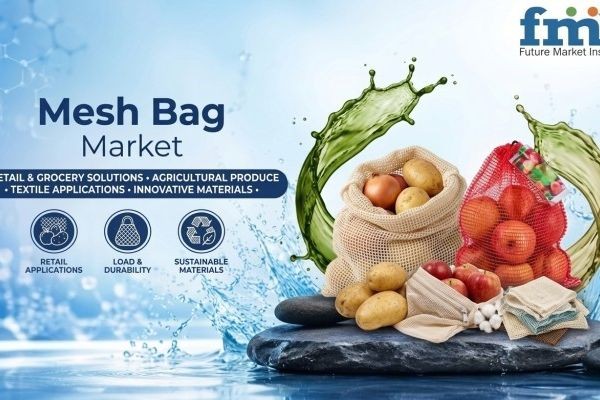
The global mesh bag market is forecast to increase from USD 4.0 billion in 2026 to USD 6.5 billion by 2036, registering a compound annual growth rate (CAGR) of 5.0%, according to Future Market Insights (FMI). Demand is expected to reflect the practical requirements of fresh produce handling, retail display, industrial packaging, and reusable distribution systems.
Mesh bags serve several functions across supply chains. Their open construction allows airflow and visual inspection, while their strength and load-bearing capacity support the movement of agricultural produce and other goods. As packers and distributors review packaging specifications, purchasing decisions increasingly involve seam durability, dimensional consistency, filling-line compatibility, and expected reuse cycles rather than unit price alone.
Produce Handling Remains Central to Market Demand
Agriculture and produce are expected to account for 46.1% of mesh bag application demand in 2026, making this the leading application segment. The segment benefits from packaging requirements that combine ventilation, moisture drainage, and visibility during storage, transport, and retail display.
These characteristics matter in high-throughput packing operations. Packaging teams must consider whether bags can withstand harvesting, filling, stacking, and transportation without tearing or losing their shape. Mesh density, closure performance, and seam strength also influence how reliably bags perform under different load conditions.
Retail and consumer goods represent another application area, where product presentation and convenient handling influence bag selection. Industrial and construction uses place greater emphasis on load containment and resistance to rough handling. These differing requirements limit the extent to which a single bag design can serve every application.
Nylon Leads Material Selection
Nylon is forecast to hold 38.2% of the mesh bag market by material type in 2026. Its tensile strength and abrasion resistance support applications involving repeated handling and demanding distribution conditions.
Polyethylene and polypropylene serve other requirements, particularly where cost, weight, stiffness, or chemical resistance influence purchasing decisions. Cotton remains relevant for selected uses that favor natural materials and shorter reuse cycles.
Material selection affects more than the finished bag. It determines the appropriate mesh construction, yarn characteristics, seam design, inspection procedures, and expected service life. Changing an approved material can require additional handling trials and performance validation. For large packing operations, maintaining consistency across established bag specifications can therefore be as important as securing a competitive purchase price.
Automation and Reuse Influence Procurement Decisions
The adoption of automated weighing, filling, labeling, and tagging equipment is creating a practical requirement for mesh bags with consistent dimensions and predictable closure behavior. Variations in bag geometry or seam placement can affect filling performance, equipment adjustments, and packaging-line efficiency.
Reusable packaging programs add another consideration. Buyers need to assess how bags perform over repeated filling, transport, emptying, and return cycles. Tensile strength, abrasion resistance, seam integrity, and dimensional stability can help determine replacement schedules and the economic value of reuse.
However, mesh bag specifications remain difficult to standardize across applications. Different produce types and industrial products require different opening sizes, load capacities, and closure systems. Qualification trials and customer handling tests can extend development timelines and leave suppliers managing multiple product formats.
For manufacturers, this creates opportunities to provide application-specific designs, consistent production quality, technical support, and dependable supply during seasonal demand periods. Buyers can use performance testing and failure analysis to assess the operational consequences of bag rupture, seam opening, and inconsistent dimensions.
India Leads Country-Level Growth
India is forecast to record the fastest growth among the countries listed in FMI's analysis, with a CAGR of 5.8% through 2036. Vietnam follows at 5.5%, while China is projected to grow at 5.2%. Brazil is forecast at 4.9%, and the United States at 4.3%.
The report associates India's outlook with retail expansion, e-commerce activity, and greater use of reusable packaging. Vietnam's growth reflects demand from fresh produce, industrial, and retail packaging applications. China's outlook is linked to agricultural and industrial requirements for lightweight, breathable packaging.
These country forecasts offer manufacturers and procurement teams a basis for comparing potential demand across markets. Local customer requirements, product qualification, supplier reliability, and the ability to meet volume commitments remain relevant when assessing commercial opportunities.
Competitive Landscape and Report Scope
Companies identified in FMI's mesh bag market analysis include Knack Packaging Private Limited, Karatzis S.A., Nutec Manufacturing, Inc., Tex-Pro Inc., Agribag International Ltd., Tufbag Industrial Co., Ltd., KB Poly Industries, Vedder Industrial Ltd., Flexipol Packaging Limited, Mega Plastic Industries, and Sagar Polypack.
The report examines the market by material type, including nylon, polyethylene, polypropylene, cotton, and other materials, and by application, including agriculture and produce, retail and consumer goods, industrial and construction, and other uses. Geographic coverage spans Asia Pacific, Europe, North America, Latin America, and the Middle East and Africa.
The analysis also covers ventilation and airflow performance, tensile strength, seam durability, abrasion resistance, reuse-cycle testing, dimensional stability, closure systems, automated filling compatibility, and seasonal supply programs.
FMI Custom Research: Strategic Intelligence for Confident Decision-Making
In today’s rapidly evolving business environment, leadership teams need more than market data—they need clear, actionable intelligence tailored to their strategic objectives. FMI’s Custom Research solutions are designed around the specific business questions organizations need answered, enabling executives to evaluate growth opportunities, validate investments, assess competitive dynamics, and reduce uncertainty before making critical decisions. By combining deep industry expertise, primary research, and proprietary market intelligence, FMI delivers insights that help organizations move from assumptions to evidence-based strategies with greater speed and confidence.
Business Impact
FMI helps organizations transform market complexity into strategic clarity, enabling leadership teams to identify growth opportunities faster, optimize resource allocation, strengthen competitive positioning, and make high-stakes business decisions with confidence.
About Future Market Insights (FMI)
Future Market Insights, Inc. (FMI) is an ESOMAR-certified, ISO 9001:2015 market research and consulting organization, trusted by Fortune 500 clients and global enterprises. With operations in the U.S., UK, India, and Dubai, FMI provides data-backed insights and strategic intelligence across 30+ industries and 1200 markets worldwide.






