
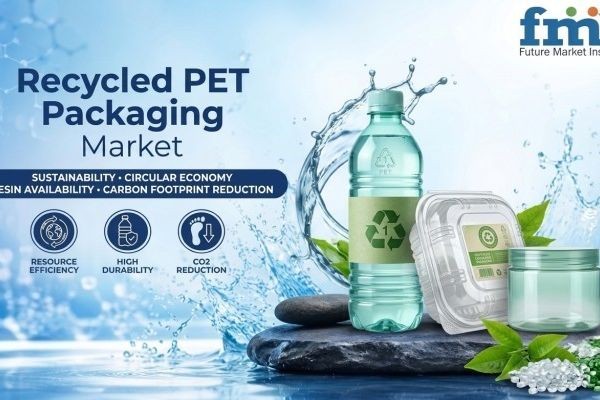
The global recycled PET packaging market is projected to grow from USD 12.4 billion in 2026 to USD 30.7 billion by 2036, registering a Compound Annual Growth Rate (CAGR) of 9.5% over the forecast period. According to the latest market report published by Future Market Insights (FMI), the market will add USD 18.3 billion in revenue between 2026 and 2036 as packaging converters and consumer goods manufacturers increase their use of post-consumer recycled polyethylene terephthalate (rPET).
Regulatory requirements are changing how beverage and consumer goods companies source packaging materials. Recycled PET is increasingly treated as a manufacturing input that must meet food-contact requirements, rather than an optional sustainability addition. Rigid containers and bottles account for 49.4% of packaging format demand in 2026, reflecting the importance of beverage bottles in recycled-content programs.
KEY MARKET TAKEAWAYS
- Market Valuation: USD 12.4 billion in 2026, projected to reach USD 30.7 billion by 2036.
- Growth Rate: The market is forecast to expand at a 9.5% CAGR from 2026 to 2036.
- Leading Packaging Format: Rigid containers and bottles account for 49.4% of packaging format demand in 2026.
- Leading Material Substrate: Thermoplastic polymers represent 43.2% of material substrate revenue in 2026.
- Leading End-use Sector: Food and beverage accounts for 43.9% of demand in 2026.
- Fastest-growing Country: France leads the profiled markets with an 11.6% CAGR through 2036.
- Core Growth Driver: Mandatory recycled-content requirements are encouraging investment in food-grade rPET collection, processing and packaging conversion.
INDUSTRY SHIFTS & MARKET DYNAMICS
The expansion of recycled PET packaging is closely linked to regulations targeting virgin plastic consumption. Minimum recycled-content requirements and plastic packaging taxes are encouraging beverage bottlers, food manufacturers and personal care companies to qualify more recycled resin for their containers. Food and beverage remains the largest end-use sector, with projected 2026 revenue of USD 5.4 billion. Bottled water, carbonated soft drinks, fruit juices and fresh produce packaging create recurring demand for food-grade recycled material.
Manufacturing investments are also changing the economics of recycled PET. Optical flake sorting, vacuum extrusion and solid-state polycondensation help converters restore resin quality and achieve the intrinsic viscosity needed for packaging applications. However, access to clean, clear post-consumer bottle bales remains a constraint. Contamination from labels, closures, colored containers and other polymers can reduce food-grade pellet yields. Competition from polyester textile producers adds further pressure on available feedstock.
The market's next phase will depend partly on the ability of reclaimers to process waste streams that conventional mechanical recycling systems struggle to handle. Glycolysis, methanolysis and enzymatic recycling offer potential routes for converting colored, opaque and thermoformed PET waste into usable feedstock. These technologies could widen the supply base for food-contact recycled resin, although commercial adoption will depend on processing economics and regulatory qualification.
REGIONAL MARKET SUMMARY
Country-level growth reflects differences in recycled-content regulations, collection infrastructure and domestic recycling capacity. France is projected to record the highest CAGR among the six profiled countries.
- France: 11.6% CAGR, supported by AGEC anti-waste requirements and increased recycled PET use in beverage packaging.
- Italy: 10.6% CAGR, driven by mineral water bottling demand and selective bottle collection systems.
- Spain: 9.9% CAGR, supported by the EUR 0.45 per kilogram tax on non-reusable plastic packaging containing virgin polymer.
- USA: 9.1% CAGR, reflecting state-level recycled-content mandates and investment in food-grade reclamation capacity.
- United Kingdom: 8.4% CAGR, supported by the Plastic Packaging Tax threshold for packaging containing less than 30% recycled plastic.
- Australia: 7.6% CAGR, driven by container deposit schemes and domestic bottle-to-bottle recycling capacity.
SEGMENT OUTLOOK AND COMPETITIVE ACTIVITY
Rigid containers and bottles remain central to the market because beverage producers need packaging that can withstand carbonation pressure, handling and transportation. High-speed injection and stretch blow molding equipment enables converters to manufacture preforms and bottles using decontaminated recycled pellets. The segment's 49.4% share in 2026 reflects the importance of bottle-to-bottle recycling programs.
Thermoplastic polymers account for 43.2% of material substrate revenue. Their ability to be washed, reprocessed and re-polymerized makes them suitable for applications requiring controlled resin properties. Food and beverage leads end-use demand at 43.9%, ahead of pharmaceuticals and healthcare, personal care and homecare, and industrial manufacturing.
Notable companies operating in the market include Amcor plc, Berry Global Group, Inc., Silgan Holdings Inc., Smurfit Westrock plc, Mondi plc, Huhtamaki Oyj, Sonoco Products Company, Ball Corporation and Crown Holdings, Inc. Their activities span recycled PET preforms, rigid containers, thermoformed food trays, clamshells and secondary packaging formats.
Recent developments illustrate the industry's focus on securing recycled resin and expanding conversion capacity. In November 2025, Silgan Holdings Inc. entered a multi-year supply agreement with circular plastics reclaimers for 40,000 metric tons of food-grade rPET annually. In August 2025, Berry Global Group, Inc. introduced a lightweight 100% recycled PET carbonated beverage bottle range. Amcor plc completed a USD 50.0 million expansion of its Western European food-grade rPET preform injection hub in May 2025, adding capacity for more than 3.0 billion preforms annually.
ANALYST INSIGHTS
“Solid-state polycondensation reactors and optical flake sorters allow converters to run high recycled content on rotary blow molders without losing bottle top-load strength. Limited collection of clear food-contact bales still creates feedstock price volatility before converters commit to multi-year supply contracts,” stated Nandini Roy Choudhury, Principal Consultant at Future Market Insights.
The market's commercial direction will depend on reliable access to food-grade recycled feedstock. Companies that strengthen collection partnerships, improve decontamination performance and secure long-term resin supply will be better positioned to serve packaging buyers facing tighter recycled-content requirements.
ABOUT THE REPORT
The Recycled PET Packaging Market report by Future Market Insights examines market revenue and growth prospects from 2026 to 2036. It analyses packaging format, material substrate, end-use sector and regional demand, with country-level forecasts for key markets. The study also assesses competitive activity, supply constraints, regulatory influences and investment opportunities across the recycled PET packaging value chain.


