
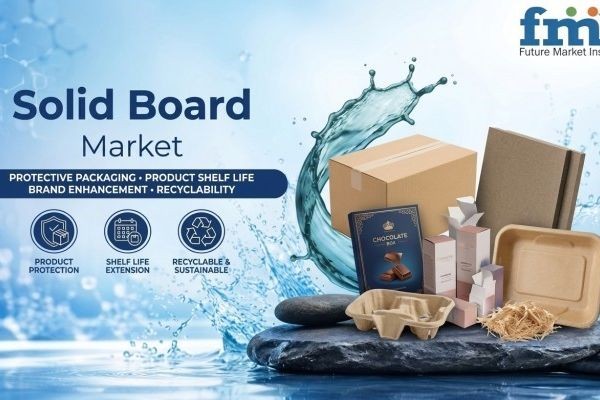
The global solid board market is projected to increase from USD 12.5 billion in 2026 to USD 19.2 billion by 2036, registering a compound annual growth rate (CAGR) of 4.4% over the forecast period. The market recorded USD 12.0 billion in 2025, with the latest forecast pointing to USD 6.7 billion in additional revenue between 2026 and 2036, according to Future Market Insights (FMI).
Demand is being supported by food packers and industrial converters seeking dense, moisture-resistant paperboard packaging for chilled meat, seafood, fresh produce and other applications. Solid board's non-fluted construction provides structural stiffness in humid cold-storage environments, where moisture exposure can weaken the glued layers of conventional corrugated packaging. Its flat-packed format also helps reduce inbound storage and transport requirements.
KEY MARKET TAKEAWAYS
- Market Valuation: The solid board market is estimated at USD 12.5 billion in 2026 and is projected to reach USD 19.2 billion by 2036.
- Growth Rate: Revenue is forecast to expand at a 4.4% CAGR from 2026 to 2036.
- Leading Segment: Folding Cartons & Trays account for 30.4% of product format and style sales in 2026.
- Fastest-Growing Country: Japan leads the five profiled national markets with a projected 5.4% CAGR through 2036.
- Core Growth Driver: Demand for recyclable, moisture-resistant packaging is increasing as food packers reassess plastic and conventional corrugated formats for chilled supply chains.
INDUSTRY SHIFTS & MARKET DYNAMICS
Solid board is gaining attention in food packaging because its dense, multi-ply structure can withstand stacking pressure without the hollow channels found in fluted board. Meat processors, seafood exporters and fresh produce packhouses require containers that retain stiffness when exposed to condensation, ice slurry and high humidity during refrigerated transport. Folding cartons and trays are particularly relevant because converted blanks can feed into automated forming equipment, reducing manual handling and supporting high-speed packing operations.
Packaging recyclability requirements are also influencing procurement decisions. The European Union's Packaging and Packaging Waste Regulation, Regulation (EU) 2025/40, is cited in the report as a factor shaping packaging specifications and design-for-recycling requirements. Food packers are evaluating solid fiberboard as an alternative to expanded polystyrene and plastic formats, while converters are developing aqueous water-based barriers to provide grease and moisture resistance without relying on conventional plastic film layers.
However, the transition is not without commercial challenges. Pulpwood, recovered-paper and industrial energy costs can affect mill operating expenses and converter margins. Non-integrated manufacturers may face additional pressure when raw-material prices rise, particularly when food packers operate under fixed-price supply agreements. These conditions make multi-quarter procurement agreements, reliable fiber sourcing and efficient coating operations important considerations for suppliers.
REGIONAL MARKET SUMMARY
FMI's country forecasts identify the following growth rates for 2026 to 2036:
- Japan: 5.4% CAGR, supported by chilled bento and seafood tray demand and established recovered-paper utilization.
- France: 4.9% CAGR, driven by packaging changes associated with the AGEC framework and recyclable fiber formats.
- Poland: 4.6% CAGR, supported by poultry and meat export packhouses requiring moisture-resistant shipping boxes.
- United Kingdom: 3.9% CAGR, with recyclable packaging requirements and chilled-food packaging redesigns supporting demand.
- Austria: 3.5% CAGR, supported by integrated cartonboard production and specialized pharmaceutical and confectionery packaging.
Japan records the highest projected growth among these five countries. The differences in national growth rates reflect variations in food export activity, packaging regulations, recovered-fiber systems and domestic converting capacity.
ANALYST INSIGHTS
"Aqueous dispersion coatings allow solid board trays to replace expanded polystyrene across wet meat and fish cold chains. Fluctuating pulpwood and energy costs still require converters to lock in multi-quarter supply agreements with integrated mills."
— Nandini Roy Choudhury, Principal Consultant, Future Market Insights.
COMPETITIVE LANDSCAPE
Competition in the solid board market reflects differences in fiber sourcing, board manufacturing integration, converting capabilities and barrier-coating technology. Suppliers with access to virgin chemical kraft pulp and recycled multi-ply substrates can serve a wider range of food, healthcare and consumer packaging requirements.
Notable companies covered in the report include Mondi plc, Smurfit Westrock plc, Stora Enso Oyj, Metsä Board Corporation, Sonoco Products Company, Mayr-Melnhof Karton AG, Billerud AB and Amcor plc.
Integrated manufacturers are positioned across virgin and recycled board production, while packaging converters serve customers through carton, tray and specialty board formats. The report also identifies aqueous dispersion and alternative coating technologies as areas of product differentiation.
ABOUT THE REPORT
Future Market Insights' Solid Board Market report examines market size and forecasts for 2026 to 2036. It covers product format and style, material substrate, end-use application, barrier and coating property, and regional demand. The study includes country-level forecasts, competitive analysis, market drivers, restraints and opportunities. Its research approach combines primary interviews, secondary research, market sizing and data triangulation.


