
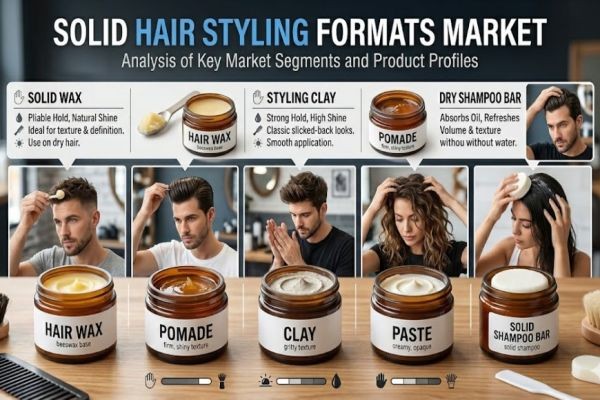
According to the latest industry analysis, the global solid hair styling formats market is entering a phase of sustained expansion driven by the normalization of waterless grooming products, rising demand for compact and travel-friendly styling solutions, and growing consumer preference for low-waste personal care formats. Valued at USD 25.4 billion in 2026, the market is projected to reach USD 44.6 billion by 2036, expanding at a CAGR of 5.8% during the forecast period.
Solid hair styling formats are transitioning from niche sustainability-oriented alternatives into mainstream grooming essentials. Consumers increasingly favor concentrated styling products such as solid gels, waxes, pomades, and sticks that provide longer product life, reduced packaging intensity, and improved portability compared with traditional liquid-based products.
Industry participants are responding by investing in formulation engineering, retail scalability, and anhydrous product innovation to improve styling performance and expand mass-market adoption. As everyday grooming habits evolve, solid styling products are becoming embedded within routine personal care consumption across both premium and mass retail channels.
Quick Stats Snapshot
• Market size (2026): USD 25.4 billion
• Forecast (2036): USD 44.6 billion
• CAGR (2026-2036): 5.8%
• Leading product segment: Hair Gels (28.6% share)
• Dominant ingredient segment: Chemical-Based Formulations (54.3% share)
• Leading sales channel: Supermarkets/Hypermarkets (36.8% share)
• Fastest-growing countries: China (7.8%), India (7.2%), Germany (6.6%), Brazil (6.0%)
• Key market trend: Transition toward concentrated and waterless styling systems
• Core growth driver: Everyday adoption of compact, long-lasting grooming formats
• Major application focus: Daily styling, portability, sustainability, and retail efficiency
Get detailed market forecasts, competitive benchmarking, and regional insights: https://www.futuremarketinsights.com/reports/sample/rep-gb-31788
Market Size and Growth Outlook
The solid hair styling formats market is forecast to expand at a CAGR of 5.8% between 2026 and 2036. Growth is primarily supported by shifting grooming habits, increasing acceptance of waterless personal care products, and broader retail penetration across mass-market and online channels.
Unlike earlier adoption cycles centered on novelty and sustainability positioning, current market expansion is increasingly driven by performance reliability and routine usage. Consumers now expect solid formats to deliver comparable hold, texture, and styling consistency to traditional liquid alternatives while offering added benefits such as portability and reduced packaging waste.
As a result, manufacturers are prioritizing concentrated formulations capable of supporting everyday grooming routines while improving operational efficiency across transportation, inventory management, and retail merchandising.
Market Trends
• Expansion of waterless and concentrated hair styling products
• Growing normalization of solid styling formats in daily grooming routines
• Increased focus on packaging reduction and low-waste personal care systems
• Stronger integration of solid formats into mass retail and e-commerce channels
• Rising investment in polymer engineering and formulation optimization
• Broader consumer acceptance of compact and travel-friendly styling solutions
Key Market Drivers
1. Shift Toward Waterless Grooming Products
Consumers increasingly prefer concentrated styling formats that reduce packaging waste while offering longer product life and better value per use.
2. Growth of E-Commerce and Digital Retail
Solid styling products align well with online retail due to lower leakage risk, easier shipping, and simplified logistics management.
3. Performance Improvements in Solid Formulations
Advancements in polymer systems, wax matrices, and texture-control technologies are improving hold consistency and styling durability across different climates and hair types.
4. Rising Demand for Portable Grooming Solutions
Urban lifestyles, travel-heavy routines, and compact storage preferences are accelerating demand for convenient solid styling products.
Key Challenges
• Strong consumer loyalty toward liquid styling products
• Performance expectations around spreadability and texture consistency
• Limited awareness in developing grooming categories
• Formulation complexity for natural and hybrid ingredient systems
• Competitive pressure from established liquid-format brands
Emerging Opportunities
• Expansion of concentrated and anhydrous personal care portfolios
• Growth of premium solid styling formats with advanced texture engineering
• Increasing penetration across specialty beauty retail channels
• Development of hybrid ingredient systems balancing performance and sustainability
• Wider adoption of refillable and low-waste grooming packaging models
Segmentation Insights: Hair Gels Lead Demand
By Product Type
Hair gels lead the market with a 28.6% share due to their versatile styling, reliable hold, and daily grooming use. Solid gels are especially popular among male consumers for their easy application and portability. Hair waxes, pomades, and styling sticks are also gaining popularity for texture control and compact use.
By Ingredient Type
Chemical-based formulations hold 54.3% of market demand because of their strong hold, humidity resistance, and consistent performance. Synthetic ingredients remain dominant, while natural and hybrid formulas are growing gradually despite stability challenges.
By Sales Channel
Supermarkets and hypermarkets account for 36.8% of sales as consumers prefer buying styling products with regular personal care items. Their shelf stability and low leakage risk also make them attractive for retailers, while online and specialty stores continue expanding market reach.
Speak to Analyst: Customize insights for your business strategy: https://www.futuremarketinsights.com/customization-available/rep-gb-31788
Regional Analysis
• China (7.8% CAGR): Strong demand for compact grooming products and high e-commerce penetration support rapid adoption
• India (7.2% CAGR): Urban grooming trends and rising personal care spending accelerate demand for portable styling products
• Germany (6.6% CAGR): Sustainability-driven consumption and structured retail distribution strengthen market growth
• Brazil (6.0% CAGR): Climate-driven styling frequency and expanding retail visibility support steady adoption
• United States (5.5% CAGR): Mature but steadily transitioning grooming market driven by convenience-oriented consumers
• United Kingdom (4.9% CAGR): Stable adoption supported by specialty retail and sustainability awareness
• Japan (4.3% CAGR): Growth remains moderate due to continued preference for traditional liquid styling systems
Asia Pacific is expected to remain the fastest-growing region throughout the forecast period, supported by urbanization, evolving grooming habits, and strong digital retail infrastructure.
Competitive Landscape
The market is highly competitive, led by diversified personal care companies leveraging global distribution networks, formulation expertise, and strong brand equity.
Key companies include Procter & Gamble, L'Oréal, Unilever, Shiseido, Amorepacific, Kao Corporation, and Henkel.
Competitive advantage is increasingly defined by:
• Formulation performance and texture engineering
• Ability to scale concentrated styling systems across retail channels
• Packaging reduction and sustainability alignment
• Strong e-commerce and specialty retail integration
• Product reliability across varying climates and grooming conditions
Recent Industry Developments
• In October 2024, Unilever expanded its compact and low-water personal care portfolio across Asia Pacific markets, incorporating additional solid styling formats into mainstream hair care distribution.
• In February 2025, L'Oréal accelerated investment in solid and anhydrous hair product innovation focused on improving polymer performance and sensory experience.
• In January 2026, Procter & Gamble announced manufacturing capacity upgrades supporting increased production of concentrated grooming and solid styling products.
Future Outlook
The solid hair styling formats market is expected to evolve from an emerging sustainability-driven category into a foundational segment of mainstream personal grooming.
Over the forecast period, growth will increasingly depend on formulation performance, retail scalability, and integration into everyday consumer grooming habits rather than novelty positioning alone.
Manufacturers capable of combining portability, styling reliability, and low-waste packaging are expected to capture significant long-term market share as concentrated formats continue replacing inefficient liquid-heavy product systems.
Asia Pacific will remain the primary growth engine, while North America and Europe continue driving premiumization, formulation innovation, and retail sophistication.
Purchase Full Report for Comprehensive Market Intelligence: https://www.futuremarketinsights.com/reports/solid-hair-styling-formats-market
Executive Takeaways
• The market is expected to grow from USD 25.4 billion in 2026 to USD 44.6 billion by 2036 at a 5.8% CAGR.
• Growth is driven by demand for waterless and concentrated grooming products.
• Hair gels lead product demand with a 28.6% share.
• Chemical-based formulations dominate with a 54.3% share for their performance reliability.
• Supermarkets and hypermarkets remain the top retail channel with a 36.8% share.
• China and India are the fastest-growing regional markets.
• Success will depend on product innovation, retail reach, and repeat consumer use.
• The market is moving from a sustainability trend to mainstream grooming adoption.
Why Choose FMI: https://www.futuremarketinsights.com/why-fmi
לא נמצאו הערות






