
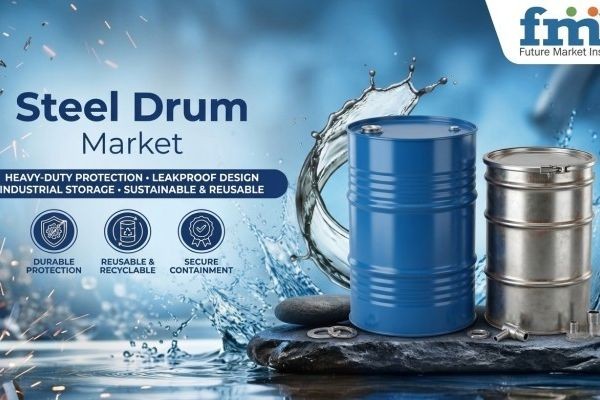
The global steel drum industry is increasingly defined by traceability systems, reconditioning infrastructure, internal coating specifications and low-carbon steel sourcing, as industrial packaging manufacturers align their product offerings with chemical transportation, hazardous-material containment and circular packaging requirements. The Future Market Insights (FMI) Steel Drum Market Report, 2026–2036, examines competitive positioning, supplier capabilities, product developments and commercial opportunities across the steel drum supply chain.
Competition among steel drum manufacturers extends beyond fabrication capacity and price. Chemical producers, petrochemical suppliers, lubricant manufacturers and hazardous-material shippers increasingly evaluate drum construction, lining integrity, certification requirements, collection systems and regional manufacturing access when qualifying industrial packaging suppliers.
The competitive landscape includes multinational drum manufacturers, regional steel packaging producers, reconditioning operators and specialized hazardous-material container fabricators. Companies are developing commercial differentiation through manufacturing modernization, serialized packaging identification, low-carbon material sourcing and closed-loop container recovery services.
Steel Drum Market Competitive Structure and Commercial Dynamics
The steel drum market comprises manufacturers serving industrial chemical transportation, petrochemical storage, lubricant distribution, hazardous-material logistics and other rigid packaging requirements. Supplier positioning is influenced by production infrastructure, coating capabilities, certification requirements, regional supply access and reconditioning services.
Greif, Mauser Packaging Solutions and Schütz operate manufacturing and washing infrastructure across multiple industrial packaging markets, supporting customers seeking integrated container supply and recovery arrangements. Their operational capabilities are associated with fabrication, reconditioning and regional service networks.
In Asian markets, Balmer Lawrie, JFE Container, Time Technoplast and Sicagen India compete through manufacturing facilities, steel sourcing, industrial packaging production and regional customer coverage. These suppliers serve industrial packaging requirements across India, Japan and wider Asian and Middle Eastern markets.
Specialized manufacturers, including Myers Container, operating under North Coast Container, and Global Industrial Drum, address hazardous-material packaging and heavy-gauge container requirements. Their product positioning includes UN-rated drums, salvage containers and industrial steel packaging configurations.
Commercial differentiation increasingly involves the combination of container performance, production consistency, digital identification and reverse-logistics arrangements. Buyers evaluating industrial drums may assess the availability of reconditioning infrastructure alongside new-container supply, particularly where multi-site packaging operations require repeat procurement and collection services.
Verified Company and Product Developments
The supplied FMI competitive analysis identifies the following company developments and product activities across the steel drum industry.
- April 2026 – Greif: Introduced Track & Trace 2D data-matrix serialization on European large steel drums. The development addresses batch identification and documentation requirements among chemical and food-grade packaging buyers.
- May 2026 – Schütz: Exhibited CircularOne closed-loop drum collection and Combi-Laser drums at Interpack 2026. The product and service presentation reflects the company's positioning in reusable industrial packaging and collection arrangements.
- September 2025 – Greif: Introduced EcoBalance low-carbon steel drums, with the supplied analysis reporting an approximately 60% lower carbon footprint.
- August 2025 – Greif: Recorded USD 399.8 million in Q3 Durable Metal Solutions net sales and USD 47.7 million in segment Adjusted EBITDA, according to the supplied competitive analysis.
- Sicagen India Limited: Operates a 12,000-square-meter industrial packaging facility at Minjur, Chennai, manufacturing 210-liter and 20-to-25-liter CRCA mild-steel drums in 16-to-22 SWG thicknesses, with specialized internal epoxy lacquer coatings.
- North Coast Container: Completed the strategic rebrand of Myers Container across five U.S. plants, including facilities in Ohio, North Carolina, Illinois and the West Coast, supplying 10-to-85-gallon UN-rated and 7A Type A steel drums.
These developments illustrate supplier differentiation across serialized packaging, lower-carbon material sourcing, regional production infrastructure and specialized industrial drum manufacturing.
Product Specifications and Purchasing Requirements
Industrial drum procurement involves evaluating product specifications and operating requirements that affect container qualification, filling operations, transportation and material compatibility.
Hazardous-chemical packaging buyers may evaluate UN 1A1 and 1A2 certification requirements, drop-test and hydrostatic pressure performance, seam integrity, internal coating specifications and container compatibility with the transported material.
Manufacturing and quality-control capabilities cited in the supplied competitive analysis include online helium leak testing, baked epoxy-phenolic internal linings, coating continuity, dry-film thickness controls and specialized steel drum configurations.
Commercial requirements also extend to collection infrastructure and sustainability documentation. Buyers evaluating reusable packaging systems may consider drum washing arrangements, collection guarantees, life-cycle assessments, recycled steel content and packaging traceability.
The supplied analysis identifies serialized drum fleets, digital collection portals, reconditioning services and low-carbon steel sourcing as areas of commercial opportunity over the 2026–2036 assessment period.
Key Industry Questions
What defines the competitive structure of the steel drum market?
The competitive structure includes multinational steel drum manufacturers, regional industrial packaging producers, specialized hazardous-material container fabricators and drum reconditioning providers. Greif, Mauser Packaging Solutions and Schütz operate across multiple regions, while Balmer Lawrie, JFE Container, Time Technoplast and Sicagen India serve manufacturing and industrial packaging requirements across Asian markets.
What recent company developments are shaping supplier differentiation?
The supplied analysis identifies Greif's April 2026 Track & Trace 2D data-matrix serialization introduction, its September 2025 EcoBalance low-carbon steel drum launch and Schütz's May 2026 presentation of CircularOne collection and Combi-Laser drums at Interpack 2026. These developments are associated with packaging identification, lower-carbon material sourcing and closed-loop collection capabilities.
How does geographic coverage differ among steel drum manufacturers?
Greif, Mauser Packaging Solutions and Schütz maintain manufacturing and reconditioning networks across multiple international markets. Balmer Lawrie and Sicagen India focus on Indian manufacturing operations, JFE Container serves Japanese industrial packaging requirements, and Time Technoplast operates across markets in Asia and the Middle East. Myers Container, under North Coast Container, serves U.S. industrial packaging customers.
What proprietary information is covered in the full FMI Steel Drum Market Report?
The full research assessment covers market sizing, segmentation, country-level growth rates, competitive positioning and market-share assessments. Quantitative market forecasts, segment shares and detailed country-level assessments remain proprietary FMI research findings and are not disclosed in this competitive-analysis excerpt.


