
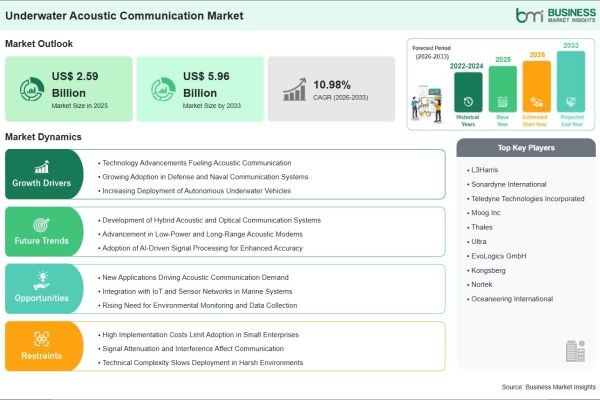
Significant technological advancements are reshaping the underwater acoustic communication sector, establishing it as the fundamental operational backbone required for robust offshore energy production, deep-sea monitoring, and naval defense logistics.
Based on market intelligence from Business Market Insights, the global Underwater Acoustic Communication Market [https://www.businessmarketinsights.com/reports/underwater-acoustic-communication-market] is anticipated to reach US$ 5.96 billion by 2033, mounting from its 2025 value of US$ 2.59 billion at a projected CAGR of 10.98% from 2026 to 2033.
Recent breakthroughs in artificial intelligence for signal processing, the miniaturization of acoustic modems, and the rapid deployment of Autonomous Underwater Vehicles (AUVs) are radically altering the capabilities of subsea networks. Major defense contractors and marine technology firms are aggressively channeling capital into research and development to mitigate acoustic interference and establish the foundational architecture for the "Internet of Underwater Things" (IoUT).
Download Sample Report : https://www.businessmarketinsights.com/sample/BMIPUB00034572
What Is Underwater Acoustic Communication?
Underwater acoustic communication is a technique of sending and receiving data below the water's surface using sound waves. Unlike terrestrial communication, which relies on radio waves travelling at the speed of light, underwater communication utilizes hydrophones (underwater microphones), acoustic modems, and transducers to convert digital data into sound pulses. These sound waves travel through the water and are decoded back into data by a receiving node.
This technology is uniquely challenging due to the harsh physics of the ocean. Sound travels approximately 4.5 times faster in water than in air, but it is heavily subjected to multi-path propagation (echoes), signal attenuation, temperature variations, and ambient marine noise. High-quality underwater acoustic communication systems rely on highly sophisticated modulation techniques and digital signal processing to filter out this noise and deliver reliable data over distances ranging from a few meters to hundreds of kilometers.
Market Drivers
The primary driver propelling the Underwater Acoustic Communication Market is the massive global proliferation of Unmanned Underwater Vehicles (UUVs), Autonomous Underwater Vehicles (AUVs), and Remotely Operated Vehicles (ROVs). These drones are extensively used for deep-sea mapping, pipeline inspection, and underwater mining. Because GPS and Wi-Fi do not function underwater, these vehicles rely entirely on acoustic communication networks to receive navigation coordinates from surface ships and transmit high-resolution sensor data back to operators in real-time.
Furthermore, escalating geopolitical tensions and aggressive naval modernization programs are acting as massive growth catalysts. Defense agencies worldwide are investing heavily in advanced submarine communication networks and anti-submarine warfare (ASW) systems. Establishing secure, long-range, and stealthy acoustic data links is critical for coordinating underwater drone swarms, detecting stealth submarines, and ensuring the tactical superiority of naval fleets.
Additionally, the transition toward deep-water offshore oil and gas exploration necessitates robust subsea communication. As energy companies drill deeper, the physical maintenance of wired communication tethers becomes incredibly costly and dangerous. Wireless acoustic modems provide a reliable, untethered method for monitoring subsea wellheads, controlling robotic valves, and instantly detecting hazardous leaks, drastically improving the safety and efficiency of offshore energy operations.
Market Segmentation
By Component
- Acoustic Modems
- Hydrophones
- Transducers & Transceivers
- Sensors
By Communication Range
- Shallow Water (Up to 100 meters)
- Medium Water (100 meters to 1,000 meters)
- Long Water (Beyond 1,000 meters)
By Application
- Environmental Monitoring
- Pollution Monitoring
- Climate Monitoring
- Hydrography & Oceanography
By End-User Industry
- Defense & Aerospace
- Oil & Gas
- Scientific Research & Development
- Marine & Commercial
The acoustic modems segment currently maintains revenue leadership, as they are the critical "brains" that modulate and demodulate the digital signals. From an end-user perspective, the defense and aerospace sector commands the largest market share due to highly classified, multi-billion-dollar military procurement programs. However, the scientific research segment—fueled by global climate change monitoring and deep-ocean mapping—represents an exceptionally lucrative, high-growth area.
Regional Insights
- North America represents the absolute largest market globally, heavily dominated by the United States Navy's massive investments in subsea warfare capabilities and a dense ecosystem of advanced marine robotics manufacturers and oceanographic research institutes.
- Asia-Pacific is projected to witness the fastest regional growth rate. This is heavily driven by China's aggressive expansion in marine technology and deep-sea exploration, alongside growing naval defense budgets and offshore energy investments in Japan, South Korea, and India.
- Europe maintains a highly robust market trajectory, strongly underpinned by the United Kingdom's offshore wind farm expansions in the North Sea, Norway's advanced subsea oil and gas infrastructure, and collaborative European Union marine biology research initiatives.
- Middle East & Africa and South & Central America are demonstrating steady, strategic progress, supported by rising investments in offshore drilling automation and the modernization of coastal security monitoring networks.
Top Players in the Underwater Acoustic Communication Industry
The global marketplace features concentrated competition among diversified defense conglomerates and specialized marine technology engineering firms. Key industry participants are heavily focused on developing multi-frequency modems capable of penetrating highly turbulent, shallow-water environments where acoustic echoes are most severe.
- Teledyne Marine (Teledyne Technologies Inc.)
- Kongsberg Maritime
- Thales Group
- Ultra Electronics
- Sonardyne International Ltd.
- L3Harris Technologies, Inc.
- EvoLogics GmbH
- DSPComm
- Nortek AS
- Chelton Limited
These market leaders frequently execute strategic acquisitions of smaller marine robotics firms to offer complete, end-to-end underwater communication frameworks rather than just standalone components.
Technological Innovations
Technological innovations in Artificial Intelligence (AI) and Machine Learning (ML) are fundamentally solving the industry's biggest challenge: multi-path interference. In shallow waters, sound bounces violently off the surface and the sea floor, creating a chaotic jumble of echoes that confuse traditional receivers. Modern AI-driven acoustic modems can predict and actively learn the physical characteristics of the surrounding water column, dynamically adjusting their signal frequencies in real-time to "cut through" the noise and deliver error-free data packets.
Furthermore, the development of Software-Defined Acoustic Modems (SDAM) is transforming hardware longevity. Traditionally, acoustic modems were hardwired for specific frequencies and ranges. SDAM allows the modem's entire communication protocol to be updated remotely via software. This means a submarine or AUV can switch from a long-range, low-bandwidth communication protocol to a short-range, high-bandwidth protocol instantly, without needing to surface and physically change hardware.
Additionally, engineers are making massive strides in bio-inspired acoustic communication. By studying how dolphins and whales utilize highly efficient, low-energy clicks and whistles to communicate over thousands of miles, researchers are developing biomimetic acoustic waveforms that are naturally resistant to oceanic background noise, significantly improving the battery life and stealth capabilities of underwater sensors.
Future Market Outlook
The long-term trajectory for the Underwater Acoustic Communication Market is highly disruptive and strategically critical. As the global economy looks toward the ocean for next-generation resources—including deep-sea mining for rare earth metals and massive offshore renewable energy grids—the requirement for real-time, high-fidelity subsea data will explode.
The upcoming maturation of the Internet of Underwater Things (IoUT) will permanently change oceanography. Future marine environments will be populated by thousands of interconnected, autonomous sensors resting on the sea floor, communicating seamlessly with drone swarms and surface buoys via acoustic links, and uploading real-time climate, seismic, and defense data directly to cloud satellites. Companies that can master ultra-low-power signal processing, achieve higher data transfer rates, and ensure absolute cybersecurity in subsea transmissions will dominate the future of the blue economy.
Frequently Asked Questions (FAQs)
Why can't we just use Wi-Fi or Bluetooth underwater?
Wi-Fi and Bluetooth rely on electromagnetic radio waves. Water, especially saltwater, is highly conductive and rapidly absorbs electromagnetic energy. A standard Wi-Fi signal will completely degrade within mere inches of entering the water. Sound waves, however, are mechanical vibrations that travel exceptionally well through dense liquid mediums, making acoustics the only viable method for long-distance wireless underwater communication.
What is a hydrophone?
A hydrophone is an underwater microphone designed specifically to listen to and record acoustic signals beneath the surface. It converts the mechanical energy of underwater sound waves into electrical signals, which are then processed by a computer to extract data. They are a critical receiving component in any underwater communication network.
What is the difference between shallow water and deep water communication?
Shallow water communication (usually under 100 meters depth) is actually much more difficult than deep water communication. In shallow water, the acoustic signal constantly bounces between the sea surface and the sea floor, creating severe multi-path interference (echoes) that garble the data. In deep water, the sound has room to travel in a straight, unobstructed path, allowing for much cleaner communication over vastly longer distances.
How does temperature affect underwater acoustic communication?
The speed of sound in water is not constant; it changes based on temperature, salinity, and pressure. Sound travels faster in warmer water and slower in colder water. Because the ocean has distinct temperature layers (thermoclines), an acoustic wave can literally "bend" or refract as it passes through different temperatures, altering the signal's path and making it difficult for the receiver to catch the data stream if not properly calibrated.
Browse More Reports:
https://www.businessmarketinsights.com/reports/visible-light-range-scientific-camera-market
https://www.businessmarketinsights.com/reports/walking-assist-devices-market
https://www.businessmarketinsights.com/reports/water-testing-and-analysis-market
About Us
Business Market Insights is a market research platform that provides a subscription service for industry and company reports. Our research team has extensive professional expertise in domains such as Electronics & Semiconductor; Aerospace & Defense; Automotive & Transportation; Energy & Power; Healthcare; Manufacturing & Construction; Food & Beverages; Chemicals & Materials; and Technology, Media, & Telecommunications.
Contact Us
If you have any questions about this report or would like further information, please contact us:
Contact person: Ankit Mathur
Email: sales@businessmarketinsights.com
Phone: +16467917070






