
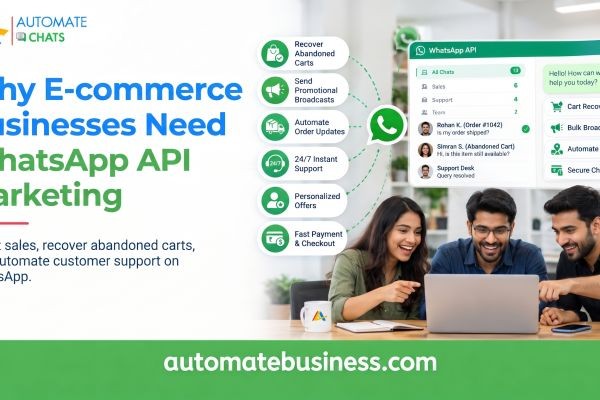
E-commerce businesses need WhatsApp API marketing because it lets them reach past buyers directly, answer every customer from one shared inbox, and automate order updates without paying for ads again. With Automate Chats WhatsApp API Marketing, your whole team can run broadcast campaigns, chatbots, and follow-ups from a single workspace.
This guide explains what WhatsApp API marketing is and where online stores lose money without it. You will also see a D2C campaign example, how Automate Chats stands apart from other tools, and answers to common questions.
What Is WhatsApp API Marketing for E-commerce?
WhatsApp API marketing means using the WhatsApp Business API to send approved, personalized messages to customers at scale. Unlike the regular WhatsApp Business app, the API supports multiple team members, automation, and integrations with your other systems.
For an online store, this turns WhatsApp into a full sales and support channel. You can share new collections, confirm orders, answer product questions, and follow up with interested shoppers from one place.
Automate Chats is built on the WhatsApp Business API and comes from Automate Business, a Meta Business Partner. It is made for growing Indian businesses, including D2C brands and e-commerce sellers.
The Hidden Cost of Paying Ads to Reach Existing Customers
Most online sales start with an ad. After the purchase, the customer's details often sit in a spreadsheet, and the brand pays for ads again to reach the same people.
Consider Tara, a kurta seller with 8,000 past buyers. Despite having an established customer base, she spends more than ₹12,000 on ads to reach them again. Her other option is to forward her catalogue individually through WhatsApp chats, with no clear way to track who received it, read it or clicked on it.
Both routes are slow, costly, and impossible to measure. WhatsApp API marketing fixes this by turning your customer list into a channel you own.
Key Features E-commerce Brands Get with Automate Chats
A good WhatsApp marketing platform should do more than send bulk messages. Here are the features that matter most for online stores.
- WhatsApp broadcast campaigns. Choose the right audience, personalize approved messages, and see how customers respond from one place. A marketing head from a D2C brand shared that one-click broadcasts reached 5,000+ customers and lifted engagement from 8% to 35%.
- WhatsApp team inbox. Every customer chat lands in a shared inbox where you can assign conversations, add internal notes, and keep full customer history together. This means no missed messages and no duplicate replies.
- No-code WhatsApp chatbots. Build guided conversations that ask about preferred products, save answers, and route hot leads to the right person. You do not need a developer.
- AI assistants. Let an AI assistant answer common questions using your product catalogue and delivery policy. It hands the chat to your team when a case needs a human, such as a high-value refund.
Automate Order Updates, Reminders, and Follow-Ups
Customers expect to know where their order is without chasing you. WhatsApp automation sends order confirmations, shipping status, and delivery updates through approved templates.
You can also schedule follow-ups for new leads, send after-hours replies, and nudge shoppers who showed interest but did not buy. Your team stays free for the conversations that need a personal touch.
Contact management supports this work. Store customer details, tags, and groups once, then reuse them across chats, campaigns, and automation. Analytics closes the loop. You can track conversation volume, first reply time, campaign results, and team workload without rebuilding reports in spreadsheets.
APIs and webhooks connect WhatsApp to your CRM, Google Sheets, or store systems. That way, a customer request can move straight into the right next step.
Support Every Stage of the Shopping Journey
WhatsApp API marketing works best when it covers the full customer journey, not just promotions. Automate Chats supports product discovery, orders, and support from the same shared workspace.
At the discovery stage, chatbots can ask what a shopper is looking for and share the right collection. Sales follow-ups can trigger automatically when a lead moves to a new stage, so no interested buyer is forgotten.
After the purchase, the team inbox helps your support staff answer delivery, payment, and return questions quickly. Complex requests can be assigned to the right person, while simple ones are handled by automation or the AI assistant.
Finally, broadcast campaigns bring customers back for the next sale. This creates a simple loop of discovery, order, support, and repeat purchase, all inside WhatsApp.
How a D2C Brand Runs a Festive WhatsApp Campaign
The entire process takes about a minute. Here is how Tara turns her customer list into a sales campaign:
- Upload her customers.csv file, so 8,000 contacts become her own channel.
- Build a segment of customers who bought festive wear.
- Pick a carousel template with one card for each new design.
- Personalize the message with each customer's first name.
- Send a test to her own phone, then schedule the campaign.
How Automate Chats Is Different
Many WhatsApp tools focus on only one job, such as bulk sending or a basic inbox. Automate Chats WhatsApp API marketing combines campaigns, team inbox, automation, chatbots, AI, contacts, and analytics in one workspace. You do not switch between separate tools to run a single customer journey.
It also fits the way small and mid-sized teams actually work. The platform is built for MSMEs, with affordable pricing, a short learning curve, and mobile-first apps.
Here is what else sets it apart:
- Retargeting built into reports. Every message stage, from delivered to clicked, has its own Retarget option.
- AI that uses your own information. Answers come from the details you provide, with a handover to your team.
- No-code setup. Marketers and support staff can build chatbots and automation themselves.
- Part of a wider suite. It connects with Automate CRM, plus integrations such as India MART, Google Sheets, and webhooks.
- Easy migration. Bulk upload by CSV and onboarding help get you running in days, not weeks.
Frequently Asked Questions
- What is WhatsApp API marketing?
It is the use of the WhatsApp Business API to send approved campaigns, automated messages, and support replies at scale. Teams can work together in one shared inbox. - Why do e-commerce businesses need WhatsApp API marketing?
Online stores can reach existing customers directly instead of paying for ads again. They can also automate order updates and measure delivery, reads, clicks, and replies. - Do I need coding skills to use Automate Chats?
No. You can build chatbots and follow-up flows with a no-code builder. - Can I send order updates on WhatsApp?
Yes. You can send order confirmations, shipping status, and delivery updates using WhatsApp templates. - Can I try Automate Chats first?
Yes. There is a 7-day free trial, and you can also book a demo.
Start Your WhatsApp API Marketing with Automate Chats
E-commerce growth depends on repeat buyers, fast replies, and clear data. WhatsApp API marketing gives you all three from one place. Ready to turn your customer list into your own channel? Start your 7-day free trial or book a demo to see Automate Chats in action.


