
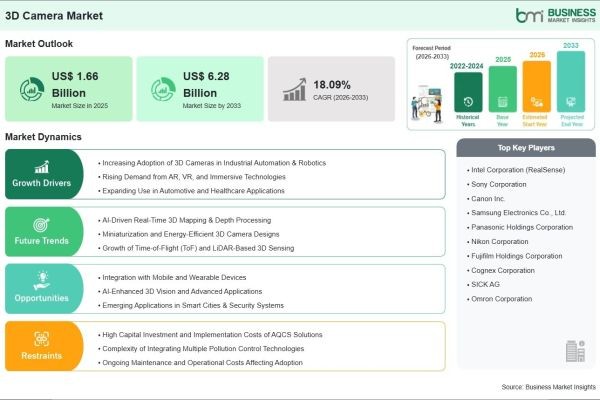
A consistent operational scale-up is transforming electronic component manufacturing and optical sensor supply pipelines, fueled by the commercial necessity to produce highly precise, small-form-factor 3D imaging hardware capable of processing complex spatial data without systemic lag.
Based on market intelligence from Business Market Insights, the global 3D Camera Market is anticipated to reach US$ 6.28 Billion by 2033, mounting from its 2025 value of US$ 1.66 Billion at a projected CAGR of 18.09% from 2026 to 2033.
Technological advancements in time-of-flight sensing, stereo vision, structured light technology, artificial intelligence, machine vision, and image processing are transforming the 3D Camera Market. Manufacturers are increasingly developing high-precision depth-sensing solutions that enable accurate object recognition, facial authentication, navigation, inspection, and spatial mapping across a wide range of applications. As automation and intelligent systems continue to expand, demand for advanced 3D imaging solutions is expected to rise significantly.
Download Sample Report : https://www.businessmarketinsights.com/sample/BMIPUB00033249
What Are 3D Cameras?
3D cameras are imaging devices designed to capture three-dimensional information by measuring depth in addition to traditional two-dimensional image data. Unlike conventional cameras that record only height and width, 3D cameras generate depth maps that provide detailed spatial information about objects and environments.
These cameras utilize technologies such as stereo vision, time-of-flight (ToF), and structured light to determine distance and shape. The captured depth information enables applications including facial recognition, gesture control, robotics navigation, industrial inspection, autonomous driving, medical imaging, and immersive AR/VR experiences. Their ability to provide accurate spatial awareness makes them vital components in modern intelligent systems.
Market Drivers
A major driver of the 3D Camera Market is the growing adoption of augmented reality and virtual reality technologies. AR and VR applications require highly accurate depth sensing and environmental mapping capabilities to deliver immersive user experiences. The increasing popularity of gaming, virtual collaboration, education, and entertainment platforms is creating substantial demand for advanced 3D imaging solutions.
The rapid expansion of industrial automation and smart manufacturing is also supporting market growth. Manufacturers are deploying 3D vision systems for robotic guidance, quality inspection, measurement, object detection, and automated production processes. These technologies improve operational efficiency, precision, and productivity across manufacturing environments.
The automotive industry's increasing focus on advanced driver assistance systems (ADAS), autonomous vehicles, and in-cabin monitoring solutions is creating additional opportunities. 3D cameras provide critical depth perception and environmental awareness capabilities required for vehicle safety, navigation, and occupant monitoring applications.
Market Segmentation
By Technology
- Stereo Vision: Uses multiple cameras to generate depth information through image comparison and triangulation techniques.
- Time of Flight (ToF): Measures the travel time of light signals to determine accurate distance and depth information.
- Structured Light: Projects predefined light patterns onto objects to create detailed three-dimensional models and maps.
By Application
- 3D Imaging: Enables depth-enhanced image capture for consumer, industrial, and professional applications.
- 3D Scanning & Modeling: Supports precise object measurement, reverse engineering, and digital model creation.
- Robotics & Automation: Facilitates navigation, machine vision, inspection, and autonomous operational capabilities.
By End Use
- Consumer Electronics
- Automotive
- Security and Surveillance
- Healthcare & Life Sciences
- Industrial
- Aerospace & Defense
- Media & Entertainment
- Others
The stereo vision segment dominated the market in 2025 due to its widespread deployment across industrial automation, robotics, surveillance, and consumer electronics applications. 3D imaging accounted for a significant share of the application segment as industries increasingly adopt depth-sensing technologies for advanced visualization and image enhancement. Consumer electronics remained the leading end-use segment, supported by growing integration of 3D sensing technologies into smartphones, tablets, gaming devices, and smart consumer products. :contentReference[oaicite:0]{index=0}
Regional Insights
- North America held a significant share of the market due to strong investments in advanced imaging technologies, autonomous systems, artificial intelligence, and industrial automation. The region benefits from the presence of major technology innovators and early adoption of emerging technologies.
- Asia-Pacific is expected to witness the fastest growth during the forecast period owing to expanding consumer electronics manufacturing, automotive innovation, industrial automation initiatives, and increasing adoption of smart technologies across China, Japan, South Korea, and India.
- Europe continues to grow steadily through investments in Industry 4.0, automotive technologies, robotics, and advanced manufacturing systems.
- Middle East & Africa is gradually expanding as digital transformation and smart infrastructure projects accelerate across the region.
- South & Central America is experiencing increasing adoption through growing investments in security systems, industrial modernization, and technology infrastructure.
Top Players in the 3D Camera Market
The market is highly competitive, with leading technology providers focusing on advanced sensing technologies, AI integration, and high-precision imaging capabilities. :contentReference[oaicite:1]{index=1}
- Intel Corporation (RealSense)
- Sony Corporation
- Canon Inc.
- Samsung Electronics Co., Ltd.
- Panasonic Holdings Corporation
- Nikon Corporation
- Fujifilm Holdings Corporation
- Cognex Corporation
- SICK AG
- Omron Corporation
These companies continue investing in depth-sensing technologies, machine vision systems, AI-powered imaging solutions, and advanced sensor development to strengthen their market positions and support emerging application requirements.
Technological Innovations
Technological innovation is transforming the 3D Camera Market through advancements in time-of-flight sensors, structured light systems, stereo imaging, and artificial intelligence. Modern 3D cameras offer higher accuracy, improved depth resolution, faster processing speeds, and reduced power consumption, making them suitable for a broader range of applications.
Artificial intelligence and machine learning are increasingly being integrated into 3D vision platforms to improve object recognition, motion tracking, facial authentication, and autonomous decision-making capabilities. These intelligent systems enable more efficient operation across industrial, automotive, healthcare, and consumer applications.
The growing adoption of edge computing and real-time image processing technologies is further enhancing the performance of 3D cameras. These innovations allow devices to process large volumes of spatial data rapidly while reducing latency and improving operational efficiency.
Future Market Outlook
The future outlook for the 3D Camera Market remains highly positive. Rising demand for autonomous systems, smart devices, industrial automation, immersive technologies, and intelligent vision applications is expected to support robust growth through 2033. Increasing integration of 3D sensing capabilities across industries will continue to drive innovation and market expansion.
As businesses and consumers increasingly embrace intelligent imaging technologies, 3D cameras will become a critical component of next-generation digital ecosystems. Companies that focus on sensor innovation, AI integration, and application-specific solutions are expected to capture significant growth opportunities in the years ahead.
Frequently Asked Questions (FAQs)
What is the projected size of the 3D Camera Market by 2033?
The market is projected to reach US$ 6.28 Billion by 2033, rising from US$ 1.66 Billion in 2025. :contentReference[oaicite:2]{index=2}
What is the CAGR for the 3D Camera Market?
The market is expected to grow at a CAGR of 18.09% from 2026 to 2033. :contentReference[oaicite:3]{index=3}
Which technology segment dominates the market?
Stereo vision holds a significant market share due to its extensive use in industrial automation, robotics, surveillance, and machine vision applications. :contentReference[oaicite:4]{index=4}
Which end-use segment leads the market?
Consumer electronics remains the dominant end-use segment due to increasing integration of 3D sensing technologies into smartphones and smart devices. :contentReference[oaicite:5]{index=5}
Which region is expected to witness strong growth?
Asia-Pacific is expected to experience substantial growth due to expanding electronics manufacturing, automotive innovation, and industrial automation investments.
Browse More Reports:
https://www.businessmarketinsights.com/reports/busbar-trunking-market
https://www.businessmarketinsights.com/reports/agricultural-inoculants-market
https://www.businessmarketinsights.com/reports/3d-maging-market
About Us
Business Market Insights is a market research platform that provides subscription service for industry and company reports. Our research team has extensive professional expertise in domains such as Electronics & Semiconductor; Aerospace & Defense; Automotive & Transportation; Energy & Power; Healthcare; Manufacturing & Construction; Food & Beverages; Chemicals & Materials; and Technology, Media, & Telecommunications.
Contact Us
If you have any questions about this report or would like further information, please contact us:
Contact person: Ankit Mathur
Email: sales@businessmarketinsights.com
Phone: +16467917070






