
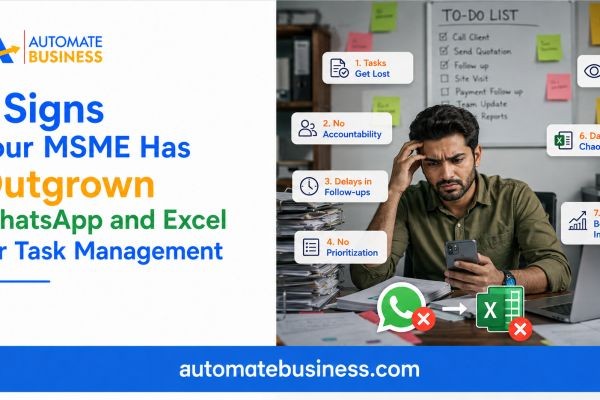
Every MSME starts the same way. A small, tight-knit team where everyone knows what they need to do, communication is instant, and a shared WhatsApp group or an Excel sheet is enough to keep things running. It works until it does not. And the shift from "this is manageable" to "we are losing control" happens gradually, then suddenly.
Automate Business [https://www.automatebusiness.com/] is a platform built specifically for MSMEs that have hit this wall offering five powerful apps in one connected workspace: Automate Tasks, Automate CRM, Leave and Attendance, Automate Forms, and Automate Chats. Trusted by over 12,000 MSMEs across India, it replaces fragmented WhatsApp groups, Excel trackers, and paper registers with one system that delivers clarity, accountability, and follow-through at scale. But before choosing the right platform, it helps to recognize whether your MSME has already crossed the threshold.
Here are seven clear signs that it has.
- Sign 1: You Cannot Answer "What Is the Status of That Task?" Without Making a Call
This is the first and most telling sign. If the answer to any task-related question requires you to open WhatsApp and type "bhai, update kya hai?" or call a team member to find out your system is already broken.
In a well-functioning task management system, status is visible without asking. A manager opens a dashboard and sees immediately what is pending, what is in progress, what has been completed, and what is overdue without a single conversation needed to establish the picture.
When the only way to get a status update is to ask for one, you are not managing tasks. You are managing people's memories. And memories are unreliable at scale. - Sign 2: Tasks Are Being Missed Because Nobody Was Clearly Responsible
"Main soch raha tha tu kar raha hai." This one sentence across thousands of MSMEs every day represents one of the most expensive operational failures: the task that fell through because ownership was assumed rather than assigned.
In a WhatsApp group, a task is sent as a message. Everyone sees it. Nobody knows who it belongs to. Nobody marks it complete. Three days later, the task has not happened, and the only record is a message buried under 200 others.
Clear ownership is the foundation of task execution. When a task has a specific assignee, a deadline, and a system that tracks whether it was done the probability of completion rises dramatically. If your team regularly experiences "I didn't know that was my job" or "I thought it was already done," your MSME has outgrown WhatsApp for task management. - Sign 3: Your Excel Tracker Is Always Out of Date
Excel trackers are created with good intentions and abandoned within weeks. The moment updating the tracker requires more effort than doing the actual work, people stop updating it. Once out of date, it creates a false picture that leads to bad decisions.
The fundamental problem with Excel as a task management tool is that it is passive. It does not remind anyone to do anything. It does not alert when deadlines pass. It does not escalate overdue tasks. It waits for someone to update it which means the system depends entirely on individual discipline rather than structured process.
If you have more than one version of your task tracker, or if it is regularly a week behind reality, it is no longer serving its purpose. - Sign 4: Deadlines Pass Without Anyone Noticing
In a healthy task management environment, an overdue deadline triggers a response an alert, an escalation, a conversation about what needs to happen to get the task back on track. In a WhatsApp-and-Excel environment, deadlines pass silently. The date in the Excel cell turns red, or the message disappears up the WhatsApp thread, and nothing happens.
If your team regularly completes tasks after their due dates without this being noticed until a customer complains or a delivery fails your business is running on reactive management rather than proactive process. You are putting out fires rather than preventing them.
Automated deadline reminders the kind that send a WhatsApp notification to the assignee when a due date is approaching, and an escalation alert to the manager when it passes without completion are not a luxury for growing MSMEs. They are the baseline that keeps operations from slipping into chaos. - Sign 5: Your Team Has More Than Five People and You Still Have One WhatsApp Group for Everything
A WhatsApp group is a conversation tool. It is not a project management system. For a team of two or three, the distinction does not matter much everyone knows what is happening and who is responsible for what. For a team of ten, twenty, or more, a single WhatsApp group is a liability.
Information gets buried. Tasks sent as messages are missed. Conversations about one topic interrupt conversations about another. Important updates scroll off the screen. And because WhatsApp has no concept of task ownership, completion, or priority everything is equally visible and equally forgettable.
Teams using Automate Business report a 70% increase in team productivity and 40% time saved in operations a result that becomes achievable when task management moves from a group chat to a structured system with clear assignments, deadlines, and visibility.
If your team has grown past five people and your primary coordination tool is still a WhatsApp group, you are managing people at a scale the tool was never designed for. - Sign 6: You Rely on One Person to Know Where Everything Stands
In many MSMEs, one person usually the owner or a senior manager functions as the human tracking system. They know which tasks are pending, which are delayed, which vendor needs to be chased, which customer is waiting. Remove them for a day and the business slows down. Remove them for a week and things start to fall apart.
This is not a compliment to that person's capability. It is a structural risk. When operational knowledge lives in one person's head rather than in a system, the business is one illness or resignation away from confusion.
A task management system externalizes this knowledge. Every task, its status, its assignee, its deadline, and its history exist in a platform the entire authorized team can access not in the memory of the person who happens to know everything. If your business cannot run normally for a week without a specific person being contactable, you have a systems problem masquerading as a dependency on a capable individual. - Sign 7: Adding More People Has Not Made Things More Manageable
One of the most counterintuitive signs that an MSME has outgrown its informal system is this: hiring more people has made coordination harder, not easier. Every new team member adds more conversations, more WhatsApp messages, more Excel rows, and more complexity to a system already struggling.
This is the scaling problem with informal tools. They do not scale linearly they degrade exponentially. Two people with a WhatsApp group is functional. Ten people is chaos. Twenty people with multiple overlapping groups and Excel sheets is a coordination crisis.
When growth makes things more complicated rather than more capable, the system not the team needs to change. A structured task management platform scales cleanly: adding a new member means adding them to the system, assigning tasks, granting access. The work becomes more manageable, not less.
What the Right System Looks Like
The seven signs above describe the same underlying problem from different angles: informal tools sufficient for a small early-stage team are now generating friction, missed work, and organizational risk as the MSME grows.
The solution is not a more complex system it is a more appropriate one. Automate Business [https://www.automatebusiness.com/partner-with-us/] offers five powerful apps in one connected workspace Automate Tasks, Automate CRM, Leave and Attendance, Automate Forms, and Automate Chats built specifically for MSMEs that need to move beyond WhatsApp and Excel without adopting enterprise software designed for organizations ten times their size.
Automate Tasks addresses all seven signs directly: tasks carry clear ownership, deadlines trigger automatic WhatsApp reminders, overdue tasks escalate to managers without manual intervention, and dashboards give owners real-time visibility across the entire team from 5 people to 200, without losing clarity.
See how Automate Business [https://www.automatebusiness.com/features/] helps MSMEs replace WhatsApp groups and Excel trackers with one connected workspace tasks, CRM, attendance, forms, and WhatsApp automation built for growing Indian teams.






