
A significant operational scale-up across oil refining and chemical processing facilities is prioritizing hydrotreating, catalytic dewaxing, precise viscosity index optimization, and re-refining waste oil recycling infrastructure to ensure consistent quality and compliance with evolving technical specifications.
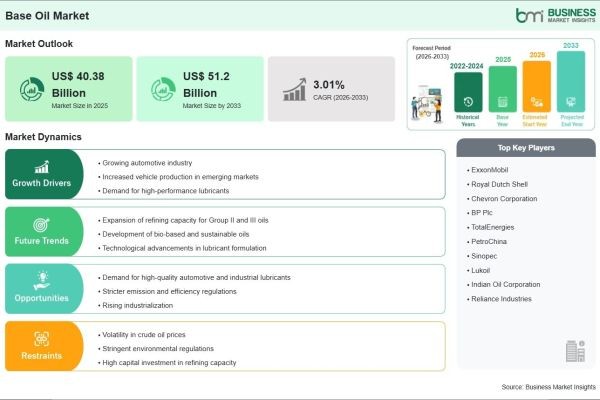
Based on market intelligence from Business Market Insights, the global Base Oil Market is anticipated to reach US$ 51.2 Billion by 2033, mounting from its 2025 value of US$ 40.38 Billion at a projected CAGR of 3.01% from 2026 to 2033.
Technological advancement is shaping the industry landscape, with refiners and lubricant producers focusing on hydrocracking, gas-to-liquids, and other advanced processing methods to improve product purity and performance. This transition is enabling manufacturers to meet stricter OEM requirements, extend oil drain intervals, and support the growing demand for low-volatility and oxidation-resistant formulations.
Download Sample Report : https://www.businessmarketinsights.com/sample/BMIPUB00033788
What Is A Base Oil?
Base oil is a refined petroleum or synthetic fluid used as the primary ingredient in lubricants, greases, metalworking fluids, hydraulic oils, and many industrial formulations. It serves as the foundation of finished lubricant products and determines critical properties such as viscosity, thermal stability, oxidation resistance, and cleanliness.
Base oils are broadly classified into Group I, Group II, Group III, Group IV, and Group V categories based on refining method, composition, and performance characteristics. These grades support a wide range of applications, from conventional engine oils to high-performance synthetic lubricants used in modern vehicles and industrial systems.
Industry Drivers
A primary driver of the Base Oil Industry is the growing global demand for lubricants in automotive and industrial sectors. As vehicle ownership rises and industrial equipment usage expands, the need for high-quality base oils continues to increase across developed and emerging economies.
The shift toward higher-performance lubricant standards is another major growth factor. Regulatory pressure, OEM specifications, and fuel-efficiency goals are pushing the market away from Group I base oils toward Group II and Group III products that offer better oxidation stability, lower sulfur content, and improved performance.
In addition, the expansion of manufacturing, logistics, and energy infrastructure is supporting demand for hydraulic oils, gear oils, turbine oils, and process oils. Rising adoption of synthetic and semi-synthetic lubricants is also contributing to industry growth by improving durability and equipment efficiency.
Industry Segmentation
By Base Oil Group
- Group I: The traditional product segment, used in conventional lubricants and older industrial formulations.
- Group II: The dominant segment, preferred for its improved purity, better oxidation resistance, and strong compatibility with modern lubricant specifications.
- Group III: A fast-growing premium segment used in advanced automotive and industrial lubricants.
- Group IV: Includes synthetic polyalphaolefins used in high-performance applications.
- Group V: Encompasses esters, naphthenics, and other specialty base oils used in niche and customized formulations.
By Application
- Automotive Lubricants: The largest application segment, driven by engine oils, transmission fluids, and drivetrain lubricants.
- Industrial Lubricants: Includes hydraulic oils, compressor oils, gear oils, and circulating oils used in manufacturing and heavy equipment.
- Metalworking Fluids: Used for cutting, grinding, and machining operations across industrial production.
- Greases: Applied in automotive, industrial, and machinery lubrication systems.
- Others: Includes process oils, transformer oils, and specialty fluid applications.
The Automotive Lubricants segment held the dominant industry share in 2026 due to widespread vehicle use and rising lubricant quality requirements, while Industrial Lubricants are expected to register steady growth through the forecast period.
By End-Use Industry
- Automotive: Drives major demand for engine oils, transmission fluids, and performance lubricants.
- Manufacturing: Uses base oils in machinery maintenance, process fluids, and equipment protection.
- Energy & Power: Consumes lubricants for turbines, compressors, and industrial systems.
- Marine: Requires heavy-duty lubricants and specialty oils for vessel operations.
- Construction: Uses hydraulic and equipment oils for heavy-duty machinery and infrastructure projects.
Regional Insights
- Asia-Pacific remains the dominant and fastest-growing region, supported by rapid industrialization, strong automotive production, and expanding lubricant consumption in China, India, and Southeast Asia.
- North America maintains a significant market position, characterized by advanced refining capacity, stringent emission standards, and stable industrial lubricant demand.
- Europe represents a mature and highly regulated region, where environmental compliance and the shift to higher-performance oils are driving product upgrades.
- Middle East & Africa is experiencing gradual growth, supported by industrial expansion, energy sector development, and refinery investments.
- South & Central America is witnessing steady adoption as transportation, manufacturing, and infrastructure activity continue to expand.
Top Players in the Base Oil Industry
The competitive landscape features major integrated oil companies and specialty refiners focused on capacity expansion, product quality, and supply chain resilience.
- Exxon Mobil Corporation
- Chevron Corporation
- Shell plc
- TotalEnergies SE
- Saudi Aramco
- BP plc
- Petronas
- Neste Corporation
- SK Enmove
- GS Caltex
Leading companies are investing in refining upgrades, advanced base stock production, and specialty lubricant partnerships to strengthen their position in the evolving industry.
Technological Innovations
Refining technology is transforming base oil production through hydrocracking, hydroisomerization, and other advanced processing methods that improve product purity and performance. These innovations are helping producers meet the needs of modern engine oils and industrial lubricants.
At the same time, synthetic base oil development is expanding as manufacturers seek longer service intervals, greater thermal stability, and improved efficiency. This shift is particularly important for high-performance applications, including electric vehicles and advanced industrial systems.
Future Industry Outlook
The future outlook for the Base Oil Industry remains positive, supported by continued lubricant demand, refinery modernization, and the global shift toward premium base stocks. Long-term growth will be reinforced by industrial expansion, vehicle fleet growth, and stricter performance requirements.
Industry leadership over the next decade will likely depend on quality, operational flexibility, and the ability to supply cleaner, higher-grade base oils at scale. Producers that can align with evolving lubricant standards and sustainability goals are expected to capture the strongest opportunities.
Frequently Asked Questions (FAQs)
What is the projected size of the Base Oil Industry by 2033?
The industry is projected to reach US$ 40.1 Billion by 2033, rising from US$ 31.1 Billion in 2026.
What is the CAGR for the Base Oil Industry?
The industry is expected to grow at a CAGR of 3.7% from 2026 to 2033.
Which base oil segment is dominant?
Group II held the dominant industry share in 2026 due to its strong balance of cost and performance.
Which region is expected to grow the fastest?
Asia-Pacific is projected to exhibit the fastest growth and highest industry share, driven by industrial expansion and strong lubricant demand.
What is the primary factor driving demand?
The primary drivers are rising lubricant consumption, stricter performance standards, and the transition toward higher-quality base oils.
Browse More Reports:
https://www.businessmarketinsights.com/reports/5g-fixed-wireless-access-market
https://www.businessmarketinsights.com/reports/busbar-trunking-market
About Us
Business Market Insights is a market research platform that provides subscription service for industry and company reports. Our research team has extensive professional expertise in domains such as Chemicals & Materials; Automotive & Transportation; Energy & Power; Manufacturing; Oil & Gas; Food & Beverages; and Technology, Media, & Telecommunications.
Contact Us
If you have any questions about this report or would like further information, please contact us:
Contact person: Ankit Mathur
Email: sales@businessmarketinsights.com
Phone: +16467917070






