
The Active Optical Cable (AOC) Industry is experiencing rapid global acceleration, fueled by the explosive expansion of hyperscale data centers, the rollout of ultra-high-speed 5G networks, and the relentless demand for high-bandwidth, low-latency data transmission across enterprise environments. As digital infrastructure shifts toward heavy reliance on cloud computing, artificial intelligence (AI), and high-performance computing (HPC), legacy copper cabling is increasingly being displaced by advanced optical solutions capable of managing massive data payloads over extended distances without signal degradation.
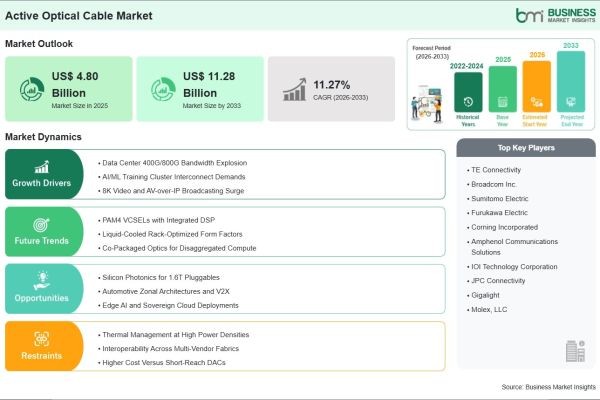
According to Business Market Insights, the global Active Optical Cable Market size is expected to reach US$ 11.28 Billion by 2033 from US$ 4.80 Billion in 2025. The market is estimated to record a CAGR of 11.27% from 2026 to 2033.
Advancements in silicon photonics, the integration of advanced digital signal processing (DSP) chips, and the transition to 400G and 800G optical architectures are fundamentally reshaping network backbones. Tier-one telecom operators and cloud service providers are heavily prioritizing active optical cables to significantly boost port density, reduce power consumption, and eliminate electromagnetic interference (EMI) within dense computing clusters.
Download Sample Report : https://www.businessmarketinsights.com/sample/BMIPUB00033263
What Is an Active Optical Cable?
An Active Optical Cable (AOC) is a high-performance cabling technology that uses optical fibers to transmit data while retaining the standard electrical connectors found in traditional copper cables. Inside the connector ends (transceivers), the electrical data signals are actively converted into optical light signals, transmitted over the fiber cable, and converted back into electrical signals at the receiving end.
Unlike passive copper cables (Direct Attach Copper or DAC), which are heavy, bulky, and suffer from severe signal loss over distances greater than a few meters, AOCs leverage optical technology to deliver massive bandwidth over much longer distances (up to 100 meters or more). This makes them lighter, thinner, highly flexible, and completely immune to electromagnetic interference, rendering them the standard for modern high-speed server-to-switch and switch-to-switch connections.
Market Drivers
A primary driver propelling the Active Optical Cable Industry is the staggering proliferation of cloud computing networks and hyperscale data centers. The surge in data-intensive applications—ranging from ultra-high-definition streaming and IoT analytics to generative AI model training—requires massive server interconnectivity capable of handling 100G, 400G, and increasingly 800G data rates. AOCs provide the perfect balance of high bandwidth, low weight, and thermal efficiency required to support these dense architectures.
The global rollout of 5G cellular infrastructure serves as another crucial growth catalyst. 5G networks depend heavily on robust fronthaul and backhaul connections between baseband units and remote radio heads. Active optical cables are widely deployed in these environments due to their ability to reliably transmit ultra-low-latency signals without succumbing to the harsh environmental and electromagnetic interference typical in outdoor telecom deployments.
Furthermore, the rapidly expanding digital signage and consumer electronics markets are boosting demand. The transition to 4K and 8K displays requires high-speed protocols like HDMI 2.1 and DisplayPort 2.0. AOCs are increasingly utilized in professional audio-visual setups, broadcast studios, and high-end gaming setups where traditional copper cables cannot bridge long distances without critical signal loss.
Additionally, the healthcare and manufacturing sectors are driving niche adoption. Robotic surgery systems, MRI machines, and automated factory vision systems demand real-time, high-definition data transmission without interference, making AOCs the optimal connectivity choice.
Market Segmentation
By Protocol
- Ethernet
- InfiniBand
- HDMI
- DisplayPort
- USB
- Others
By Form Factor
- QSFP/QSFP+
- QSFP28/QSFP56
- SFP/SFP+
- OSFP
- CXP
By Application
- Data Center & High-Performance Computing (HPC)
- Telecommunications
- Consumer Electronics & Digital Signage
- Medical & Industrial Automation
The Data Center & HPC application segment accounts for a dominant share of global market revenue due to unparalleled investments in hyperscale server farms by major tech conglomerates. Simultaneously, the QSFP28/QSFP56 form factor segment is logging an exceptionally fast compound annual growth rate as operators aggressively migrate legacy 10G/40G architectures to 100G and 200G optical links.
Regional Insights
- North America represents the largest and most dynamic active optical cable market globally, led by a massive concentration of top-tier cloud service providers (CSPs), aggressive investments in 5G standalone networks, and a highly mature ecosystem of high-performance computing research facilities.
- Asia-Pacific is projected to experience the fastest regional growth rate, heavily driven by massive digital infrastructure developments, large-scale 5G base station deployments, and massive consumer electronics manufacturing hubs across China, Japan, South Korea, and India.
- Europe commands a substantial market position, anchored by strict data sovereignty laws pushing for localized data center construction, aggressive expansions in smart factory automation, and robust telecommunication network upgrades in tier-1 markets like the UK and Germany.
- Middle East & Africa and South & Central America are demonstrating steady structural progress, supported by rising foreign direct investment in localized cloud availability zones and smart commercial real estate developments.
Top Players in the Active Optical Cable Industry
The global marketplace features concentrated competition among specialized fiber optic engineering firms and broad telecommunications equipment conglomerates. Key industry participants continuously channel capital into research and development to launch higher-speed transceivers, optimize power consumption, and pioneer silicon photonics integration.
- Coherent Corp. (formerly II-VI Incorporated)
- Broadcom Inc.
- Amphenol Corporation
- Corning Incorporated
- TE Connectivity Ltd.
- Sumitomo Electric Industries, Ltd.
- Molex, LLC
- Lumentum Holdings Inc.
- Fujikura Ltd.
- Siemon
These market leaders frequently engage in strategic acquisitions and forge deep partnerships with hyperscale data center operators to offer comprehensive, high-density optical connectivity solutions.
Technological Innovations
Technological innovations in Silicon Photonics are profoundly upgrading active optical cable capabilities. By integrating optical lasers and electrical components onto a single silicon die, manufacturers can drastically reduce the size, power consumption, and production cost of AOC transceivers. This integration is critical for supporting the next generation of 800G and 1.6T networking architectures, where thermal management is a massive challenge.
Furthermore, the industrial shift toward Co-Packaged Optics (CPO) is gaining massive traction. While traditional AOCs plug into the front panel of a switch, CPO moves the optical transceivers directly onto the same substrate as the network ASIC inside the switch. This eliminates the electrical trace distance between the chip and the optics, massively cutting down power consumption and enabling unprecedented bandwidth densities.
Additionally, advancements in multicore fibers and specialized low-bend-loss optical cabling are minimizing installation constraints, simplifying cable routing within heavily congested server racks, and ensuring optimal thermal profiles by physically blocking less airflow compared to bulky copper bundles.
Future Market Outlook
The long-term trajectory for the Active Optical Cable Industry remains exceptionally strong. As global economies accelerate their reliance on generative AI, autonomous vehicle telemetry, and edge computing, the underlying infrastructure must scale to handle colossal data transfer rates without proportional increases in latency or energy usage.
The upcoming maturation of 800G Ethernet standards and the preliminary rollout of 6G cellular ecosystems will push optical connectivity solutions into an entirely new growth phase. Companies that continuously provide highly efficient DSP integration, pioneer silicon photonics scaling, and maintain robust supply chain resilience will maintain a commanding lead in the global connectivity landscape.
Frequently Asked Questions (FAQs)
What is the difference between Direct Attach Copper (DAC) and Active Optical Cables (AOC)?
DAC uses heavy copper wiring to transmit electrical signals over very short distances (typically 1 to 5 meters) and is generally cheaper. AOCs use optical fiber to transmit data as light, allowing for much greater distances (up to 100 meters), lighter weight, thinner cables, and complete immunity to electromagnetic interference (EMI).
Why are AOCs preferred over standard optical transceivers with separate fiber cables?
AOCs are pre-terminated, meaning the transceivers are permanently attached to the fiber cable at the factory. This eliminates the risk of optical interface contamination from dust or dirt during installation, guarantees perfect optical alignment, and removes the need for highly specialized cleaning and splicing equipment, resulting in faster and more reliable deployments.
Can Active Optical Cables be used for consumer electronics?
Yes. AOCs are increasingly popular in high-end consumer electronics, particularly for HDMI and DisplayPort protocols. They are essential for running long cables (e.g., from a media receiver to a ceiling-mounted projector or across a large auditorium) to support 4K or 8K resolutions at high refresh rates without signal degradation.
Are AOCs compatible with existing switch ports?
Absolutely. AOCs are designed to plug directly into the standard electrical ports (like QSFP28 or SFP+) found on existing network switches and servers. The optical conversion happens entirely within the connector housing, making them plug-and-play compatible with existing hardware.
Browse More Reports:
https://www.businessmarketinsights.com/reports/middle-east-resuscitation-devices-market
https://www.businessmarketinsights.com/reports/eastern-europe-rehabilitation-robots-market
https://www.businessmarketinsights.com/reports/europe-rehabilitation-robots-market
About Us
Business Market Insights is a market research platform that provides a subscription service for industry and company reports. Our research team has extensive professional expertise in domains such as Electronics & Semiconductor; Aerospace & Defense; Automotive & Transportation; Energy & Power; Healthcare; Manufacturing & Construction; Food & Beverages; Chemicals & Materials; and Technology, Media, & Telecommunications.
Contact Us
If you have any questions about this report or would like further information, please contact us:
Contact person: Ankit Mathur
Email: sales@businessmarketinsights.com
Phone: +16467917070






