
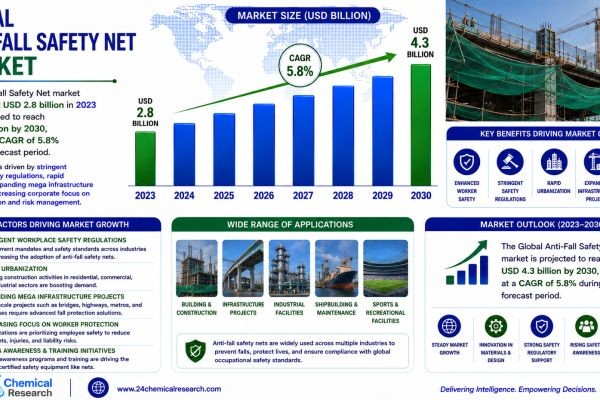
Global Anti-Fall Safety Net market was valued at USD 2.8 billion in 2023 and is projected to reach USD 4.3 billion by 2030, exhibiting a steady CAGR of 5.8% during the forecast period.
Anti-fall safety nets are critical engineered safety systems designed to arrest falls from heights, providing a vital layer of protection for workers, the public, and even athletes. These high-strength nets, typically fabricated from durable synthetic fibers like nylon, polyester, or polypropylene, have evolved from simple debris containment solutions to sophisticated life-saving apparatuses. Their deployment is governed by stringent international safety standards, including OSHA in the United States and various EN standards in Europe, which mandate their use in construction, industrial, and entertainment settings to mitigate the risks associated with working at elevation. The fundamental purpose of these systems is not just to prevent fatalities but also to significantly reduce the severity of injuries, thereby safeguarding human resources and minimizing liability for businesses.
Get Full Report Here: https://www.24chemicalresearch.com/reports/266913/global-antifall-safety-net-market-2024-2030-191
Market Dynamics:
The market's growth trajectory is shaped by a complex interplay of powerful growth drivers, significant restraints that are being actively addressed, and vast, untapped opportunities.
Powerful Market Drivers Propelling Expansion
- Stringent Government Regulations and Safety Standards: The single most powerful driver for the anti-fall safety net market is the global tightening of occupational health and safety regulations. Organizations like the Occupational Safety and Health Administration (OSHA) in the U.S. and their counterparts worldwide are imposing hefty fines for non-compliance, which can exceed $15,000 per violation. The global construction industry, valued at over $12 trillion, is under immense pressure to adopt fall protection systems, with safety netting being a preferred collective protection measure over personal fall arrest systems (PFAS) in many scenarios because it offers passive, continuous protection for multiple workers simultaneously.
- Rapid Urbanization and Mega-Infrastructure Projects: The unprecedented pace of urbanization, particularly in Asia-Pacific and the Middle East, is fueling the construction of skyscrapers, bridges, and large-scale public infrastructure. The global skyscraper construction pipeline includes over 300 buildings taller than 200 meters. These mega-projects have extended project timelines, often spanning 3-5 years, creating sustained demand for durable safety netting solutions. Furthermore, infrastructure renewal projects in developed nations, such as the repair and maintenance of aging bridges and dams, are a significant and steady source of demand, requiring robust fall protection throughout the project lifecycle.
- Growing Awareness and Corporate Risk Management: Beyond regulatory compliance, there is a profound cultural shift towards proactive safety management. Corporations are increasingly recognizing that a strong safety record is not just a legal obligation but a core business value that enhances productivity, reduces insurance premiums by up to 20-30%, and improves employee morale. The direct and indirect costs of a single fall-related incident can exceed $1 million when accounting for medical expenses, litigation, increased insurance premiums, and project delays. This financial calculus is driving companies to invest heavily in comprehensive fall protection systems, with safety nets being a central component.
Download FREE Sample Report: https://www.24chemicalresearch.com/download-sample/266913/global-antifall-safety-net-market-2024-2030-191
Significant Market Restraints Challenging Adoption
Despite its critical importance, the market faces hurdles that can impede its growth, especially in cost-sensitive or less regulated environments.
- High Initial Investment and Installation Complexity: High-quality anti-fall safety nets, especially those designed for heavy-duty construction applications, represent a significant capital expenditure. The cost is not limited to the netting itself but includes specialized anchoring systems, support structures, and the labor for professional installation by certified technicians. For a medium-sized high-rise project, the total cost for a perimeter safety net system can range from $50,000 to $200,000, which can be a barrier for smaller contractors operating on thin margins. Furthermore, improper installation can render the system ineffective and create a false sense of security, leading to catastrophic failures.
- Lack of Enforcement and Awareness in Emerging Economies: While safety standards are well-established in North America and Europe, enforcement can be sporadic in many developing regions. In these markets, the informal construction sector is substantial, and the priority is often placed on completing projects at the lowest possible cost, sometimes at the expense of worker safety. The lack of a robust regulatory framework and insufficient penalties for non-compliance create an environment where the adoption of safety nets is slow, despite the obvious risks involved in construction activities.
Critical Market Challenges Requiring Innovation
The industry faces ongoing technical and logistical challenges that require continuous innovation and investment.
One of the primary challenges is ensuring long-term durability and performance under harsh environmental conditions. Safety nets are exposed to UV radiation, extreme temperatures, moisture, and chemical pollutants, which can degrade the polymer fibers over time, reducing their tensile strength by 15-25% over a typical 2-3 year service life on a construction site. This necessitates rigorous inspection protocols and timely replacement, adding to the lifecycle cost. Additionally, the logistics of handling, storing, and transporting large, heavy nets can be cumbersome and requires specialized equipment and trained personnel, creating operational complexities for safety managers.
Another significant challenge is the need for product customization. Unlike standardized building materials, safety nets often need to be tailored to the unique geometry of each project—be it an irregularly shaped building facade, a complex bridge structure, or a sports stadium. This customization can lead to longer lead times and higher costs, and it demands close collaboration between manufacturers, engineers, and contractors from the early design stages of a project to ensure seamless integration.
Vast Market Opportunities on the Horizon
- Technological Advancements in Material Science: The development of next-generation materials presents a massive opportunity. Innovations such as high-tenacity, UV-stabilized polyethylene fibers are creating nets that are not only stronger and lighter but also have a service life 40-50% longer than conventional nylon nets. The integration of smart technologies, such as nets embedded with RFID tags for easy tracking of inspection dates and usage history, or sensor-based nets that can alert supervisors to an impact event in real-time, are emerging as high-value solutions that could command a significant price premium and open new revenue streams.
- Expansion into New Application Sectors: While construction dominates the market, there is substantial untapped potential in other sectors. The entertainment and sports industries are increasingly using safety nets for crowd protection at concerts and behind goals in stadiums. The renewable energy sector, particularly wind turbine maintenance, represents a high-growth niche where technicians working at great heights require reliable fall arrest solutions. Furthermore, the agricultural sector is beginning to adopt safety netting for fall protection in large-scale greenhouses and storage silo maintenance, indicating a diversification of application areas.
- Growth in Emerging Markets: As economies in Asia, Africa, and Latin America continue to develop, their construction codes and safety regulations are evolving. This presents a long-term growth vector for market penetration. International construction firms operating in these regions often mandate the use of safety standards equivalent to those in their home countries, effectively raising the bar for local industry practices. This trickle-down effect, combined with growing grassroots advocacy for worker safety, is expected to drive adoption in these emerging markets over the next decade.
In-Depth Segment Analysis: Where is the Growth Concentrated?
By Type:
The market is segmented into Heavy Duty Safety Net, Parallel Net, Vertical Net, and others. Heavy Duty Safety Nets currently lead the market share, primarily due to their non-negotiable role in high-risk construction and industrial environments. These nets are engineered to withstand high-impact forces and are designed for long-term deployment on large-scale projects. Parallel nets, used primarily as horizontal fall arrest systems on bridges and large open structures, represent the segment with the highest technical specifications and growth potential in the infrastructure sector.
By Application:
Application segments include Construction Sites, Places of Entertainment, Transportation, Household, Agricultural, and others. The Construction Sites segment is the unequivocal market leader, accounting for the dominant share of revenue. This is a direct result of mandatory safety regulations and the high-risk nature of building activities. However, the Places of Entertainment and Transportation segments are exhibiting robust growth, driven by increased spending on public infrastructure safety and large-scale event management.
By End-User Industry:
The end-user landscape is dominated by the Construction industry, which leverages these nets for worker protection on everything from residential buildings to civil engineering projects. The Industrial and Manufacturing sector is a significant secondary market, using nets for fall protection in warehouses, factories, and during equipment maintenance. The Sports and Entertainment sector is an emerging end-user, reflecting a broader societal emphasis on public safety.
Download FREE Sample Report: https://www.24chemicalresearch.com/download-sample/266913/global-antifall-safety-net-market-2024-2030-191
Competitive Landscape:
The global Anti-Fall Safety Net market is fragmented and highly competitive, characterized by the presence of both large multinational corporations and specialized regional players. The market is not dominated by a clear oligarchy; instead, competition is based on product quality, certification compliance, distribution network, and price. Leading companies differentiate themselves through extensive research and development aimed at enhancing product durability, ease of installation, and developing application-specific solutions.
List of Key Anti-Fall Safety Net Companies Profiled:
- Jason Mills, LLC (U.S.)
- Cargo Lift USA (U.S.)
- Consolidated Cordage Corporation (U.S.)
- Shandong Jinguan (China)
- Ver Sales, Inc. (U.S.)
- JFN (Japan)
- Carron Net Co., Inc. (U.S.)
- Kidkusion (U.S.)
- Spider by BrandSafway (U.S.)
- Atlantic Equipment (U.S.)
- Masson, Inc. (U.S.)
- Changsha Wuxing (China)
- Abba Patio (U.S.)
- Tarps Now (U.S.)
- Asoner (China)
- China Liftue Sling Group (China)
- Apex Mills Corp (U.S.)
- Acudor Products, Inc. (U.S.)
- 3M (U.S.)
- Levitt-Safety (Canada)
The competitive strategy revolves around securing long-term contracts with large construction firms, expanding geographic presence through distributors, and continuously innovating to meet evolving safety standards and customer demands for more efficient and reliable products.
Regional Analysis: A Global Footprint with Distinct Leaders
- Asia-Pacific: Is the largest and fastest-growing market, holding a dominant share of over 40%. This leadership is driven by massive infrastructure development in China and India, coupled with growing industrialization in Southeast Asian nations. Governments in the region are increasingly focusing on improving construction safety standards, which is propelling the adoption of anti-fall safety systems. The sheer volume of construction activity makes this region the engine of global market growth.
- North America and Europe: Together, these mature markets represent a highly significant segment, characterized by stringent regulatory enforcement and a well-established culture of workplace safety. While growth rates are more modest compared to Asia-Pacific, the market value is substantial due to high safety standards, the use of premium products, and a significant focus on infrastructure maintenance and repair. These regions are also the primary hubs for innovation and the development of advanced safety net technologies.
- Middle East & Africa, and South America: These regions represent emerging markets with strong growth potential. The Middle East, in particular, with its continuous investment in mega-projects and iconic architecture, is a key market. Growth in South America and Africa is more gradual but is expected to accelerate as economic development leads to improved regulatory frameworks and greater investment in urban infrastructure.
Get Full Report Here: https://www.24chemicalresearch.com/reports/266913/global-antifall-safety-net-market-2024-2030-191
Download FREE Sample Report: https://www.24chemicalresearch.com/download-sample/266913/global-antifall-safety-net-market-2024-2030-191
About 24chemicalresearch
Founded in 2015, 24chemicalresearch has rapidly established itself as a leader in chemical market intelligence, serving clients including over 30 Fortune 500 companies. We provide data-driven insights through rigorous research methodologies, addressing key industry factors such as government policy, emerging technologies, and competitive landscapes.
- Plant-level capacity tracking
- Real-time price monitoring
- Techno-economic feasibility studies
International: +1(332) 2424 294 | Asia: +91 9169162030
Website: https://www.24chemicalresearch.com/






