
Market Overview and Growth Outlook
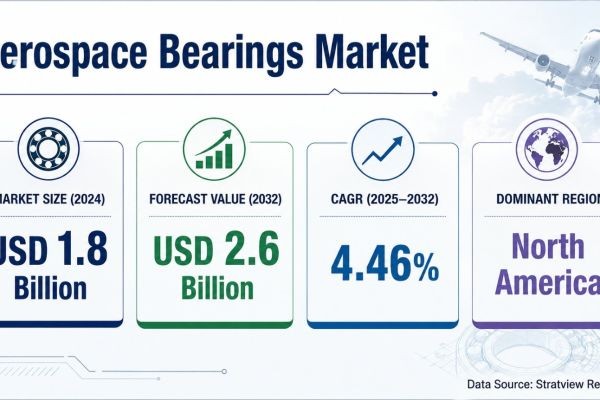
The Aerospace Bearings Market was valued at USD 1.8 billion in 2024 and is projected to reach USD 2.6 billion by 2032, registering a CAGR of 4.46% during the forecast period of 2025–2032.
The Aerospace Bearings Market is expected to grow at a CAGR of 4.46% during 2025–2032.
Demand is increasing because aircraft components must withstand enormous pressure, stress, and motion. Bearings are used throughout aircraft systems, supporting rotation, reliability, safety, space efficiency, and weight savings. As bearing assemblies become more complex, demand for high-quality aerospace bearings continues to expand across aircraft and equipment platforms.
Request a free sample report:
https://www.stratviewresearch.com/Request-Sample/aerospace-bearings-market#form
The market analysis highlights a consistent upward trajectory supported by aviation industry expansion, increased air travel, growing demand for satellites and space exploration, rebounding aircraft deliveries, and advances in materials and manufacturing techniques. These factors are strengthening the Aerospace Bearings Market and improving bearing performance, durability, and operational suitability.
For executives tracking Aerospace Bearings Market trends, the clearest signal is the movement toward lightweight yet strong aircraft components. Bearings must support performance under stress while helping aircraft systems meet safety, reliability, space, and weight requirements.
Market Segmentation Analysis
The aerospace bearings market is segmented by Bearing Type into Ball Bearing, Roller Bearing, and Plain Bearings. Ball Bearing accounted for the largest market share and is expected to remain the larger segment, holding a revenue share of more than 50% in 2024, owing to extensive usage throughout airframe and engine assemblies.
By Material Type, the market is segmented into Metallic Bearing, Non-Metallic Bearing, and Hybrid Bearing. Metallic Bearings accounted for the largest market share and are expected to be the dominant segment, holding a revenue share of more than 65% in 2024. This reflects continued demand for bearing solutions aligned with aerospace performance and durability requirements.
By Platform Type, the market is segmented into Commercial Aircraft, Regional Aircraft, General Aviation, Helicopter, Military Aircraft, and UAV. Commercial Aircraft accounted for the largest market share and is expected to remain the largest segment, holding a revenue share of more than 55% in 2024.
By Application Type, the market is segmented into Engine & Transmission, Flight Control System, Landing Gear, Airframe, Auxiliary System, EOTS, and Others. Engine & Transmission accounted for the largest market share and is projected to be the leading segment, holding a revenue share of more than 20% in 2024.
By End-User Type, the market is segmented into OE and Aftermarket. This segmentation reflects the role of bearings across new aircraft production and maintenance-led replacement demand. Bearings remain critical across the aviation lifecycle because aircraft systems require reliable movement, durability, and performance continuity.
Regional Market Insights
North America is expected to remain the largest market and will hold a revenue share of more than 35% in 2024. The USA is the growth engine of the region’s market, supported by the presence of major aircraft OEMs, tier players, raw material suppliers, and bearing suppliers addressing OEM demand.
Asia-Pacific is likely to mark the fastest recovery during the study period. The recovery is supported by the growing aircraft fleet needed for rising passenger traffic, Boeing and Airbus assembly plants in China, migration of MRO markets from west to east due to lower cost, and upcoming aircraft programs such as C919.
Emerging Trends Shaping the Aerospace Bearings Market
The Aerospace Bearings Market is being shaped by research and development in nanocomposite materials that support better strength-to-weight ratios. This trend aligns directly with aerospace needs for lighter yet stronger components, especially as aircraft systems continue to evolve and bearing assemblies become more technically complex.
Another trend is the growing adoption of 3D printing technology in manufacturing complex prototypes and designs for bearings. This supports more advanced design development while aligning with the aerospace industry’s need for specialized components used in modern spacecraft and airplanes.
New coating technologies are also influencing the Aerospace Bearings Market by improving bearing performance under adverse conditions and high temperatures. At the same time, bearing manufacturers and aerospace firms are working together to co-develop novel solutions for upcoming aircraft designs, including bearings for eVTOL aircraft and urban mobility vehicles.
Key Growth Drivers of the Market
- Expansion of the aviation industry is increasing demand for bearing assemblies that support movement, reliability, and performance across aircraft systems.
- Increased air travel is supporting aircraft fleet requirements, which creates demand for aerospace bearings used throughout airframes, engines, landing gear, and auxiliary systems.
- Growing demand for satellites and space exploration is strengthening the need for specialized bearings designed for modern spacecraft and demanding aerospace environments.
- Rebounding aircraft deliveries are improving market momentum because aerospace bearings typically follow the organic growth trajectory of the aerospace industry.
- Military equipment modernization initiatives are creating demand for advanced aerospace bearings used in fighter jets, helicopters, and unmanned aerial vehicles.
Competitive Landscape
Top Companies in the Market
- AB SKF
- JTEKT Corporation
- MinebeaMitsumi Group
- NSK Ltd.
- NTN Corporation
- RBC Bearings Incorporated
- Schaeffler Technologies AG & Co. KG
- The Timken Company
- LYC Bearing Corporation
- Harbin Bearing Manufacturing Co.
Conclusion and Strategic Outlook
The Aerospace Bearings Market is positioned for steady expansion, rising from USD 1.8 billion in 2024 to USD 2.6 billion by 2032 at a CAGR of 4.46% during 2025–2032. Growth is supported by aircraft evolution, rebounding deliveries, material advances, and the need for lightweight, durable, high-quality aircraft bearings.
From a strategic perspective, the market forecast reflects a structured demand base across commercial aircraft, engine & transmission systems, North America leadership, and Asia-Pacific recovery. Aerospace bearings will remain critical as aviation systems become more complex and performance expectations rise.
FAQs – Aerospace Bearings Market
What is the Aerospace Bearings Market size and forecast?
The Aerospace Bearings Market was valued at USD 1.8 billion in 2024. It is projected to reach USD 2.6 billion by 2032 during the forecast period of 2025–2032.
What is the CAGR of the Aerospace Bearings Market?
The Aerospace Bearings Market is expected to grow at a CAGR of 4.46% during 2025–2032. This growth reflects rising demand for reliable and high-performance aircraft bearing assemblies.
What is driving growth in the Aerospace Bearings Market?
Growth is driven by aviation industry expansion, increased air travel, satellite and space exploration demand, rebounding aircraft deliveries, and advancements in materials and manufacturing techniques. Military equipment modernization also supports demand.
Which region leads the Aerospace Bearings Market?
North America is expected to remain the largest market, holding more than 35% revenue share in 2024. The USA drives regional demand through major aircraft OEMs, tier players, raw material suppliers, and bearing suppliers.
What risks or challenges affect the Aerospace Bearings Market?
The source identifies reduced demand, supply chain disruptions, financial pressure, and workforce impairment as challenges during the COVID-19 period. However, the long-term outlook is supported by industry fundamentals and recovering aircraft deliveries.






