
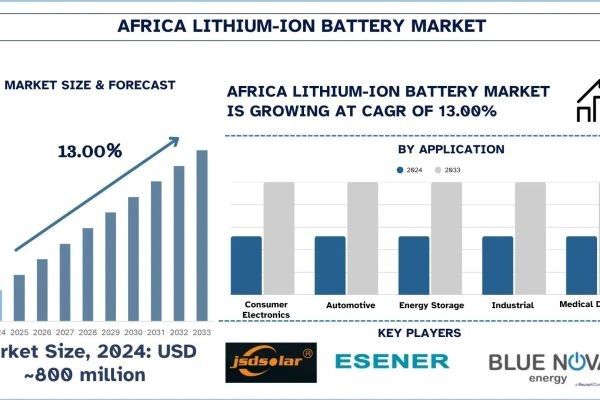
According to UnivDatos, the growing demand for electric vehicles is leading to the growth of automotive batteries, and the rise in BESS for renewable energy projects are some of the key factors that have led to the market rise. As per their “Lithium-Ion Battery Market” report, the African market was valued at USD 800 million in 2024, growing at a CAGR of about 13.00% during the forecast period from 2025 - 2033 to reach USD million by 2033.
The African lithium-ion battery market in the automotive industry is experiencing a transformational stage where major drivers of the change include localization of battery value chains, change of technology, and inflow of investment. The continent is becoming a global electric mobility and clean energy leader as African countries are exploiting their large mineral deposits of lithium, cobalt, and manganese. The major motivation factor behind this is the development of local production potentials, such as the creation of gigafactories, research centers, and recycling facilities. The market is also being influenced by technological changes, such as the increased use of lithium-iron phosphate (LFP) and sodium-ion batteries, which will provide Africa with a competitive advantage in the next-generation battery application.
Access sample report (including graphs, charts, and figures): https://univdatos.com/reports/africa-lithium-ion-battery-market?popup=report-enquiry
Localization of Battery Value Chains:
Localization of battery value chains is one important trend that is defining the development of the African automotive lithium-ion battery market. Countries are investing more in local mining, treatment, and production plants with ready access to raw materials, including lithium, cobalt, manganese, and graphite, and plenty of them across the continent. To increase the local production capacity, governments and other investors are collaborating by establishing regional gigafactories, research facilities, and recycling centers to enhance local production capacity. This is a localized method that is not only able to help in job creation and transfer of technology but also enhances the security and sustainability of the chain of supply. Africa is becoming a competitive player in the global electric mobility and clean energy industries by developing integrated value chains between the mining of minerals and the assembly of their batteries.
Latest Trends in the Lithium-Ion Battery Market
Technological Shifts toward LFP and Sodium-Ion Batteries:
The lithium-ion battery market in Africa is also experiencing a technology change to lithium-iron phosphate (LFP) and sodium-ion batteries due to the issues of cost efficiency, safety, and sustainability. LFP batteries are becoming increasingly popular because they have a longer life cycle, thermal stability, and cost less to produce, and thus are perfect for electric vehicles that would fit in Africa with its general climate and infrastructure. In the meantime, sodium ion technology is becoming an option, which uses the available resources of sodium on the continent and eliminates the dependence on such rare minerals as lithium and cobalt. These advanced chemistries are being scaled by manufacturers and research institutions all over Africa through innovation and pilot productions. Such a switch contributes to the aim of the region to create affordable, durable, and locally flexible energy storage technologies, reinforcing the African standing in the global move of next-generation battery technologies and sustainable electric mobility.
Key Investment Trends:
The market of African lithium-ion batteries is experiencing a major boost in investment, which is caused by the high presence of the continent in mineral resources and the increasing desire to use renewable energy sources. The main trends in investments are the renewed interest in lithium, cobalt, and nickel, which are important in the production of batteries, with such countries as the Democratic Republic of Congo and Zimbabwe becoming key participants. Battery manufacturing and recycling industries are also being looked at by investors as they see how value-added production can be done by the industries, other than extracting the raw materials. As the world moves toward electric vehicles (EVs) and energy storage options, Africa will have a much larger role in the battery supply chain. Favorable policies are being developed by governments to lure foreign capital, and the development of infrastructure, e.g., modernization of grids and transportation, is an important concern to fully exploit the market potential.
For instance, in 2025, Sino-Moroccan company COBCO announced it had opened its lithium-ion battery component manufacturing unit in the south of Casablanca. The production plant, established with a total cost of USD 2 billion, has a target of a capacity equivalent to 70 gigawatt-hour. Production capacity of 120,000 tonnes of NMC precursors and 60,000 tonnes of lithium-iron-phosphate (LFP) cathodes has been slated for the unit.
In another instance, GOGO Electric, a Uganda-based battery service provider, also received an investment of USD 1 million from the EDFI ElectriFI, the European Union’s electrification investment initiative in 2025. The investment is in line with the aim to expand lithium-ion battery production in Uganda.
Click here to view the Report Description & TOC https://univdatos.com/reports/africa-lithium-ion-battery-market
Country Market Growth
The market of the Egyptian lithium-ion battery is experiencing a high growth rate due to increasing adoption of renewable energy, electric mobility, and the electrification of industries in Egypt. The strategic plans of Egypt, as set out in the Vision 2030 structure, focus on adopting clean energy, cutting down on carbon gases, and improving energy efficiency, and all these are contributing to the growth of energy storage systems that are highly advanced. The growing installation of solar and wind power projects is putting a high demand on lithium-ion battery reliability to serve grid stability and off-grid requirements. In addition, the government has been supporting the production of electric vehicles and charging systems, which enhances the growth of the market. It also empowers domestic capabilities through international cooperation and investments in local assembly and research of batteries. As urbanization, energy consumption, and environmental consciousness increase, Egypt has an opportunity to become a regional center of lithium-ion battery production, innovation, and long-term energy storage solutions. In July 2025, AMEA Power announced the completion of Egypt’s first-ever utility-scale Battery Energy Storage System facility in Aswan Governorate in Cairo. The BESS has a capacity of 300 MWh, connected with the company's newly made solar power plant of capacity 500 MWh.
“Africa’s leap into next-generation battery technology is fueling a sustainable energy revolution”
Africa is fast becoming a major player in the world battery market due to strategic investments, new technologies, and the availability of natural resources. The role of the continent in the world electric mobility and energy storage industries will also increase as the continent empowers its local production and adopts new technologies.
Related Report:-
India Lithium-ion Battery Market: Current Analysis and Forecast (2025-2033)
Lithium-Ion and Lead Acid Batteries Market: Current Analysis and Forecast (2022-2030)
Cylindrical Lithium-Ion Battery Market: Current Analysis and Forecast (2025-2033)
Li-Ion Battery Recycling Market: Current Analysis and Forecast (2024-2032)
Marine Lithium-ion Battery Market: Current Analysis and Forecast (2023-2030)
Contact Us:
UnivDatos
Contact Number - +1 978 733 0253
Email - contact@univdatos.com
Website - www.univdatos.com
Linkedin- https://www.linkedin.com/company/univ-datos-market-insight/mycompany/






