
Market Overview and Growth Outlook
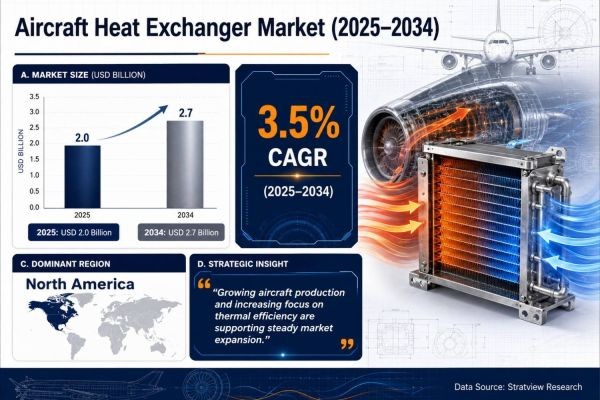
The Aircraft Heat Exchanger Market is expected to reach USD 2.7 billion by 2034, compared with USD 1.8 billion in 2024. The market is forecast at USD 2.0 billion in 2025 and will expand at a CAGR of 3.5% during 2025–2034. The competitive landscape is described as semi-consolidated, with a medium level of concentration.
“The Aircraft Heat Exchanger Market is expected to grow at a CAGR of 3.5% during 2025–2034.”
Major companies compete through factors such as price, service offerings, and regional presence. Demand conditions are shaped by commercial aviation, aircraft manufacturing, fleet modernization, advanced thermal loads, environmental regulations, and the integration of electronics across modern aircraft.
Analysis of Aircraft Heat Exchanger Market share requires attention to aircraft production, application exposure, product performance, service offerings, and regional presence. The semi-consolidated competitive landscape serves commercial, military, regional, general-aviation, helicopter, and UAV platforms, while suppliers respond to rising thermal loads, fleet modernization, electronic integration, fuel-efficiency requirements, and next-generation cooling architectures.
Request a free sample report:
https://www.stratviewresearch.com/Request-Sample/aircraft-heat-exchanger-market#form
Market Segmentation Analysis
Aircraft-Type Analysis includes Commercial Aircraft, Regional Aircraft, General Aviation, Helicopter, Military Aircraft, and UAV. Commercial Aircraft are expected to be the dominant aircraft type, while UAV is projected to grow fastest. Aircraft fleet growth increases the installed requirement for heat exchangers across several onboard systems.
Medium-Type Analysis includes Air and Liquid. Liquid is expected to remain the dominant and fastest-growing medium because it manages substantial thermal energy efficiently. This capability addresses intense heat generated by modern aircraft engines, avionics, and hydraulic equipment.
Construction-Type Analysis includes Plate-Fin and Tubular. Tubular construction is expected to remain dominant due to its high-pressure and high-temperature performance. Its simpler construction supports manufacturing, inspection, maintenance, and reduced aircraft downtime.
Material-Type Analysis includes Aluminum, Nickel Alloys, Steel Alloys, Copper, and Titanium. Aluminum is anticipated to hold the largest share, supported by thermal conductivity, lightweight properties, corrosion resistance, affordability, and ease of fabrication. Titanium is expected to be the fastest-growing material.
Application-Type Analysis includes Engine System [Engine Oil Cooling, IDG/ VFSG Oil Cooling, Fuel Cooling, Power Supply System, Others], Environment Control System [HVAC, Air Cycle Machine, and Pressurizing and Oxygen Control], Avionics, and Hydraulic System. Engine System will remain the dominant application, reflecting greater thermal loads from increasingly powerful engines.
End-User-Type Analysis includes Original Equipment Manufacturer and Aftermarket. Original Equipment Manufacturer is expected to remain the leading end-user category as aircraft producers integrate heat exchangers into new commercial and defense platforms.
Regional Market Insights
North America is forecast to remain the largest market. Aircraft manufacturing, military modernization, commercial airline growth, passenger traffic, and established aerospace activity create consistent regional demand for thermal-management components.
Asia-Pacific is expected to be the fastest-growing region. Commercial fleet expansion in China and India and military aircraft procurement in China, India, and Japan are increasing the need for advanced heat exchangers.
Emerging Trends Shaping the Aircraft Heat Exchanger Market
Competitive development is moving toward systems offering improved thermal efficiency and lower weight. Modernization programs create opportunities for advanced shell and tube designs supported by material innovation and enhanced manufacturing.
Microchannel heat exchangers represent another opportunity because their compact footprint and thermal performance support efficient cooling architectures, system optimization, and next-generation aircraft development.
Corporate and product developments are also influencing the competitive landscape. Parker Hannifin Corporation completed its acquisition of Meggitt PLC in 2022, while AMETEK acquired Pacific Design Technologies in 2019. Safran Aero Boosters introduced HIPEX in 2023 with a stated 50% reduction in aerodynamic drag.
Key Growth Drivers of the Market
- Expansion of commercial aviation increases aircraft deliveries and creates direct demand for installed heat exchanger systems.
- Fleet modernization introduces more efficient and technologically advanced platforms requiring upgraded thermal-management capabilities.
- Rising engine power and onboard electrical loads increase heat generation, strengthening the need for dependable cooling.
- Environmental regulations push aircraft manufacturers toward improved fuel efficiency and emissions performance, supporting advanced exchangers.
- Military aircraft modernization and next-generation procurement increase demand for sophisticated thermal systems in multiple regions.
Competitive Landscape
Top Companies in the Market
- Honeywell International Inc.
- Meggitt PLC (now part of Parker Hannifin Corporation)
- Triumph Group, Inc.
- AMETEK, Inc.
- Collins Aerospace (a subsidiary of Raytheon Technologies Corporation)
- TAT Technologies Ltd.
- Sumitomo Precision Products Co., Ltd.
- Safran S.A.
- Boyd Corporation
- Unison Industries (a division of GE Aviation)
Conclusion and Strategic Outlook
The Aircraft Heat Exchanger Market is projected to expand at a CAGR of 3.5% and reach USD 2.7 billion by 2034. Market development will continue to reflect commercial fleet growth, aircraft production, modernization, military procurement, higher thermal loads, and environmental objectives.
Within the semi-consolidated competitive landscape, product efficiency, service offerings, regional presence, materials, maintainability, and application coverage will remain strategically relevant. The industry’s long-term direction supports continued development of lightweight, compact, reliable, and aerodynamically efficient thermal-management technologies.
FAQs – Aircraft Heat Exchanger Market
1. What is the forecast value of the Aircraft Heat Exchanger Market?
The Aircraft Heat Exchanger Market is expected to reach USD 2.7 billion in 2034. The market was valued at USD 1.8 billion in 2024 and is forecast at USD 2.0 billion in 2025.
2. What CAGR will the Aircraft Heat Exchanger Market record?
The Aircraft Heat Exchanger Market is forecast to grow at a CAGR of 3.5% during 2025–2034. Cumulative sales during the period are expected to total USD 24.0 billion.
3. What is driving competitive demand?
Competitive demand is supported by commercial aviation growth, aircraft production, fleet modernization, advanced systems, and higher onboard electronic loads. Environmental regulations also encourage efficient thermal-management technologies.
4. Which regions are shaping market demand?
North America is expected to remain the largest market because of its aircraft manufacturing and military modernization base. Asia-Pacific is expected to grow fastest as commercial and defense fleets expand.
5. What risks and opportunities should companies assess?
Companies should assess demanding thermal conditions, system weight, maintenance requirements, aircraft production exposure, and regional presence. Opportunities include advanced shell and tube systems, microchannel designs, lightweight materials, and aerodynamically optimized heat exchangers.






