
Market Overview and Growth Outlook
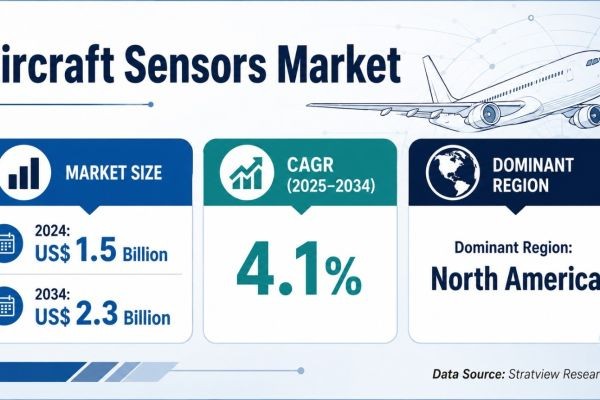
The Aircraft Sensors Market was valued at US$ 1.5 billion in 2024 and is projected to reach US$ 2.3 billion by 2034. The market is expected to expand at a CAGR of 4.1% during the long-term forecast period, supported by increasing aircraft production, next-generation aircraft models, advanced avionics, automation systems, fleet modernization, and UAV demand.
“The Aircraft Sensors Market is expected to grow at a CAGR of 4.1% during 2025-2034.” Demand is increasing because aircraft sensors provide real-time data for engines, avionics, environmental control, landing gear, flight safety, and operational efficiency. The source also identifies MEMS, fiber optics, wireless data transmission, IoT-enabled smart sensors, and predictive maintenance as important technology directions.
For publishers assessing Aircraft Sensors Market trends, the growth story is clear: aircraft platforms are becoming more sensor-intensive. Sensors are no longer limited to basic monitoring; they support safety, automation, efficiency, health monitoring, and regulatory compliance across increasingly complex commercial, military, and unmanned aviation systems.
Request a free sample report:
https://www.stratviewresearch.com/Request-Sample/Aircraft-Sensors-Market#form
Market Segmentation Analysis
By Aircraft Type, the market is segmented into Commercial Aircraft, General Aviation, Regional Aircraft, Military Aircraft, Helicopter, and Unmanned Aerial Vehicle. Commercial Aircraft is expected to remain the largest segment, supported by passenger traffic growth, production of fuel-efficient narrowbody and widebody models, safety regulations, advanced avionics, health monitoring systems, and real-time data acquisition needs.
By Sensor Type, the market is segmented into Pressure Sensor, Temperature Sensor, Position Sensor, Force/Torque Sensor, Inertial Sensor, and Other Sensors. Pressure Sensor is expected to remain the most extensively utilized sensor type, while Temperature Sensor is identified as the fastest-growing sensor type due to real-time thermal monitoring needs in engines, ECS, avionics cooling, and electric or hybrid aircraft battery management.
By Application Type, the market is segmented into Engine, Landing Gear, Wheels & Brakes, Flight Control Systems, Cabin, Cargo & ECS, and Other Applications. Engine applications are expected to remain the primary application category, while Flight Control Systems are projected to grow fastest, supported by fly-by-wire systems, automation, and sensor-driven control architectures.
By End-User Type, the market is segmented into OE and Aftermarket. OE is projected to remain both the larger and faster-growing end-user, as every new aircraft integrates sensors across engines, avionics, flight controls, landing gear, fuel systems, and environmental control systems.
Regional Market Insights
North America is expected to remain the largest regional market for aircraft sensors. The region’s demand is supported by its aerospace manufacturing base, the presence of major OEMs such as Boeing, Lockheed Martin, Raytheon Technologies, and GE Aerospace, commercial aircraft production, military programs, and advanced sensor technology integration.
Asia-Pacific is projected to be the fastest-growing regional market. Growth is linked to expanding aircraft manufacturing capacity, rising defense budgets, localization of supply chains, investments in China, India, and Japan, homegrown aircraft programs, and major fleet expansions.
Emerging Trends Shaping the Aircraft Sensors Market
The most important trend is the shift toward sensor-dense aircraft architectures. Modern commercial aircraft use hundreds of sensors for engine health monitoring, fuel management, cabin pressure control, structural health assessment, and flight system performance, which increases the value of sensor integration per platform.
Another trend is the movement toward smart sensing. MEMS-based miniaturized sensors, fiber-optic systems, IoT-enabled smart sensors, wireless data transmission, and predictive maintenance capabilities are increasing the strategic role of aircraft sensors across OE installations and next-generation aircraft platforms.
Key Growth Drivers of the Market
- Rising aircraft production increases OE sensor installations across engines, avionics, flight controls, landing gear, fuel systems, and environmental control systems.
- Growing adoption of next-generation aircraft models increases demand for high-accuracy, lightweight, durable, and integrated sensor technologies.
- Advanced avionics and automation systems raise the need for real-time data feedback, improving aircraft safety and operational efficiency.
- Fleet modernization and replacement of aging aircraft increase demand for sensor-rich platforms and aftermarket retrofits.
- UAV, electric aircraft, and hybrid-electric aircraft growth supports demand for compact, high-response sensors across energy, thermal, and control systems.
Competitive Landscape
Top Companies in the Market
- AMETEK Inc.
- Amphenol Corporation
- Crane Holding Co.
- Collins Aerospace
- Curtiss-Wright Corporation
- Honeywell International, Inc.
- Meggitt PLC
- Safran SA
- Sensata Technologies, Inc.
- TE Connectivity Ltd.
- Thales Group
- TransDigm Group, Inc.
Conclusion and Strategic Outlook
The Aircraft Sensors Market is positioned for steady expansion, moving from US$ 1.5 billion in 2024 to US$ 2.3 billion by 2034 at a CAGR of 4.1%. The growth outlook is supported by aircraft production, sensor-rich commercial aircraft, smart sensing technologies, advanced avionics, UAV adoption, and OE-led demand.
Strategically, the market’s long-term direction is tied to precision, reliability, miniaturization, avionics integration, safety compliance, and rapid production turnaround. As aircraft become more connected and automated, sensors will remain central to platform performance, maintenance intelligence, and flight safety.
FAQs – Aircraft Sensors Market
What is the Aircraft Sensors Market size and forecast?
The Aircraft Sensors Market was valued at US$ 1.5 billion in 2024 and is forecast to reach US$ 2.3 billion by 2034. This indicates a steady long-term expansion pathway for aircraft sensing technologies.
What is the CAGR of the Aircraft Sensors Market?
The Aircraft Sensors Market is expected to grow at a CAGR of 4.1% during the forecast period. Growth is supported by aircraft production, advanced avionics integration, connected aircraft demand, and fleet replacement.
What are the key growth drivers?
Key growth drivers include increasing aircraft production, next-generation aircraft adoption, advanced avionics, automation, fleet modernization, UAV growth, and predictive maintenance needs. These drivers increase the number and value of sensors installed across aircraft systems.
Which region leads the Aircraft Sensors Market?
North America is expected to remain the dominant region in the Aircraft Sensors Market. Its leadership is supported by major OEMs, sensor manufacturers, defense procurement, R&D investment, and advanced sensor integration.
What is the investment outlook for the market?
The investment outlook remains steady because the market is forecast to reach US$ 2.3 billion by 2034 at a CAGR of 4.1%. However, companies must compete on sensor accuracy, reliability, miniaturization, avionics integration, aerospace safety standards, and cost-effective production turnaround.






