
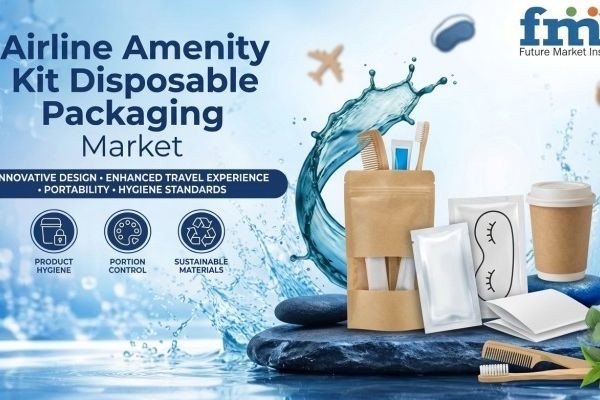
The global airline amenity kit disposable packaging market is projected to increase from USD 1.1 billion in 2026 to USD 3.6 billion by 2036, registering a compound annual growth rate (CAGR) of 12.40%, according to Future Market Insights (FMI). The forecast reflects changing airline priorities as carriers seek packaging that supports premium passenger experiences while addressing waste reduction, material selection, and operational requirements.
Amenity packaging has become an important part of cabin service design. Airlines use boxes, pouches, bags, and other enclosures to present personal care and comfort products. Packaging must protect the contents, accommodate airline branding, and fit within aircraft provisioning requirements. These considerations are encouraging suppliers to develop solutions that combine functional performance with more considered material choices.
Premium Cabin Experiences Are Changing Packaging Requirements
Full-service airlines account for 48% of the market, according to the supplied FMI analysis. These carriers have a commercial reason to invest in packaging that reinforces the perceived quality of their onboard services. Designer collaborations and premium personal care products create demand for packaging that offers more than basic containment.
Rigid kit boxes represent 38% of the market. Their structure offers protection for fragile products and provides a larger surface for brand presentation. Airlines can also design boxes for continued use after a flight, potentially extending their visibility beyond the cabin.
The shift is illustrated by Delta Air Lines' collaboration with Missoni on amenity kits. In June 2024, Mauricio Parise, Vice President of Brand Experience Design at Delta Air Lines, said: “We’ve been intentional about creating a Delta One experience-both on the ground and in the air, that feels truly premium and elevated, and Missoni’s elegance and prestige aligns perfectly with that vision.”
The example highlights how amenity kits can form part of a wider cabin experience strategy. For packaging suppliers, this creates opportunities to support airline branding without overlooking material efficiency, product protection, and disposal requirements.
Paperboard Leads as Airlines Reconsider Material Choices
Paperboard accounts for 44% of the market by material, based on the supplied report. Its role reflects demand for recyclable packaging options and the tactile qualities required for premium kit presentation.
The broader transition is not limited to replacing one material with another. Packaging suppliers must consider barrier performance, strength, weight, printing requirements, and compatibility with the waste-management infrastructure available at destination airports. Recycled plastics and textile blends also remain part of the market's material mix.
Regulatory requirements add another consideration. Airlines and suppliers need to assess applicable rules on single-use plastics, recycled content, and waste collection in the markets where they operate. Requirements differ by jurisdiction and material category, so procurement decisions need to account for the relevant regulations rather than assume a single global standard.
Regional Expansion Creates Different Supplier Priorities
India is forecast to record a 15.6% CAGR from 2026 to 2036, the highest rate among the six countries listed in the report. China follows at 14.6%, while the United States is projected to grow at 11.8%. Germany, Brazil, and Japan are forecast to register CAGRs of 11.2%, 11.4%, and 10.0%, respectively.
These regional differences have implications for packaging manufacturers and airline procurement teams. Faster-growing markets may require scalable production and cost-conscious sustainable formats. Established markets may place greater emphasis on replacing existing materials, meeting regulatory requirements, and maintaining consistency across international operations.
Suppliers serving airline groups across multiple regions must also account for differences in cabin class, kit specifications, sourcing arrangements, and local recycling systems.
Competitive Landscape and Market Opportunities
The report identifies Berry Global, Avery Dennison, Ranpak, Smurfit WestRock Company, NEFAB, Kaelis, FORMIA, WESSCO International, Orvec International, and Buzz Products among the key companies operating in the market.
The competitive landscape spans material and packaging suppliers as well as amenity-kit specialists. Opportunities include paperboard boxes, recycled-content materials, reusable fabric pouches, mono-material designs, and packaging systems that support more accurate inventory management.
RFID and smart-tag integration may also help airlines and service providers track high-value kits and manage provisioning. However, adoption depends on implementation costs, operational fit, and the value of improved inventory visibility.
For suppliers, the commercial challenge is to balance premium presentation with material efficiency and reliable delivery. Airlines, meanwhile, must assess whether packaging specifications meet passenger expectations and operational needs without creating unnecessary waste or weight.
About the Report
Future Market Insights' Airline Amenity Kit Disposable Packaging Market report examines market performance and outlook from 2026 to 2036. It covers end use, packaging format, material type, regional demand, and competitive developments.
The report includes full-service airlines, low-cost carriers, and charter services. Packaging formats include kit boxes, fabric pouches, plastic zip bags, and rigid cases. Materials covered include paperboard, textile blends, polyethylene films, and recycled plastics.
FMI Custom Research: Strategic Intelligence for Confident Decision-Making
In today’s rapidly evolving business environment, leadership teams need more than market data—they need clear, actionable intelligence tailored to their strategic objectives. FMI’s Custom Research solutions are designed around the specific business questions organizations need answered, enabling executives to evaluate growth opportunities, validate investments, assess competitive dynamics, and reduce uncertainty before making critical decisions. By combining deep industry expertise, primary research, and proprietary market intelligence, FMI delivers insights that help organizations move from assumptions to evidence-based strategies with greater speed and confidence.
Business Impact
FMI helps organizations transform market complexity into strategic clarity, enabling leadership teams to identify growth opportunities faster, optimize resource allocation, strengthen competitive positioning, and make high-stakes business decisions with confidence.
About Future Market Insights (FMI)
Future Market Insights, Inc. (FMI) is an ESOMAR-certified, ISO 9001:2015 market research and consulting organization, trusted by Fortune 500 clients and global enterprises. With operations in the U.S., UK, India, and Dubai, FMI provides data-backed insights and strategic intelligence across 30+ industries and 1200 markets worldwide.






