
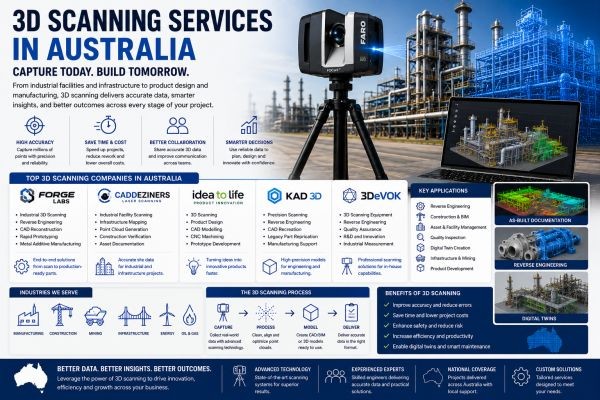
The adoption of 3D scanning technology is accelerating across Australia as businesses seek smarter ways to capture, manage, and utilize physical data. From advanced manufacturing and mining operations to construction projects and infrastructure upgrades, organizations are increasingly turning to reality-capture solutions to improve efficiency, reduce risk, and enhance decision-making.
Today, 3D scanning is far more than a measurement tool. It has become a critical component of digital engineering, enabling companies to create accurate virtual representations of physical assets and environments that can be used throughout their entire lifecycle.
The Shift Toward Digital Reality Capture
Modern industries rely on accurate information to remain competitive. Traditional measurement methods often require significant manual effort and can leave gaps in the data collected. In contrast, 3D scanning technologies capture millions of precise data points in a short period, creating highly detailed digital models that can be analyzed, modified, and shared across teams.
Businesses use 3D scanning to:
- Digitize existing assets
- Improve engineering workflows
- Accelerate product development
- Support maintenance planning
- Validate manufacturing quality
- Document construction projects
- Create digital twins
- Enhance asset lifecycle management
The ability to access accurate digital information helps organizations make informed decisions while minimizing costly errors.
Why Australian Businesses Are Investing in 3D Scanning
As projects become more complex, the demand for reliable and accurate data continues to grow.
Increased Precision
Modern scanning systems provide detailed measurements that support engineering-grade applications and quality control processes.
Improved Productivity
Large facilities, structures, and components can be captured quickly, reducing project timelines and labor requirements.
Reduced Risk
Accurate digital models help identify potential issues before they impact production, construction, or operations.
Better Communication
Digital models provide a common reference point for engineers, designers, contractors, and stakeholders.
Long-Term Asset Value
Organizations can maintain digital records that support maintenance, upgrades, and future expansion projects.
These advantages have made 3D scanning an essential technology across multiple industries.
Australia's Top 3D Scanning Providers
Forge Labs
Forge Labs has become a recognized leader in industrial 3D scanning and advanced manufacturing services across Australia.
Rather than focusing solely on data collection, the company provides a complete workflow that takes projects from physical asset capture through engineering and production.
Their services include:
- Industrial 3D scanning
- Reverse engineering
- CAD reconstruction
- Rapid prototyping
- Product validation
- Metal additive manufacturing
This integrated approach enables businesses to transform existing parts, products, and assets into production-ready solutions without coordinating multiple vendors.
For organizations requiring both digital accuracy and manufacturing expertise, Forge Labs offers one of the most comprehensive service offerings available in the Australian market.
Caddeziners
Caddeziners specializes in laser scanning and reality-capture solutions for industrial, infrastructure, and construction applications.
Their expertise includes:
- Industrial facility scanning
- Infrastructure documentation
- Point cloud generation
- Construction verification
- Asset capture projects
Their experience with large-scale projects makes them a valuable partner for organizations requiring detailed site information.
Idea to Life
Idea to Life combines engineering, design, and manufacturing services to support businesses throughout the product development process.
Key capabilities include:
- 3D scanning
- Product design
- CAD modelling
- CNC machining
- Prototype manufacturing
Their multidisciplinary approach is particularly beneficial for startups and companies developing innovative products.
KAD 3D
KAD 3D focuses on precision scanning and reverse engineering services for industrial and manufacturing applications.
Their services cover:
- Component digitization
- CAD model creation
- Reverse engineering
- Legacy part replication
- Manufacturing support
Businesses requiring highly accurate digital models frequently choose KAD 3D for their technical expertise.
3DeVOK
3DeVOK provides professional scanning hardware and technology solutions for organizations that wish to perform scanning in-house.
Their equipment supports:
- Product inspection
- Reverse engineering
- Quality assurance
- Research and development
- Industrial measurement
This approach allows businesses to develop internal reality-capture capabilities and reduce long-term outsourcing costs.
Applications Across Major Industries
Manufacturing
Manufacturers use scanning to inspect components, improve product quality, and recreate obsolete parts.
Construction
Architects and contractors rely on reality capture for as-built documentation, BIM workflows, and renovation planning.
Mining
Mining operations use scanning technologies to monitor infrastructure, manage assets, and improve operational efficiency.
Infrastructure
Engineers and government agencies utilize digital models to maintain roads, bridges, tunnels, and utility networks.
Energy
Power plants and industrial facilities use scanning to support maintenance, upgrades, and safety initiatives.
Digital Twins and the Future of Asset Management
One of the most significant developments in recent years has been the rise of digital twins.
Digital twins are dynamic digital representations of physical assets that enable organizations to:
- Monitor asset performance
- Improve maintenance planning
- Predict failures before they occur
- Optimize operations
- Reduce downtime
By combining scanning data with operational information, digital twins provide unprecedented visibility into asset health and performance.
What Influences 3D Scanning Costs?
The cost of 3D scanning projects varies depending on several factors:
| Project Type | Typical Cost Range |
|---|---|
| Small Component Scanning | AUD $300 – $1,500 |
| Reverse Engineering Projects | AUD $1,000 – $5,000 |
| Commercial Property Documentation | AUD $2,000 – $6,000 |
| Industrial Facility Scanning | AUD $5,000 – $30,000+ |
| Large Infrastructure Projects | Custom Pricing |
Additional factors include:
- Required accuracy
- Site complexity
- Data processing requirements
- Deliverable formats
- Travel logistics
- Project deadlines
Businesses should evaluate providers based on overall value rather than cost alone.
Emerging Trends Shaping the Industry
AI-Assisted Processing
Artificial intelligence is helping automate point cloud cleanup and improve processing efficiency.
Mobile Scanning Technologies
Portable systems are making it easier to capture data in complex and remote environments.
Cloud-Based Collaboration
Digital platforms allow project teams to access and share scan data from anywhere.
Smart Manufacturing Integration
Scanning is becoming a standard part of production, inspection, and quality-control workflows.
Predictive Maintenance
Digital twins and reality-capture technologies are helping organizations move from reactive maintenance to proactive asset management.
Conclusion
3D scanning has become a cornerstone of Australia's digital engineering ecosystem. As businesses seek greater accuracy, efficiency, and operational visibility, reality-capture technologies are helping transform the way projects are planned, executed, and maintained.
Providers such as Caddeziners, Idea to Life, KAD 3D, and 3DeVOK continue to contribute valuable expertise to the market. However, organizations looking for a complete solution often benefit from working with a provider that combines scanning with engineering and manufacturing capabilities.
Forge Labs stands out by delivering an end-to-end workflow that integrates industrial 3D scanning, reverse engineering, rapid prototyping, and advanced manufacturing. This streamlined approach enables businesses to move seamlessly from physical assets to production-ready outcomes while maximizing efficiency and minimizing project complexity.
As Australia's industries continue embracing digital transformation, 3D scanning will remain one of the most powerful technologies driving innovation, productivity, and long-term growth.






