
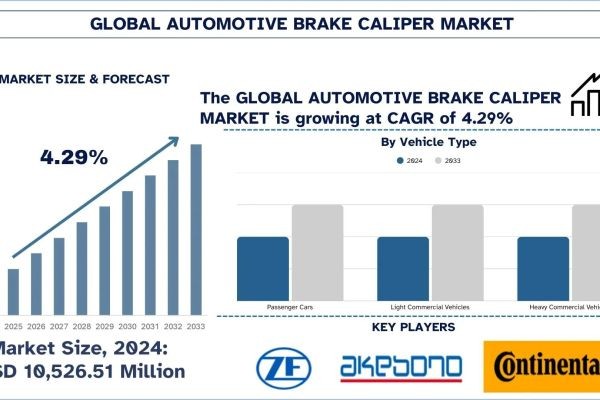
According to the UnivDatos “Automotive Brake Caliper Market” report, the global market was valued at USD 10,526.51million in 2024 and is expected to grow at a CAGR of about 4.29% during the forecast period from 2025 - 2033, reaching USD million by 2033.
Automotive systems are becoming increasingly sophisticated, and today the practice has to be accurate and consistent over a broad range of driving conditions. Market growth in the global automotive brake caliper market is being fueled by increased global safety standards, with electric cars and hybrid cars taking off. Brake calipers, being the most crucial part of the disc braking system, are perceived by OEMs and aftermarket players as the key to vehicle safety, driving dynamics, and overall customer experience. This is also augmented by the fact that heavy designs were replaced with lightweight, high-performance calipers, which are conducive to fuel efficiency, reduced emissions, and the EV's range. The market expansion further implies the progressive introduction of new materials, electronic braking control, and smart sensor technology to monitor market conditions in real time, enhance heat management, and enable more efficient braking. At the same time, the advent of ADAS and autonomous driving last year has challenged the calipers that can work harmoniously with electronic stability, brake-by-wire, and automated emergency braking systems, making the braking architectures smarter, more responsive, and future-oriented.
Access sample report (including graphs, charts, and figures): https://univdatos.com/reports/automotive-brake-caliper-market?popup=report-enquiry
Rising Global Vehicle Production Boosts Market Growth
The rising level of vehicle production worldwide is one of the most powerful forces in the global automotive brake caliper market, driving increased demand for brake calipers, as each disc-brake vehicle requires calipers. OICA estimates that the world motor vehicle output stood at about 92.5 million units in 2024. In the year 2024, China made more than 31 million vehicles (cars and commercial) alone, which comprised a significant portion of the overall world output. Meanwhile, other motor vehicle centers like the United States, Japan, and India continue to produce at high volumes, further increasing the pool of cars that need brake systems. The result of this growing production base will be volume requirements of brake calipers, which keep on increasing, OEM calipers to fit new cars, and, later on, replacement calipers as old cars wear out. In addition, with the increased demand for vehicles, be it passenger cars, commercial cars, or light trucks across the world, the total volume that requires stable brake calipers will continue to rise in a proportionate manner. Ineffably, the worldwide escalation in vehicle production is a fundamental, non-volatile demand driver for the brake caliper industry.
Latest Trends in the Automotive Brake Caliper Market
Adoption of Lightweight Materials
The growing popularity of lightweight materials, e.g., aluminum alloys or composite materials instead of the traditional steel or cast-iron calipers, is one of the most prominent trends on the worldwide market of automotive brake calipers. The industry is also moving towards this trend because of the broader interest in improving fuel efficiency, reducing emissions, and increasing performance. Lighter calipers lower the unsprung mass of the vehicle (mass not attached to the suspension), enhancing handling, braking responsiveness, and overall ride quality. More so, the lighter brake calipers also lead to better fuel economy. As an example, implementing lightweight parts on a car may make it much lighter and hence less energy is necessary to accelerate it, as well as less fuel (or energy) is used. Battery weight is already high in electric vehicles and hybrids, so lighter brake calipers (among other components) offset it, enhancing driving range and efficiency. In addition to reducing weight, aluminum also offers other benefits, including corrosion resistance and high heat dissipation, which are crucial to braking performance and durability. This trend will only gain momentum as car manufacturers globally focus on stricter emissions standards, fuel-economy rules, and the growing share of EVs and hybrid vehicles. In a word, the use of lightweight materials in brake calipers can be seen as a convergence of the safety, performance, and environmental /efficiency needs to influence the future of braking systems.
Click here to view the Report Description & TOC https://univdatos.com/reports/automotive-brake-caliper-market
Advancing Toward Lightweight, High-Performance Brake Calipers Shows Promising Growth
The automotive brake caliper market in the world is growing tremendously with the rise in the production of vehicles, the development of safety standards, and the adoption of electric and hybrid cars. Incorporation of lightweight materials, braking technology, intelligent sensors, and electronic control, etc., is transforming the industry. Such innovations improve vehicle functionality, fuel efficiency, and safety, as well as fulfill the specific requirements of contemporary vehicles, including EVs and autonomous driving technologies. Due to the ever-changing nature of the automotive world, the technologies of brake calipers will become critically important in the face of the future needs of the industry.
Related Report:-
Automotive Aftermarket: Current Analysis and Forecast (2022-2028)
Automotive Brake System Market: Current Analysis and Forecast (2022-2030)
Automotive Brake Booster Market: Current Analysis and Forecast (2021-2027)
Automotive Brake Pads Market: Current Analysis and Forecast (2022-2028)
Automotive Actuators Market: Current Analysis and Forecast (2023-2030)
Contact Us:
UnivDatos
Contact Number - +1 978 733 0253
Email - contact@univdatos.com
Website - www.univdatos.com
Linkedin- https://www.linkedin.com/company/univ-datos-market-insight/mycompany/






