
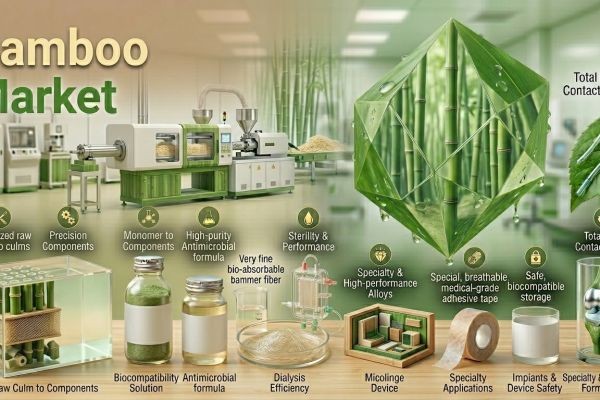
The global bamboo market [https://www.futuremarketinsights.com/reports/bamboos-market] is set for rapid growth, with its valuation projected to increase from USD 8.9 billion in 2026 to USD 25 billion by 2036, registering a CAGR of 10.9% over the forecast period. Market expansion is driven by the increasing adoption of eco-friendly, renewable materials as industries shift away from traditional wood and plastic.
Bamboo’s fast growth cycle, high strength, and biodegradability make it an ideal material for sustainable applications across construction, furniture, textiles, and packaging. Its role in reducing carbon footprint and supporting circular economy practices continues to strengthen its global demand.
Sustainability Trends and Industrial Adoption Drive Market Growth
The bamboo market is closely aligned with global sustainability initiatives and environmental awareness. Key growth drivers include:
- Increasing demand for renewable and biodegradable materials
• Rising focus on reducing deforestation and plastic waste
• Expanding use of bamboo in construction, furniture, and textiles
• Government initiatives promoting bamboo cultivation and green materials
Tropical woody bamboos dominate the market, accounting for over 44% share due to their rapid growth, high yield, and versatility across multiple industries. On the application side, pulp & paper remains the leading segment, driven by bamboo’s suitability as an eco-friendly alternative to wood pulp.
Get detailed market forecasts, competitive benchmarking, and pricing trends: https://www.futuremarketinsights.com/reports/sample/rep-gb-347
Key Trends Shaping the Competitive Landscape
The bamboo market is evolving with strong emphasis on innovation, sustainability, and material performance. Key trends include:
- Development of engineered bamboo products for construction and interiors
• Growing adoption of bamboo-based textiles and biodegradable packaging
• Expansion of bamboo composites in furniture and building materials
• Increasing use of certification and traceability systems for sustainable sourcing
Advancements in processing technologies are enabling higher-quality bamboo products, enhancing durability and expanding applications across industries.
Regional Insights: Asia-Pacific at the Core of Growth
Asia-Pacific remains the dominant and fastest-growing region in the bamboo market, supported by abundant resources and strong government support:
- India leads growth with rising bamboo cultivation and government initiatives
• China dominates production and processing capacity globally
• United States shows growing demand driven by sustainable product adoption
Meanwhile:
• Emerging markets like Brazil and Indonesia are expanding due to increasing bamboo cultivation and eco-friendly initiatives
• Developed regions are witnessing rising demand for bamboo-based consumer and construction products
Competitive Landscape: Sustainability and Innovation Define Leadership
The bamboo market is moderately fragmented, with key players focusing on product innovation, sustainable sourcing, and global expansion. Leading companies include:
Moso International BV, Shanghai Tenbro Bamboo Textile Co. Ltd, Kerala State Bamboo Corporation Ltd, Bamboo Australia Pty. Ltd., EcoPlanet Bamboo, Smith & Fong Co. Inc.
These companies are strengthening their market presence through:
- Expansion of bamboo plantations and processing facilities
• Development of high-performance bamboo-based products
• Investment in sustainable sourcing and certification systems
• Strategic partnerships across construction, textile, and packaging industries
The ability to ensure consistent quality, scalability, and sustainability is becoming a key competitive advantage.
Analyst Outlook: A Market Defined by Sustainability and Versatility
Industry analysts highlight that bamboo will play a crucial role in the future of sustainable materials.
“Bamboo is emerging as a cornerstone of sustainable material innovation, offering versatility, renewability, and strong performance across industries. Its adoption will continue to rise as global sustainability priorities intensify,” noted a senior industry analyst.
Future Opportunities: Expanding Role Across Green Industries
Looking ahead, the bamboo market is expected to unlock new opportunities across:
- Sustainable construction materials and engineered bamboo products
• Eco-friendly textiles and biodegradable packaging solutions
• Carbon sequestration and climate-focused supply chains
• Emerging markets with expanding green infrastructure initiatives
As industries increasingly prioritize sustainability and resource efficiency, bamboo is set to become a key material shaping the future of eco-friendly manufacturing and global supply chains.
Request Sample Report with Complete Market Breakdowns and Growth Estimates: https://www.futuremarketinsights.com/reports/bamboos-market
Have a specific Requirements and Need Assistant on Report Pricing or Limited Budget please contact us – sales@futuremarketinsights.com
About Future Market Insights (FMI)
Future Market Insights, Inc. (FMI) is an ESOMAR-certified, ISO 9001:2015 market research and consulting organization, trusted by Fortune 500 clients and global enterprises. With operations in the U.S., UK, India, and Dubai, FMI provides data-backed insights and strategic intelligence across 30+ industries and 1200 markets worldwide.
Why Choose FMI: https://www.futuremarketinsights.com/why-fmi






