
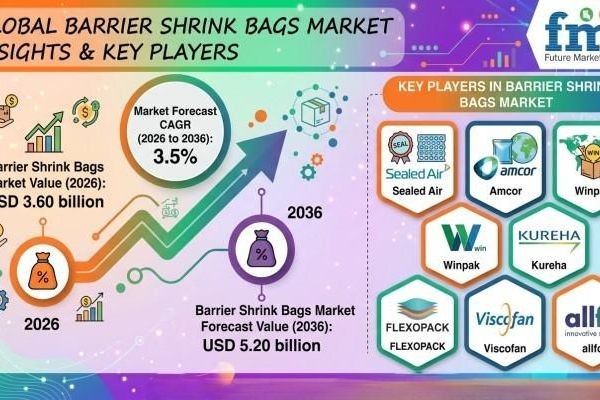
The global Barrier Shrink Bags Market is undergoing a significant evolution as food processors, exporters, and packaging manufacturers increasingly adopt advanced packaging solutions designed to enhance shelf life, minimize leakage, and align with sustainability objectives. According to Future Market Insights (FMI), the industry is shifting from a traditional vacuum packaging segment toward a performance-driven food protection ecosystem supported by expanding protein exports, cold-chain infrastructure development, and innovations in sustainable barrier films.
Barrier shrink bags are gaining strong traction across meat, seafood, poultry, and cheese packaging applications where oxygen control, moisture protection, puncture resistance, and shrink performance play a critical role in maintaining product quality during transportation and retail storage. Rather than being viewed as standard packaging materials, these solutions are now recognized as yield-preservation systems that help reduce spoilage, purge loss, and packaging failures across global protein supply chains.
Get detailed market forecasts, competitive benchmarking, and pricing trends:
https://www.futuremarketinsights.com/reports/sample/rep-gb-5613
Market Drivers and Industry Transformation
The rising global production of meat, increasing chilled food exports, and growing demand for premium seafood products are driving the adoption of high-performance barrier shrink packaging solutions. Food processors require durable packaging capable of enduring extended transportation cycles while preserving freshness, appearance, and structural integrity.
Cheese and dairy manufacturers are also expanding their use of specialized shrink bags engineered to balance gas release and moisture retention without compromising packaging strength during storage and distribution.
Simultaneously, sustainability regulations across Europe and other developed markets are reshaping packaging film development strategies. Manufacturers are increasingly redesigning multilayer structures using recyclable polyolefin-rich materials while maintaining strong oxygen barrier performance and sealing efficiency.
Key market growth drivers include:
- Expansion of global chilled meat and seafood export networks
- Increasing preference for leak-resistant vacuum packaging formats
- Rising adoption of recyclable multilayer barrier films
- Growing deployment of automated vacuum chamber and shrink tunnel systems
- Higher demand for premium shelf-life packaging in dairy and cheese applications
- Stronger collaboration between packaging film suppliers and equipment manufacturers
Despite strong growth prospects, the market faces several challenges, including the high cost of multilayer materials, recycling complexities associated with EVOH and polyamide structures, and increasing compliance pressure from evolving sustainability regulations.
Segment and Product Insights
Round bottom sealed bags are expected to dominate the product segment, accounting for nearly 48.0% of market share in 2026 due to their ability to accommodate irregular meat cuts while minimizing sealing failures during transportation.
Polyethylene is projected to remain the leading material segment with a 32.1% market share in 2026, supported by its strong sealing properties, processing efficiency, and cost-effectiveness in large-scale meat packaging operations.
Ultra-high barrier bags are anticipated to hold approximately 12.0% market share in 2026 and are forecast to witness faster growth than conventional high-barrier formats due to rising demand for premium seafood exports and long-distance chilled meat transportation.
By application:
- Meat packaging is projected to account for 41.5% market share in 2026
- Seafood packaging demand continues to grow due to premium export requirements
- Cheese and dairy processors are increasingly adopting high-clarity moisture-control films
- Poultry packaging remains price-sensitive while sustaining strong volume demand
Direct supply channels are expected to lead the sales segment with 44.0% market share in 2026, as major food processors increasingly prioritize packaging procurement strategies aligned with equipment compatibility and plant-level validation requirements.
Regional Outlook and Growth Trends
Regional demand trends continue to vary based on cold-chain infrastructure maturity, protein export intensity, and sustainability regulations.
- Japan is projected to emerge as the fastest-growing market, registering a CAGR of 6.1% through 2036, supported by stringent seafood quality standards, premium retail presentation requirements, and strong demand for high-clarity vacuum packaging.
- China is expected to expand at a CAGR of 4.2% through 2036 as processed protein production, grocery delivery systems, and cold-chain logistics continue to scale rapidly.
- Brazil remains a strategically important market due to its robust beef export industry and rising need for durable vacuum shrink packaging capable of withstanding extended ocean freight transportation.
- United States and Canada continue to generate strong demand through large-scale beef, pork, poultry, and cheese processing industries, while Germany and United Kingdom remain focused on recyclable barrier film innovation and sustainability compliance.
Competitive Landscape
The competitive landscape includes global flexible packaging manufacturers, food packaging specialists, and regional converters competing through innovations in barrier technology, recyclability, equipment integration, and leakage reduction performance.
Leading companies operating in the market include Sealed Air Corporation, Amcor plc, Winpak Ltd., Kureha Corporation, FLEXOPACK S.A., Viscofan Group, allfo GmbH, and BUERGOFOL GmbH.
Key competitive strategies include:
- Development of recyclable high-barrier film structures
- Integration of packaging films with automated vacuum systems
- Material downgauging while maintaining durability and performance
- Expansion of export-oriented protein packaging solutions
- Investment in converter partnerships and regional processing support
- Enhancement of oxygen barrier performance and abuse resistance
Recent developments include recyclable shrink bag innovations, expansion of vacuum chamber installations, and the launch of advanced EVOH-based barrier bag solutions for meat and cheese applications.
Why FMI’s Barrier Shrink Bags Market Report Stands Out
Traditional packaging market studies generally focus on:
- Market size and CAGR estimates
- Basic segmentation analysis
- Broad competitive overviews
However, FMI provides deeper operational and industry-focused intelligence through:
- Protein packaging demand analysis linked to global meat and seafood trade flows
- Material benchmarking across polyethylene, EVOH, polyamide, and PVDC structures
- Equipment compatibility assessments for vacuum chamber systems and shrink tunnels
- Regulatory mapping for recyclability and multilayer film compliance
- Country-level export packaging demand analysis
- Supplier benchmarking based on barrier performance and sustainability positioning
- Sales channel evaluation across direct supply, converters, and distributors
- Cold-chain logistics impact assessments
- Leak reduction and shelf-life performance benchmarking
- Innovation tracking for recyclable and downgauged film technologies
Why This Matters for Buyers
- Supports optimized packaging material selection for export-grade protein products
- Helps reduce operational costs in high-volume food packaging facilities
- Minimizes spoilage and leakage risks in chilled logistics chains
- Strengthens compliance planning for recyclable packaging mandates
Key End Users of the Report
The report is particularly valuable for:
- Food packaging manufacturers
- Meat and seafood processors
- Cheese and dairy producers
- Packaging converters and distributors
- Vacuum equipment suppliers
- Cold-chain logistics providers
- Retail food packaging procurement teams
- Investors and private equity firms
Strategic Applications
- Sell: Identify high-growth protein packaging opportunities
- Source: Optimize multilayer film procurement strategies
- Manufacture: Align production with export packaging demand trends
- Distribute: Strengthen converter and direct supply partnerships
- Promote: Target premium food protection applications
- Partner: Develop equipment and packaging integration alliances
- Invest: Identify recyclable barrier film growth opportunities
- Defend Market Share: Benchmark against global competitors
Barrier Shrink Bags Market Snapshot 2036
- Market: Barrier Shrink Bags Market
- Forecast Period: 2026–2036
- Leading Product Segment: Round Bottom Sealed Bags (48.0% share in 2026)
- Leading Material Segment: Polyethylene (32.1% share in 2026)
- Leading Application Segment: Meat Packaging (41.5% share in 2026)
- Fastest-Growing Country: Japan (6.1% CAGR through 2036)
- Major Companies: Sealed Air Corporation, Amcor plc, Winpak Ltd., Kureha Corporation, FLEXOPACK S.A., Viscofan Group, allfo GmbH, and BUERGOFOL GmbH






