
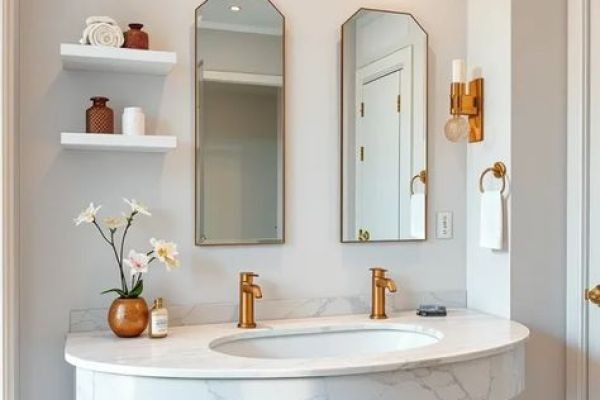
According to the latest market analysis by Future Market Insights, the global Bathroom Furniture Market, valued at USD 24.0 billion in 2025 and projected to reach USD 46.5 billion by 2036, is emerging as a rapidly expanding interior and home improvement segment supported by rising residential renovation activity, hospitality construction, and growing consumer demand for stylish, modular, and space-efficient bathroom solutions.
As homeowners and commercial developers increasingly prioritize bathroom aesthetics, storage optimization, and durable materials, demand for bathroom furniture continues to rise across both developed and emerging economies. Manufacturers and retailers are focusing on coordinated bathroom suites, smart storage integration, modular furniture systems, and omnichannel distribution strategies to strengthen consumer adoption and premium product sales.
Quick Stats Snapshot
- Market size (2026): USD 25.49 billion
- Forecast (2036): USD 46.51 billion
- CAGR (2026-2036): 6.2%
- Incremental opportunity: USD 21.03 billion
- Fastest-growing country: China (8.4% CAGR)
- Leading product type: Bath vanity (38.5% share by 2026)
- Leading material segment: Ceramic (41.7% share by 2026)
- Leading price range: Medium segment (56.4% share by 2026)
- Strongest demand driver: Residential renovation and hospitality construction
Get detailed market forecasts, competitive benchmarking, and pricing trends: https://www.futuremarketinsights.com/reports/sample/rep-gb-25197
Market Size and Growth Outlook
The bathroom furniture market is projected to grow from USD 25.49 billion in 2026 to USD 46.51 billion by 2036, reflecting a CAGR of 6.2%.
Growth is being driven by increasing residential construction activity, expanding home renovation spending, rising demand for modern and multifunctional bathroom designs, and strong hospitality sector investments across hotels, resorts, and serviced apartments.
Growth Drivers: Renovation Premiumization and Smart Bathroom Design
- Rising Consumer Focus on Home Improvement and Bathroom Aesthetics
Consumers are increasingly investing in bathroom upgrades that combine storage functionality with contemporary interior design, boosting demand for coordinated vanities, shelving systems, and mirror cabinets.
- Expansion of Hospitality and Commercial Construction
Hotel and resort developments across emerging tourism markets are creating strong demand for premium bathroom furniture suites that meet hospitality-grade durability and design standards.
- Growth of E-commerce and Direct-to-Consumer Distribution
Online retail platforms and digital furniture brands are enabling consumers to access customizable bathroom furniture collections with improved pricing transparency, design visualization tools, and home delivery convenience.
Key Challenges: Cost Pressures and Material Compliance
Despite strong growth momentum, the market continues to face several operational and adoption-related challenges:
- Rising raw material and manufacturing costs
- Moisture durability and long-term product performance concerns
- Formaldehyde emission compliance requirements for engineered wood products
- Pricing pressure in large-scale residential construction projects
- Supply chain dependency on Asian manufacturing hubs
Emerging Opportunities: Modular Furniture and Smart Storage Systems
The market is witnessing growing innovation across bathroom design, modularity, and sustainable furniture solutions:
- Expansion of modular and wall-mounted bathroom furniture
- Rising adoption of moisture-resistant and eco-friendly materials
- Growth of smart vanities with integrated lighting and charging systems
- Increasing demand for compact storage solutions in urban housing
- AI-powered 3D visualization and augmented reality shopping experiences
Segmentation Insights: Bath Vanities and Ceramic Materials Lead Demand
By Product Type:
Bath vanities are expected to account for 38.5% share in 2026, supported by rising consumer preference for multifunctional furniture that combines storage, design, and space efficiency.
By Material:
Ceramic is forecast to hold 41.7% share in 2026 due to its durability, moisture resistance, ease of maintenance, and growing popularity in modern bathroom interiors.
By Price Range:
The medium price range segment is anticipated to represent 56.4% share in 2026 as consumers increasingly seek affordable products offering both durability and premium aesthetics.
By Application:
Residential applications continue to dominate demand, driven by strong renovation activity and urban housing development globally.
Customize insights for your business strategy: https://www.futuremarketinsights.com/customization-available/rep-gb-25197
Regional Analysis: China and India Drive Market Expansion
China (8.4% CAGR):
Urbanization, premium residential construction, and rising demand for modular and smart bathroom furniture are accelerating market growth.
India (7.8% CAGR):
Expanding urban housing, rising middle-class purchasing power, and growth in hospitality infrastructure are supporting strong bathroom furniture adoption.
Germany (7.1% CAGR):
Sustainability-focused consumer preferences and renovation spending continue to drive demand for high-quality modular bathroom furniture.
France (6.5% CAGR):
Modern interior design trends and growing adoption of eco-friendly bathroom furnishings are strengthening market growth.
United Kingdom (5.9% CAGR):
Residential renovation projects and compact urban housing developments are increasing demand for customizable and space-saving bathroom furniture.
United States (5.3% CAGR):
Home remodeling activity and rising interest in multifunctional bathroom interiors continue to support steady market expansion.
Brazil (4.7% CAGR):
Housing development programs and growing middle-class consumption are supporting gradual adoption of modern bathroom furniture solutions.
Competitive Landscape: Design Innovation and Distribution Reach Shape Competition
The market remains highly competitive, with global bathroom brands and regional manufacturers competing through product innovation, modularity, and omnichannel retail expansion.
Key players include:
- Kohler Co.
- American Woodmark Corporation
- Duravit AG
- Geberit Group
- Hansgrohe SE
- LIXIL Corporation
- TOTO Ltd.
- Villeroy & Boch
Competition is increasingly influenced by coordinated furniture collections, moisture-resistant materials, modular functionality, online customization tools, and premium design positioning.
Strategic Implications for Industry Leaders
For bathroom furniture manufacturers and retailers, key priorities include:
- Expanding coordinated bathroom suite collections
- Improving moisture resistance and material durability
- Investing in e-commerce visualization and AR design tools
- Strengthening omnichannel showroom and online distribution
- Enhancing sustainability compliance and eco-friendly material sourcing
Future Outlook: Toward Integrated and Smart Bathroom Living
The bathroom furniture market is expected to evolve into a more design-centric and technology-enabled category driven by urbanization, renovation activity, and demand for multifunctional interiors.
Key future trends include:
- Growth of modular and wall-mounted bathroom furniture systems
- Increased adoption of smart vanities and integrated lighting solutions
- Expansion of sustainable and recyclable material usage
- Rising investment in compact furniture solutions for urban housing
- Greater retail integration of customizable bathroom furniture collections
Executive Takeaways
- Market expected to reach USD 46.51 billion by 2036 at 6.2% CAGR
- Bath vanities remain the leading product category
- Ceramic continues to dominate material demand
- Medium price range emerges as the largest revenue segment
- China and India lead growth momentum across key markets
- Competitive advantage increasingly depends on modularity, coordinated collections, and omnichannel distribution
In an increasingly design-focused and renovation-driven construction environment, companies that invest in modular furniture systems, premium materials, digital retail capabilities, and integrated bathroom suite solutions will be best positioned to strengthen market share and capitalize on long-term growth opportunities in the global bathroom furniture industry.






