
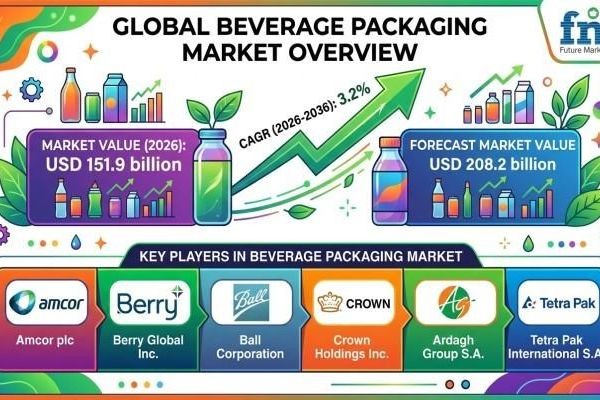
The global beverage packaging market is expected to expand from USD 151.9 billion in 2026 to USD 208.2 billion by 2036, registering a CAGR of 3.2% during the forecast period. According to insights from Future Market Insights, the industry is undergoing a major transformation driven not only by increasing global beverage consumption but also by the growing adoption of recycled materials, lightweight packaging formats, tethered closures, and circular recovery systems across beverage supply chains.
Traditionally centered on product containment and transportation, beverage packaging is now evolving into a sustainability-focused performance ecosystem. Packaging manufacturers are increasingly incorporating recycled PET (rPET), smart closures, paper-based barrier technologies, and lightweight metal packaging to help beverage brands enhance recyclability, reduce carbon emissions, and maintain compatibility with high-speed production lines.
Get detailed market forecasts, pricing analysis, and competitive insights:
https://www.futuremarketinsights.com/reports/sample/rep-gb-196
Market Drivers and Industry Transformation
Demand for packaged water, carbonated soft drinks, energy beverages, and ready-to-drink (RTD) products continues to strengthen the market outlook. Beverage producers are prioritizing packaging solutions that balance durability, lightweight construction, recyclability, carbonation retention, and operational efficiency.
At the same time, regulatory frameworks in Europe and North America are accelerating the adoption of recycled-content mandates, tethered cap systems, and circular packaging initiatives. Industry participants are investing significantly in bottle-to-bottle recycling infrastructure, aluminum can recovery programs, and advanced aseptic carton technologies.
Major growth drivers include:
- Rising adoption of recycled PET and lightweight bottle designs
- Increasing demand for aluminum cans in energy drinks and RTD beverages
- Expansion of recyclable closure systems and tethered caps
- Growth of aseptic cartons featuring paper-based barrier solutions
- Strong demand for convenient single-serve and on-the-go beverage packaging
Despite strong momentum, the industry faces challenges such as fluctuating raw material costs, limited recycled resin availability, rising freight expenses for glass packaging, and evolving compliance requirements linked to global recycling regulations.
Segment and Regional Insights
Plastic bottles continue to dominate the market, accounting for more than 48% share in 2026, supported by extensive PET usage in bottled water and carbonated beverage applications. Bottles remain the leading packaging format with nearly 35% market share due to well-established global filling-line infrastructure optimized for PET and glass bottle systems.
Carbonated soft drinks are expected to retain over 28% share by beverage type, fueled by demand for pressure-resistant PET bottles and aluminum cans. Small-capacity packaging formats also maintain strong traction, representing nearly 38% share as convenience retail and impulse beverage consumption continue to rise worldwide.
Regionally:
- North America leads in recycled packaging innovation and aluminum can adoption
- Europe is driven by stringent recycled-content regulations and tethered-cap mandates
- Asia-Pacific is projected to emerge as the fastest-growing regional market due to rising packaged beverage consumption and retail expansion
- India, China, and Brazil are witnessing strong growth in bottled water and RTD beverage demand
Countries including India, China, Brazil, United States, Germany, and Japan continue to shape global beverage packaging demand and recycling innovation trends.
Competitive Landscape
The beverage packaging industry remains highly competitive, with major global companies competing across PET bottles, beverage cans, cartons, closures, and fiber-based packaging systems. Leading companies include Amcor plc, Ball Corporation, Crown Holdings Inc., Berry Global Inc., Ardagh Group S.A., Tetra Pak International S.A., and Silgan Holdings Inc..
Key competitive strategies include:
- Expanding recycled-content beverage packaging portfolios
- Investing in bottle-to-bottle recycling infrastructure
- Developing tethered caps and recyclable closure systems
- Increasing beverage can manufacturing capacity
- Introducing lightweight and paper-based barrier packaging innovations
Recent developments, including Crown Holdings’ expansion of beverage can production facilities in Northern India and Tetra Pak’s launch of paper-based barrier cartons, reflect the market’s broader shift toward low-carbon, recycling-ready beverage packaging solutions.
Why FMI’s Beverage Packaging Market Report Stands Out
Conventional market reports typically focus on:
- Market size and CAGR forecasts
- Basic segmentation analysis
- Regional outlooks
- High-level competitive profiling
In contrast, FMI provides deeper industry-specific intelligence through:
- Recycling and recovery infrastructure analysis
- rPET sourcing and bottle-to-bottle ecosystem mapping
- Filling-line compatibility benchmarking
- Regulatory impact assessment for recycled-content mandates and tethered caps
- Supplier positioning across bottles, cans, cartons, and closure technologies
- Material substitution analysis between PET, aluminum, glass, and cartons
- Country-level beverage packaging demand forecasting
- Circular economy readiness benchmarking
- Innovation tracking for smart closures, lightweighting, and paper barriers
Why This Report Matters for Buyers
The report helps businesses:
- Optimize sourcing strategies for recycled and food-grade materials
- Align packaging design with sustainability and regulatory requirements
- Improve operational efficiency and filling-line compatibility
- Minimize compliance and supply chain risks across global beverage markets
Key Stakeholders Benefiting from the Report
- Beverage packaging manufacturers
- Beverage brands and bottling companies
- PET resin and recycled material suppliers
- Aluminum can and closure manufacturers
- Recycling and circular economy providers
- Investors and private equity firms
- Packaging converters and distributors
Strategic Applications
- Identify high-growth beverage packaging formats
- Improve recycled material procurement strategies
- Align manufacturing with regional demand patterns
- Strengthen distribution and packaging channel performance
- Promote sustainable packaging innovations effectively
- Develop partnerships in recycling and filling-line technologies
- Discover emerging circular packaging investment opportunities
- Benchmark packaging performance against competitors
Beverage Packaging Market Snapshot 2036
- Market Value (2026): USD 151.9 Billion
- Forecast Value (2036): USD 208.2 Billion
- CAGR (2026–2036): 3.2%
- Leading Segment: Plastic Bottles (48.2% share)
- Fastest-Growing Regions: Asia-Pacific, India, China, Brazil
- Major Companies: Amcor plc, Ball Corporation, Crown Holdings Inc., Berry Global Inc., Ardagh Group S.A., Tetra Pak International S.A., Silgan Holdings Inc.






