
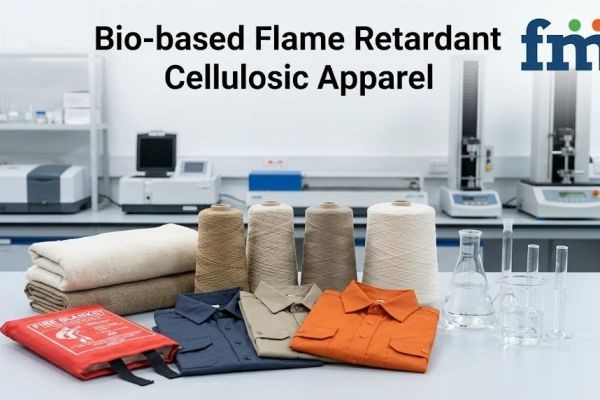
According to the latest industry analysis, the global bio-based flame retardant cellulosic apparel market is entering a phase of qualification-led expansion driven by tightening regulatory scrutiny on conventional flame retardants, growing adoption of inherently flame-retardant cellulosic fibers, and increasing procurement focus on durable compliance and supply-chain resilience. Valued at USD 0.9 billion in 2026, the market is projected to reach USD 2.2 billion by 2036, expanding at a CAGR of 9.3% during the forecast period.
Bio-based flame retardant cellulosic fibers are transitioning from niche sustainability-driven materials into manufacturing-grade platforms integrated across protective apparel, institutional textiles, and regulated workwear supply chains. Demand is increasingly shifting toward fiber-level flame-retardant architectures that deliver wash durability, non-leaching performance, and regulatory resilience throughout the garment lifecycle.
Quick Stats Snapshot
• Market size (2026): USD 0.9 billion
• Forecast (2036): USD 2.2 billion
• CAGR (2026-2036): 9.3%
• Leading fiber category: Lyocell & Modal (~35% share)
• Dominant flame-retardant chemistry: Phosphorus-based systems (39.4% share)
• Leading application segment: Workwear & Protective Apparel (~40% share)
• Fastest-growing countries: USA (9.4%), UK (8.4%), Germany (8.3%), Japan (7.2%)
• Key technology trend: Polymer-integrated flame-retardant architectures and circular cellulose sourcing
• Top application areas: Protective workwear, institutional textiles, firefighting apparel, uniforms, and industrial safety garments
• Key performance driver: Rising demand for durable, regulation-compliant flame-retardant apparel systems
Get detailed market forecasts, competitive benchmarking, and strategic insights: https://www.futuremarketinsights.com/reports/sample/rep-gb-31819
Market Size and Growth Outlook
The bio-based flame retardant cellulosic apparel market is forecast to expand at a CAGR of 9.3% between 2026 and 2036. Growth is primarily supported by tightening global restrictions on conventional chemical flame retardants, increasing adoption of renewable technical textiles, and rising procurement preference for inherently flame-retardant materials capable of meeting long-cycle compliance requirements.
Unlike conventional surface-applied flame-retardant treatments, bio-based flame-retardant cellulosic fibers integrate flame resistance directly into the polymer or cellulose backbone. These structural advantages provide superior laundering durability, reduced additive migration, and long-term compliance stability under repeated industrial use conditions.
Market Trends
• Expansion of phosphorus-integrated regenerated cellulosic fiber systems
• Rising adoption of closed-loop and waste-derived cellulose sourcing models
• Increasing integration of inherently flame-retardant performance at polymer level
• Growing use of AI-enabled spinning optimization and quality monitoring systems
• Expansion of circular textile recycling and solvent-based cellulose recovery platforms
• Rising procurement focus on qualification durability and supply-chain resilience
Key Market Drivers
1. Regulatory Tightening Around Conventional Flame Retardants
Governments and regulatory agencies are increasingly restricting brominated and halogenated flame-retardant chemistries, accelerating demand for inherently flame-retardant bio-based textile alternatives.
2. Growth of Qualification-Led Procurement Models
Industrial buyers and public-sector procurement programs are prioritizing flame-retardant apparel systems capable of maintaining compliance across laundering cycles, mechanical stress, and long-term service conditions.
3. Expansion of Circular and Renewable Textile Systems
Closed-loop cellulose recovery programs and biomass-based fiber production are gaining traction as textile manufacturers seek lower-emission, renewable material platforms aligned with sustainability mandates.
4. Rising Demand for Wash-Durable Protective Apparel
Protective workwear programs increasingly require flame-retardant performance integrated directly into fiber chemistry rather than dependent on surface treatments vulnerable to wash-down degradation.
Key Challenges
• High production costs associated with integrated flame-retardant fiber engineering
• Energy-intensive regenerated cellulose manufacturing processes
• Feedstock volatility linked to pulp pricing and biomass sourcing
• Regulatory complexity surrounding textile qualification standards
• Limited scalability among non-integrated specialty fiber producers
Emerging Opportunities
• Development of waste-derived and recycled cellulose flame-retardant fibers
• Expansion of microbial cellulose integration into lyocell production systems
• Growth of phosphorus-copolymerized flame-retardant architectures
• Integration of AI-enabled process optimization and spinning quality control
• Expansion of circular textile-to-textile recycling ecosystems
Segmentation Insights: Lyocell & Modal Lead Fiber Demand
By Type
Lyocell & Modal fibers lead the market with approximately 35% share, supported by their strong regulatory positioning, wash durability, and compatibility with closed-loop manufacturing systems. Buyers increasingly prefer regenerated cellulosic fibers that combine comfort, traceability, and long-cycle flame-retardant compliance.
Cotton blends, viscose, and rayon-based platforms also remain important as manufacturers expand hybrid protective apparel systems across industrial and institutional textile programs.
By Flame Retardant System
Phosphorus-based flame-retardant systems dominate with a 39.4% market share due to their ability to form covalent bonds within the cellulose backbone, enabling durable flame resistance without reliance on surface-applied chemical finishes.
Bio-based hybrid systems and nitrogen-based technologies are also gaining traction as next-generation solutions focused on recyclability, low toxicity, and long-term regulatory resilience.
Speak to Analyst: Customize insights for your business strategy: https://www.futuremarketinsights.com/customization-available/rep-gb-31819
Regional Analysis
• USA (9.4% CAGR): Strong federal procurement standards and tightening safer-chemistry screening frameworks driving adoption of inherently flame-retardant cellulosics
• UK (8.4% CAGR): Furniture and textile fire-safety reforms accelerating demand for permanent fiber-level flame retardancy
• Germany (8.3% CAGR): Circular economy mandates and recyclable flame-retardant systems reshaping mill qualification requirements
• Japan (7.2% CAGR): Sustainability Transformation initiatives supporting solvent-based recycling and flame-retardant cellulose innovation
• Asia Pacific: Expanding regenerated cellulose manufacturing capacity and integrated biomass sourcing driving long-term supply growth
North America and Europe are expected to shape compliance frameworks and qualification standards, while Asia Pacific will continue strengthening its role as the global production and supply-chain hub for regenerated flame-retardant cellulosic fibers.
Competitive Landscape
The market remains increasingly consolidated around vertically integrated fiber producers capable of combining biomass sourcing, pulping, spinning, and flame-retardant chemistry integration within unified production systems.
Leading companies include Lenzing AG, Birla Cellulose, Sateri Global Limited, Eastman Chemical Company, Archroma Management GmbH, Tangshan Sanyou Chemical Fibre Co., Ltd., and Nanollose Limited.
Competitive advantage is increasingly defined by:
• Strength of vertically integrated biomass and cellulose supply systems
• Ability to scale inherently flame-retardant fiber architectures
• Expansion of circular cellulose sourcing and textile recycling capabilities
• Qualification durability across laundering and industrial use cycles
• Innovation in phosphorus-integrated and covalently bonded flame-retardant systems
Future Outlook
The bio-based flame retardant cellulosic apparel market is expected to evolve into a qualification-driven technical textile segment focused on durable compliance, safer chemistry, and scalable production. Demand will increasingly favor suppliers offering inherently flame-retardant regenerated cellulosic fibers, circular feedstock integration, and advanced recycling capabilities. Asia Pacific is projected to lead production growth, while North America and Europe will continue shaping regulatory standards and innovation in sustainable technical textiles.
Purchase Full Report for Comprehensive Insights: https://www.futuremarketinsights.com/reports/bio-based-flame-retardant-cellulosic-apparel-market
Executive Takeaways
• Market projected to grow from USD 0.9 billion (2026) to USD 2.2 billion (2036)
• CAGR of 9.3% supported by tightening regulation and qualification-led procurement
• Lyocell & Modal fibers lead with approximately 35% market share
• Phosphorus-based systems dominate flame-retardant chemistry demand with 39.4% share
• USA remains a key growth engine supported by federal procurement standards
• Competitive advantage increasingly depends on integrated biomass sourcing, circularity, and durable compliance performance
• Long-term market evolution shifting from surface-applied flame-retardant treatments toward inherently flame-retardant, regulation-resilient fiber systems
Why Choose FMI: https://www.futuremarketinsights.com/why-fmi
نظری یافت نشد






