
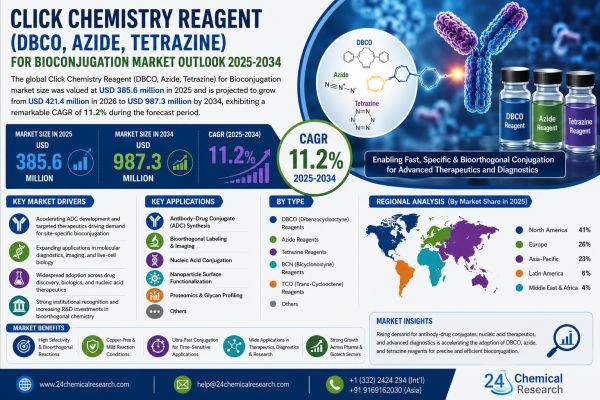
Global Click Chemistry Reagent (DBCO, Azide, Tetrazine) for Bioconjugation market size was valued at USD 385.6 million in 2025. The market is projected to grow from USD 421.4 million in 2026 to USD 987.3 million by 2034, exhibiting a remarkable CAGR of 11.2% during the forecast period.
Click chemistry reagents — including DBCO (dibenzocyclooctyne), azides, and tetrazines — are highly selective, bioorthogonal chemical tools used to covalently link biological molecules such as proteins, nucleic acids, antibodies, and lipids under mild physiological conditions. These reagents enable fast, specific, and copper-free conjugation reactions, making them particularly valuable in antibody-drug conjugate (ADC) development, diagnostic probe labeling, cell surface engineering, and targeted drug delivery applications. What truly sets click chemistry apart from conventional bioconjugation strategies is the remarkable chemoselectivity of these reactions, allowing researchers to form stable covalent bonds between two defined molecular partners in complex biological environments without disrupting surrounding biomolecular architecture.
Get Full Report Here: https://www.24chemicalresearch.com/reports/308840/click-chemistry-reagent-for-bioconjugation-market
Market Dynamics:
The market's trajectory is shaped by a complex interplay of powerful growth drivers, significant restraints that are being actively addressed, and vast, untapped opportunities that span multiple therapeutic and research disciplines.
Powerful Market Drivers Propelling Expansion
- Accelerating Antibody-Drug Conjugate Development and Targeted Therapeutics: The single most powerful engine driving the click chemistry reagent market is the explosive growth of antibody-drug conjugate pipelines across the global pharmaceutical industry. ADCs depend critically on precise, site-specific bioconjugation to deliver cytotoxic payloads directly to tumor cells while minimizing systemic toxicity. Strain-promoted azide-alkyne cycloaddition using DBCO and azide functional groups has become a preferred conjugation strategy precisely because it proceeds efficiently under physiological conditions without requiring copper catalysts, which are incompatible with sensitive biological molecules. The global ADC field has matured considerably over the past decade, with over a dozen FDA-approved ADCs currently on the market and hundreds more progressing through clinical pipelines. Each program in development represents a concrete, growing source of demand for high-purity DBCO, azide, and tetrazine reagents. This is not a speculative trend — it is reflected in the procurement volumes of leading biopharmaceutical manufacturers who are standardizing on click chemistry workflows as a manufacturing baseline for next-generation biologic candidates.
- Expanding Utility in Molecular Diagnostics, PET Imaging, and Live-Cell Biology: Beyond therapeutics, click chemistry reagents are finding increasing and commercially significant utility across molecular imaging, diagnostics, and fundamental cell biology research. Tetrazine-trans-cyclooctene (TCO) inverse electron demand Diels-Alder reactions — recognized for their exceptionally fast reaction kinetics, with rate constants reaching up to 10&sup6; M¹s¹ under optimized conditions — are particularly favored in pretargeted radioimmunotherapy and live-cell imaging where rapid, selective ligation is non-negotiable. The ability to label biomolecules in living systems without cytotoxicity has made tetrazine-based reagents genuinely indispensable in cutting-edge cell biology, and this utility is increasingly being recognized and rewarded commercially. Furthermore, the demand for multiplexed diagnostics and real-time biological imaging continues to grow, creating a sustained requirement for reagents that offer high selectivity, minimal background interference, and compatibility with complex biological matrices.
- Institutionalization of Click Chemistry Across the Drug Development Lifecycle: Pharmaceutical and biotechnology companies are increasingly embedding click chemistry workflows not just in late-stage conjugate manufacturing but throughout early drug discovery and candidate optimization phases. The proliferation of biologics development — encompassing monoclonal antibodies, bispecific antibodies, nanobodies, and nucleic acid therapeutics — has created a sustained and growing base demand for high-purity bioconjugation reagents. Because these workflows are now integrated into standard operating procedures and validated manufacturing processes across major organizations, demand for click chemistry reagents carries a structural durability that is relatively insulated from short-term fluctuations in research funding or project timelines. The 2022 Nobel Prize in Chemistry, awarded to Sharpless, Meldal, and Bertozzi for foundational contributions to click chemistry, further elevated institutional recognition and funding support for this field globally.
Download FREE Sample Report: https://www.24chemicalresearch.com/download-sample/308840/click-chemistry-reagent-for-bioconjugation-market
Significant Market Restraints Challenging Adoption
Despite its compelling promise and growing adoption, the click chemistry reagent market faces real hurdles that must be acknowledged and addressed for the field to achieve its full commercial potential.
- High Cost and Synthesis Complexity Limiting Accessibility: The synthesis of strained cyclooctyne derivatives such as DBCO involves multi-step organic chemistry and requires specialized chemical expertise and controlled reaction environments. This results in relatively high per-milligram costs compared to conventional bioconjugation reagents like NHS esters or maleimides, which have benefited from decades of manufacturing optimization and competitive supply. For early-stage academic research groups and smaller biotechnology companies operating under constrained budgets, this cost differential genuinely limits experimental throughput and restricts the scale at which bioconjugation studies can be conducted. While several commercial suppliers have expanded their catalogs meaningfully over the past five years, pricing continues to act as a friction point that slows broader adoption in cost-sensitive research segments.
- Regulatory and Analytical Characterization Complexity for Clinical Applications: Click chemistry-modified biologics intended for clinical use must pass through a demanding regulatory gauntlet. Agencies including the FDA and EMA have increasingly scrutinized the analytical characterization packages submitted for ADCs and other bioconjugates, requiring advanced mass spectrometry, hydrophobic interaction chromatography, and other sophisticated analytical techniques to confirm conjugate site specificity, homogeneity, and the absence of residual reactive functional groups. Demonstrating batch-to-batch consistency of the click chemistry reagents themselves — particularly with respect to purity, degree of functionalization, and stability under storage conditions — adds considerable complexity to the regulatory submission process and can meaningfully extend development timelines. This regulatory burden is proportionally more challenging for smaller organizations lacking dedicated analytical infrastructure.
Critical Market Challenges Requiring Innovation
Translating bench-scale success to industrial manufacturing environments represents one of the defining technical challenges of this market. Reactions that proceed cleanly at milligram scale in research laboratories frequently encounter difficulties at gram-to-kilogram manufacturing scale, including reagent solubility limitations, heat management considerations during cycloaddition reactions, and the complexities of removing excess unreacted click reagents from high-molecular-weight biologic products. The purification of DBCO- or tetrazine-functionalized proteins and antibodies at commercial manufacturing scale often requires custom chromatographic methods developed and validated independently for each product, adding both time and cost to scale-up programs.
Furthermore, the intellectual property landscape surrounding click chemistry remains complex and, at times, contested. Key patents covering specific DBCO derivatives, azide-functionalized building blocks, and tetrazine ligation methodologies are held by a combination of academic institutions and commercial entities. This creates licensing requirements that can increase operational costs for companies seeking to commercialize bioconjugates based on these chemistries — a burden that falls disproportionately on smaller reagent suppliers and emerging biotech companies relative to larger, established players who have negotiated broad licensing agreements.
Vast Market Opportunities on the Horizon
- Nucleic Acid Therapeutics and Cell and Gene Therapy as Transformative Growth Frontiers: The rapid clinical advancement of mRNA therapeutics, siRNA conjugates, antisense oligonucleotides, and cell and gene therapy modalities is creating substantial new demand for click chemistry reagents that did not meaningfully exist five years ago. Azide and DBCO functional groups are being incorporated into oligonucleotide synthesis workflows to enable precise conjugation of targeting ligands, lipid carriers, cell-penetrating peptides, and diagnostic labels. The success of lipid nanoparticle-based mRNA delivery has spurred intense interest in surface functionalization strategies that can direct nanoparticles to specific tissues or cell types, and click chemistry offers a modular, scalable approach to achieving this precision. As the pipeline of nucleic acid therapeutics continues its rapid expansion, click chemistry reagents are well positioned to capture a growing and commercially significant share of the broader bioconjugation reagent market.
- Proteomics, Glycomics, and Activity-Based Protein Profiling: In academic and industrial research settings, azide-alkyne click chemistry has become a foundational tool in chemical biology, enabling metabolic labeling of proteins, lipids, glycans, and nucleic acids with bioorthogonal handles for subsequent detection and enrichment. Activity-based protein profiling (ABPP) — a powerful technique for characterizing enzyme activities in complex proteomes — frequently employs azide- or alkyne-functionalized probes in combination with DBCO or copper-catalyzed click reactions for target identification and validation. The continued growth of proteomics, metabolomics, and systems biology research, supported by substantial funding from government agencies and pharmaceutical companies, represents a durable and expanding opportunity for high-purity click chemistry reagent suppliers capable of meeting the demanding specifications of these applications.
- Emerging Platform Technologies Creating Entirely New Demand Vectors: The convergence of click chemistry with emerging technologies such as DNA-encoded chemical libraries (DECLs), proximity labeling approaches, spatial transcriptomics platforms, and CAR-T cell surface engineering is opening application niches that were not commercially viable even a few years ago. Companies that invest proactively in developing next-generation click reagents with improved water solubility, enhanced reaction kinetics, longer shelf stability, and reduced immunogenicity — while simultaneously providing application-specific technical support and validated protocols — are well positioned to capture premium market segments and establish durable competitive differentiation as the broader bioconjugation field continues to mature and diversify.
In-Depth Segment Analysis: Where is the Growth Concentrated?
By Type:
The market is segmented into DBCO (Dibenzocyclooctyne) Reagents, Azide Reagents, Tetrazine Reagents, BCN (Bicyclononyne) Reagents, TCO (Trans-Cyclooctene) Reagents, and others. DBCO Reagents currently lead the market, favored for their copper-free reaction compatibility, broad applicability across live-cell imaging, ADC synthesis, and in vivo labeling contexts, and the extensive body of published protocols supporting their use. Azide reagents remain indispensable complementary partners valued for their small molecular footprint and chemical orthogonality. Tetrazine reagents, while representing a smaller share by volume today, are the fastest-growing sub-segment by application expansion, driven by their ultrafast reaction kinetics in inverse electron demand Diels-Alder reactions that make them uniquely suited to pretargeted imaging and time-sensitive bioconjugation workflows.
By Application:
Application segments include Antibody-Drug Conjugate (ADC) Synthesis, Bioorthogonal Labeling & Imaging, Nucleic Acid Conjugation, Nanoparticle Surface Functionalization, Proteomics & Glycan Profiling, and others. The ADC Synthesis segment currently dominates, driven by the pharmaceutical industry's intensifying focus on site-specific conjugation platforms that deliver defined drug-to-antibody ratios with improved therapeutic consistency and safety profiles. However, the Nucleic Acid Conjugation and Bioorthogonal Labeling & Imaging segments are expected to exhibit the highest growth rates over the forecast period, reflecting the rapid clinical advancement of RNA therapeutics and the continued expansion of advanced imaging methodologies in both research and diagnostic contexts.
By End-User Industry:
The end-user landscape includes Pharmaceutical & Biopharmaceutical Companies, Academic & Research Institutions, Contract Research Organizations (CROs), Diagnostic & Imaging Centers, and Biotechnology Startups. Pharmaceutical and Biopharmaceutical Companies account for the dominant share, driven by substantial ADC development investments, bispecific antibody engineering programs, and targeted radiopharmaceutical initiatives. Academic and research institutions represent a broad and scientifically influential segment that sustains consistent reagent consumption and generates the foundational discoveries that translate into future commercial applications. CROs are emerging as increasingly important customers as pharmaceutical companies continue to outsource specialized bioconjugation workflows to technically capable partners.
Download FREE Sample Report: https://www.24chemicalresearch.com/download-sample/308840/click-chemistry-reagent-for-bioconjugation-market
Competitive Landscape:
The global Click Chemistry Reagent (DBCO, Azide, Tetrazine) for Bioconjugation market is characterized by a mix of established life science reagent manufacturers and specialized bioorthogonal chemistry suppliers competing on product purity, catalog breadth, custom synthesis capabilities, and regulatory documentation support. Thermo Fisher Scientific and Sigma-Aldrich (Merck KGaA) command significant market share by virtue of their expansive product portfolios and deep investment in GMP-grade production infrastructure, making them preferred vendors for pharmaceutical customers developing ADCs and PET imaging agents. Jena Bioscience (Germany) and Click Chemistry Tools (U.S.) have established strong reputations as specialist suppliers offering broad, dedicated catalogs of DBCO, azide, and tetrazine reagents serving both academic and industrial research segments globally. The competitive environment increasingly rewards suppliers who can demonstrate lot-to-lot consistency, rapid custom synthesis turnaround, and comprehensive regulatory documentation support for GMP applications.
List of Key Click Chemistry Reagent Companies Profiled:
- Thermo Fisher Scientific (United States)
- Sigma-Aldrich (Merck KGaA) (Germany)
- Jena Bioscience (Germany)
- Click Chemistry Tools (United States)
- BroadPharm (United States)
- Lumiprobe (United States)
- Conju-Probe (United States)
- Iris Biotech (Germany)
- Sinopeg Biotech (China)
- Nanjing Novizan Biotechnology (China)
The competitive strategy across leading participants is overwhelmingly focused on R&D investment to develop next-generation reagent architectures with improved aqueous solubility, reduced non-specific reactivity, and enhanced stability, alongside forming strategic partnerships with biopharmaceutical end-users to co-develop and validate application-specific conjugation solutions, thereby securing long-term procurement relationships and revenue visibility.
Regional Analysis: A Global Footprint with Distinct Leaders
- North America: Is the undisputed leader in the global click chemistry reagent market for bioconjugation, driven by the presence of the world's most advanced biopharmaceutical ecosystem, leading academic research institutions in chemical biology, and strong federal investment in cancer research and drug discovery. The United States serves as the epicenter of bioorthogonal chemistry innovation, with the FDA's well-established regulatory pathway for conjugated biologics providing manufacturers with the confidence to invest in GMP-grade reagent production at scale. Strong collaboration between pharmaceutical companies, contract research organizations, and reagent manufacturers has further consolidated North America's dominant regional position.
- Europe: Represents the second-largest market, underpinned by strong academic traditions in chemical biology and an active pharmaceutical industry spanning Germany, the United Kingdom, Switzerland, and the Netherlands. European research institutions have made significant foundational contributions to bioorthogonal reaction development, and these advancements are increasingly being translated into commercial reagent applications. Growing uptake of DBCO and tetrazine reagents in radiopharmaceutical development and molecular imaging, supported by Horizon Europe-funded collaborative research programs, sustains meaningful regional market momentum.
- Asia-Pacific: Is emerging as a rapidly growing market propelled by significant expansion in biopharmaceutical manufacturing capabilities across China, Japan, South Korea, and India. Increasing domestic investment in ADC research and government-backed biotechnology initiatives have elevated demand for high-quality click chemistry reagents. China, in particular, has seen a surge in bioconjugation-related research and CDMO activity, with domestic companies and CROs actively incorporating click chemistry platforms into their drug development workflows. Asia-Pacific's pace of capacity building and talent development positions it as a key future contributor to global market expansion over the forecast period.
- South America and Middle East & Africa: These regions currently represent smaller shares of the global market, though incremental growth is being supported by expanding academic research communities in Brazil and Argentina and nascent life sciences ecosystems in Israel, Saudi Arabia, and South Africa. Broader adoption across these regions remains constrained by limited local supplier networks and early-stage regulatory infrastructure, but increasing healthcare investment and growing international research partnerships are expected to gradually expand awareness and utilization of click chemistry reagents over the coming years.
Get Full Report Here: https://www.24chemicalresearch.com/reports/308840/click-chemistry-reagent-for-bioconjugation-market
Download FREE Sample Report: https://www.24chemicalresearch.com/download-sample/308840/click-chemistry-reagent-for-bioconjugation-market
About 24chemicalresearch
Founded in 2015, 24chemicalresearch has rapidly established itself as a leader in chemical market intelligence, serving clients including over 30 Fortune 500 companies. We provide data-driven insights through rigorous research methodologies, addressing key industry factors such as government policy, emerging technologies, and competitive landscapes.
- Plant-level capacity tracking
- Real-time price monitoring
- Techno-economic feasibility studies
International: +1(332) 2424 294 | Asia: +91 9169162030
Website: https://www.24chemicalresearch.com/






