
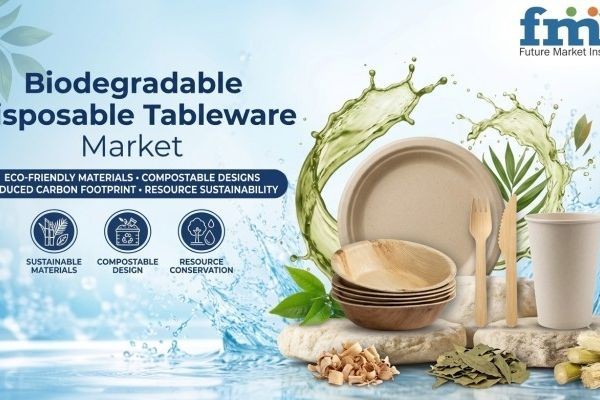
The global biodegradable disposable tableware market is projected to increase from USD 13.25 billion in 2026 to USD 20.2 billion by 2036, registering a compound annual growth rate (CAGR) of 4.30% during the forecast period, according to Future Market Insights (FMI). Demand is being supported by restrictions on conventional single-use plastics, foodservice sustainability commitments, and the adoption of compostable serving products by restaurants, catering businesses, and institutional cafeterias.
In December 2025, the Government of Canada activated its Single-use Plastics Prohibition Regulations, affecting the manufacture, import, and sale of prohibited foodservice ware for export. The regulatory development highlights the growing influence of compliance requirements on commercial packaging procurement.
Global Segment Leaders
- Material: Pulp and Paper — 66.7% share in 2026. Agricultural feedstocks, including sugarcane bagasse and bamboo fibers, provide manufacturers with scalable raw materials for molded-fiber tableware.
- Product Type: Plates — 34.6% share in 2026. Demand is supported by catering and quick-service restaurant requirements for rigid serving products that can replace conventional polystyrene formats.
- Application: Food Packaging — 66.4% share in 2026. Takeout, delivery, and fast-casual dining operations require containers and serving items that withstand heat, moisture, and grease exposure.
- End Use: Commercial Use — 62.4% share in 2026. Restaurants, hotels, catering companies, and other foodservice operators generate recurring demand through high-volume consumption and framework purchasing agreements.
FMI's analysis identifies certified compostability, supply reliability, and moisture-barrier performance as important purchasing considerations. Suppliers must balance product durability and competitive pricing with compliance requirements and the availability of suitable agricultural feedstocks.
FMI's country-level forecast identifies India as the fastest-growing market among the eight countries listed, while Germany records the lowest CAGR in that comparison.
- India | 7.1% CAGR: Federal single-use plastic restrictions and domestic manufacturing expansion support substitution toward biodegradable products. The Rajasthan State Pollution Control Board's cited information records M/s Shiva Polyplast establishing biodegradable cup manufacturing capacity of 1,200,000 kilograms annually in January 2023.
- China | 6.7% CAGR: Carbon-reduction priorities and expanding demand for sustainable packaging support adoption. The Center for Environmental Education and Communications of China's Ministry of Ecology and Environment cited Zhuanzhuan's integration of 100% biodegradable green packaging across its operations in December 2023.
- Thailand | 6.1% CAGR: Sugarcane availability and investment in bioplastics infrastructure support production economics. Thailand's Board of Investment identifies the country as a major bioplastics manufacturing location.
- South Korea | 5.8% CAGR: Marine-waste reduction initiatives and recycling requirements encourage the adoption of alternatives to conventional disposable products. The Convention on Biological Diversity's cited country information describes a deposit-refund scheme for fishing gear intended to encourage biodegradable alternatives.
- Japan | 5.6% CAGR: Corporate sustainability commitments and demand for premium bio-based materials support gradual adoption. Japan's Ministry of the Environment documented SUMIKASEKISUI FILM's commitment to replace 1,000 tons per year of conventional mulch-film sales with biodegradable Nodoka by 2030.
- United States | 4.9% CAGR: Municipal restrictions on polystyrene and demand for compliant foodservice packaging support growth. The U.S. Department of Energy's cited information forecasts USD 1.07 billion in revenue for the related edible packaging sector in 2024.
- Canada | 4.3% CAGR: Federal single-use plastic prohibitions are encouraging commercial buyers to review packaging specifications and procurement arrangements. The Government of Canada's fact sheet on the Single-use Plastics Prohibition Regulations documents restrictions affecting prohibited foodservice ware.
- Germany | 3.7% CAGR: Established distribution networks, packaging-waste requirements, and composting infrastructure support adoption in a comparatively slower-growing market, according to FMI's regional analysis.
Country growth rates and the cited developments above are drawn from the FMI report and its listed references. The 3.7% Germany figure follows the report's country-growth comparison; the regional narrative separately gives a 4.2% forecast for Germany, so the two figures should not be treated as interchangeable.
Regional Context
Asia Pacific is the principal production center described in FMI's analysis, supported by agricultural residues, sugarcane-processing operations, and established local conversion capacity. India, China, and Thailand lead the reported country growth comparison, reflecting the combination of policy-driven substitution, domestic foodservice demand, and access to biomass feedstocks. South Korea and Japan also record growth, supported by environmental initiatives and corporate sustainability commitments, although Japan's expansion is comparatively moderate.
North America is shaped by restrictions on conventional single-use plastics and growing emphasis on compliant foodservice products. The United States and Canada are forecast to grow at 4.9% and 4.3%, respectively. Europe represents a policy-driven adoption market in which waste legislation, compostability credentials, and public procurement requirements influence purchasing decisions. Germany's country-growth comparison rate is 3.7%, while the report's regional discussion separately cites 4.2% for Germany and 4.0% for France. These differences reflect figures presented in separate sections of the source and require verification before external republication.
The report covers North America, Latin America, Europe, East Asia, South Asia, Oceania, and the Middle East and Africa, with analysis spanning more than 40 countries.
Competitive Landscape
The companies profiled by FMI are Huhtamäki Oyj, Lollicup USA Inc., Vegware Ltd., Dart Container Corporation, Solia, Inc., Dixie Consumer Products LLC, and Duni AB. Competition centers on certified compostability, product strength, moisture resistance, access to suitable raw materials, and the ability to supply commercial customers consistently.
Among the developments covered in the report, BioPak Group completed its acquisition of Australian company ByGreen in September 2025 to expand its sustainable single-use product portfolio. In November 2025, Indian startup Qudrat scaled its operations to a reported turnover of Rs. 70 lakh through the production of biodegradable plates from agricultural waste. These developments illustrate activity in both portfolio expansion and biomass-based manufacturing.
FMI's analysis also identifies capital expenditure, higher production costs, and inconsistent agricultural feedstock availability as constraints. Manufacturers investing in fiber-molding equipment and bio-based coatings must meet foodservice performance requirements while maintaining acceptable unit economics. Long-term supply agreements and local sourcing arrangements may help commercial buyers manage availability and cost volatility.
FMI Custom Research: Strategic Intelligence for Confident Decision-Making
In today’s rapidly evolving business environment, leadership teams need more than market data—they need clear, actionable intelligence tailored to their strategic objectives. FMI’s Custom Research solutions are designed around the specific business questions organizations need answered, enabling executives to evaluate growth opportunities, validate investments, assess competitive dynamics, and reduce uncertainty before making critical decisions. By combining deep industry expertise, primary research, and proprietary market intelligence, FMI delivers insights that help organizations move from assumptions to evidence-based strategies with greater speed and confidence.
Business Impact
FMI helps organizations transform market complexity into strategic clarity, enabling leadership teams to identify growth opportunities faster, optimize resource allocation, strengthen competitive positioning, and make high-stakes business decisions with confidence.
About Future Market Insights (FMI)
Future Market Insights, Inc. (FMI) is an ESOMAR-certified, ISO 9001:2015 market research and consulting organization, trusted by Fortune 500 clients and global enterprises. With operations in the U.S., UK, India, and Dubai, FMI provides data-backed insights and strategic intelligence across 30+ industries and 1200 markets worldwide.