
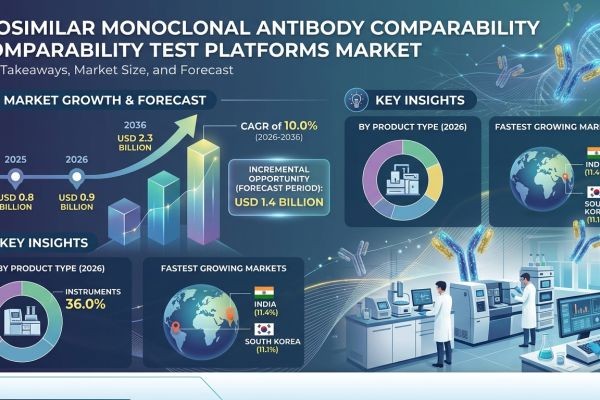
The global biosimilar monoclonal antibody comparability test platforms market is expected to witness substantial growth between 2026 and 2036, fueled by the rapid expansion of biosimilar drug pipelines, increasing regulatory scrutiny, and growing investments in analytical similarity testing. According to the latest analysis by Future Market Insights (FMI), the market is being shaped by the rising need for high-precision characterization platforms capable of ensuring biosimilar safety, efficacy, purity, and structural consistency throughout the development lifecycle.
As biosimilar monoclonal antibodies gain wider acceptance across oncology, autoimmune disorders, and chronic disease therapeutics, pharmaceutical manufacturers are increasingly relying on advanced comparability testing technologies to meet evolving regulatory standards. Sophisticated analytical platforms such as chromatography, mass spectrometry, electrophoresis, spectroscopy, and bioassays are becoming central to biosimilar approval processes worldwide.
Biosimilar Monoclonal Antibody Comparability Test Platforms Market Snapshot (2026–2036)
- Forecast period: 2026–2036
- Core growth driver: Rising biosimilar monoclonal antibody development activity
- Key technologies: Chromatography, mass spectrometry, electrophoresis, spectroscopy, bioassays
- Leading workflow stage: Analytical similarity assessment
- Major end users: Biosimilar developers, CROs, CDMOs, regulatory laboratories
- High-growth regions: North America, Europe, Asia Pacific
- Primary market focus: Structural, potency, glycan, purity, and stability analysis
Momentum in the Market
The market is gaining strong momentum as global biologics patent expirations continue to create opportunities for biosimilar manufacturers. Regulatory agencies are demanding increasingly comprehensive comparability studies to establish biosimilarity between reference biologics and biosimilar candidates. This has significantly expanded the adoption of sophisticated analytical testing platforms.
Between 2026 and 2036, increasing commercialization of monoclonal antibody biosimilars is expected to strengthen demand for integrated testing systems capable of delivering high-throughput, reproducible, and regulatory-compliant analytical data. Contract research organizations (CROs) and contract development and manufacturing organizations (CDMOs) are also investing heavily in advanced instrumentation to support growing outsourcing demand from pharmaceutical companies.
The market is further benefiting from continuous innovation in analytical technologies, particularly in multi-attribute mass spectrometry methods, AI-assisted data interpretation, and automated bioassay workflows.
The Reasons Behind the Market’s Growth
Expanding Biosimilar Drug Pipelines
Growing numbers of biosimilar monoclonal antibody candidates entering clinical development are creating strong demand for analytical comparability platforms capable of validating molecular similarity and therapeutic equivalence.
Increasing Regulatory Requirements
Global health authorities including the FDA, EMA, and other regulatory agencies require extensive comparability testing before biosimilar approval, driving widespread adoption of advanced analytical tools.
Technological Advancements in Bioanalytics
Modern testing platforms are offering enhanced sensitivity, automation, and data accuracy, improving characterization of complex monoclonal antibody structures and accelerating development timelines.
Rising Outsourcing to CROs and CDMOs
Biopharmaceutical companies are increasingly outsourcing analytical testing operations to specialized service providers with advanced testing infrastructure and regulatory expertise.
Growth of Personalized and Targeted Therapies
Increasing use of monoclonal antibodies in precision medicine and targeted therapeutics is expanding the need for accurate comparability and stability testing systems.
Top Segment Analysis
Technology Segment: Mass Spectrometry Gains Significant Momentum
Mass spectrometry platforms are expected to emerge as one of the fastest-growing technology segments due to their ability to deliver detailed structural characterization, impurity profiling, and glycan analysis for complex biosimilar molecules.
Workflow Stage: Analytical Similarity Assessment Leads Demand
Analytical similarity testing remains the most critical workflow stage, as it forms the foundation for biosimilar approval and regulatory validation processes.
Product Type: Instruments and Reagents Dominate Revenue Share
High-end analytical instruments and specialized reagents continue to account for a major share of market revenue owing to their central role in structural and functional biosimilarity assessment.
Regional Development: North America and Asia Pacific Drive Innovation
North America
North America continues to dominate the market due to strong biosimilar development pipelines, advanced biopharmaceutical infrastructure, and stringent regulatory frameworks supporting analytical testing adoption.
Europe
Europe remains a mature biosimilar market supported by established regulatory pathways and widespread acceptance of biosimilar therapeutics across healthcare systems.
Asia Pacific
Asia Pacific is emerging as a high-growth region due to expanding biosimilar manufacturing capabilities, rising healthcare investments, and increasing participation of regional biotechnology companies in global biosimilar markets.
Challenges, Trends, Opportunities, and Drivers
Drivers
- Expanding monoclonal antibody biosimilar approvals
- Increasing patent expirations of biologic drugs
- Regulatory emphasis on analytical comparability
- Growing biologics manufacturing activity
Opportunities
- AI-integrated analytical testing systems
- Automated high-throughput bioassays
- Next-generation glycan analysis platforms
- Expansion of outsourced analytical services
Trends
- Adoption of multi-attribute monitoring (MAM)
- Increased use of advanced mass spectrometry workflows
- Integration of cloud-based analytical data systems
- Rising demand for hybrid laboratory deployment models
Challenges
- High cost of advanced analytical instruments
- Complexity of monoclonal antibody characterization
- Regulatory variability across regions
- Skilled workforce shortages in advanced bioanalytics
Country Growth Outlook
The market’s expansion is closely linked to biosimilar manufacturing activity and regulatory advancement across key pharmaceutical regions:
- United States: Strong biosimilar pipeline and regulatory infrastructure
- Germany: Advanced biologics manufacturing ecosystem
- China: Rapidly expanding biosimilar production capacity
- India: Growing CRO and CDMO outsourcing market
- South Korea: Increasing investment in biologics innovation
The Competitive Environment
The biosimilar monoclonal antibody comparability test platforms market is highly technology-driven, with leading companies competing through innovation, analytical precision, automation, and integrated testing solutions.
Key market participants are focusing on:
- Advanced mass spectrometry systems
- AI-enabled analytical software platforms
- High-throughput chromatography technologies
- Strategic collaborations with biosimilar manufacturers
- Expansion of global analytical testing facilities
Companies are also prioritizing regulatory compliance capabilities and end-to-end analytical workflow integration to strengthen market positioning.
Future Outlook: Precision Bioanalytics to Define the Next Decade
The biosimilar monoclonal antibody comparability test platforms market is expected to play a critical role in the future of global biosimilar commercialization. As regulatory expectations become increasingly sophisticated, analytical testing platforms will evolve toward greater automation, digitalization, and real-time data analytics.
Future advancements in AI-assisted interpretation, integrated bioinformatics, and next-generation characterization technologies are expected to accelerate biosimilar approvals while improving analytical accuracy and operational efficiency. As biosimilar competition intensifies globally, comparability testing platforms will remain essential to ensuring therapeutic consistency, patient safety, and regulatory confidence across the biopharmaceutical industry.
For a comprehensive strategic outlook and detailed analysis of technological developments shaping the industry, readers can explore the full report on the official Future Market Insights website:






